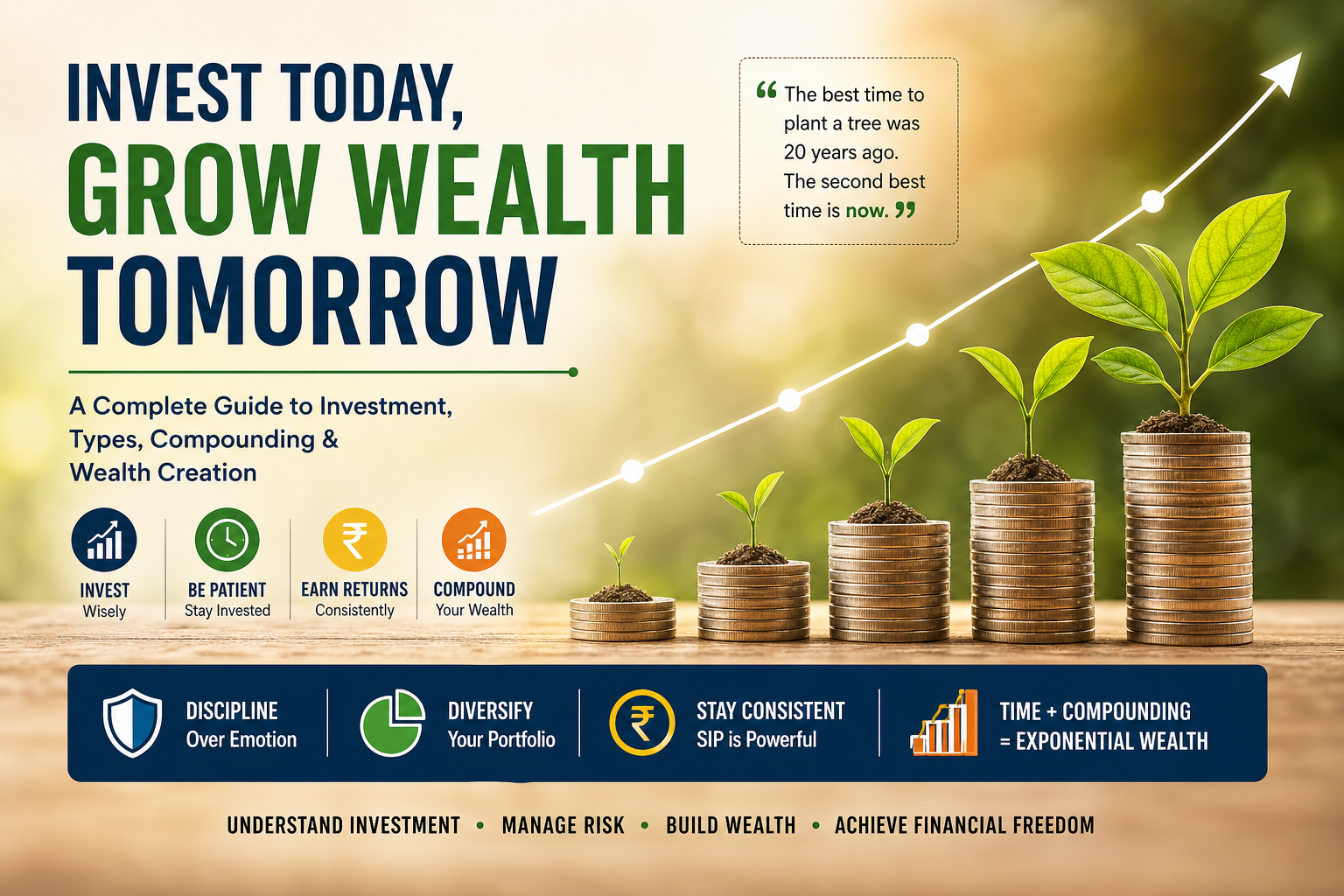
What is Investment?
Thank you for reading this post, don’t forget to subscribe!Investment refers to the allocation of money or resources into assets or ventures with the expectation of generating income, profit, or appreciation over time. Unlike mere saving, investment involves risk-taking with the goal of earning returns.
In simple terms:
Investment is putting your money to work so it can grow.
Investment and Wealth Creation: The Connection
Wealth creation is the process of accumulating assets over time. Investment is the primary engine that drives this process.
Without investment:
- Money loses value due to inflation
- Savings remain stagnant
With investment:
- Money grows through returns
- Returns generate further returns
- Wealth multiplies over time
Thus, investment transforms income into long-term financial security and prosperity.
How Investment Creates Wealth
Wealth creation through investment happens via three core mechanisms:
1. Capital Appreciation
The increase in the value of an asset over time
Example: Buying shares at ₹100 and selling at ₹200
2. Income Generation
Regular earnings from investments
- Dividends (stocks)
- Interest (bonds, FDs)
- Rent (real estate)
3. Reinvestment
Reinvesting returns leads to exponential growth
This is where compounding begins
Types / Kinds of Investment
Investments can be broadly classified as follows:
1. Financial Investments
- Stocks (Equity)
- Bonds (Debt instruments)
- Mutual Funds
- Exchange-Traded Funds (ETFs)
- Fixed Deposits (FDs)
- Public Provident Fund (PPF)
2. Real Assets
- Real Estate
- Gold & Precious Metals
- Commodities
3. Alternative Investments
- Cryptocurrencies
- Private Equity
- Hedge Funds
4. Hybrid Investments
- Balanced Mutual Funds
- REITs (Real Estate Investment Trusts)
Risk vs Return Trade-off
Every investment comes with a balance between risk and return:
| Investment Type | Risk Level | Return Potential |
| Fixed Deposits | Low | Low |
| Bonds | Low-Medium | Moderate |
| Mutual Funds | Medium | Moderate-High |
| Stocks | High | High |
| Crypto | Very High | Very High |
Higher returns usually require higher risk tolerance.
What is Compounding?
Compounding is the process where returns generated on an investment start earning returns themselves.
In simple words:
You earn returns not only on your money but also on your past returns.
How Compounding Creates Wealth
Compounding turns linear growth into exponential growth.
Example:
- Invest ₹10,000 at 10% annual return
- After 1 year → ₹11,000
- After 10 years → ₹25,937
- After 25 years → ₹1,08,347
Notice how growth accelerates over time.
Key Characteristics of the compounding Curve:
- Starts slow in initial years
- Gradually bends upward
- Becomes steep after long duration
This is why compounding is often called the “8th wonder of the world.”
Factors That Influence Wealth Creation
1. Time (Most Important)
The earlier you start, the greater the wealth
Time amplifies compounding
2. Rate of Return
Higher returns accelerate growth
3. Consistency
Regular investments (like SIPs) build wealth steadily
4. Discipline
Avoid emotional decisions and market timing
5. Inflation
Real wealth = Returns – Inflation
Popular Investment Strategies
1. Systematic Investment Plan (SIP)
- Regular investment in mutual funds
- Reduces market timing risk
2. Buy and Hold Strategy
- Long-term holding of quality assets
3. Diversification
- Spread investments across asset classes
4. Value Investing
- Buying undervalued assets
Common Mistakes to Avoid
- Delaying investments
- Lack of diversification
- Chasing quick profits
- Ignoring inflation
- Panic selling during market downturns
Role of Financial Planning in Wealth Creation
Investment without planning is incomplete. A good financial plan includes:
- Goal setting (short-term & long-term)
- Risk assessment
- Asset allocation
- Periodic review
Why Compounding is Powerful in India’s Context
In a growing economy like India:
- Equity markets offer long-term growth
- Young population → long investment horizon
- Increasing financial awareness
Early investors benefit the most.
Conclusion
Investment is not just about making money—it is about building sustainable wealth over time. The real magic lies in:
- Starting early
- Staying consistent
- Letting compounding work
Wealth is not created overnight—it is built patiently through disciplined investment.
Final Takeaway
“Don’t wait to invest. Invest and then wait.”
Leave a Reply