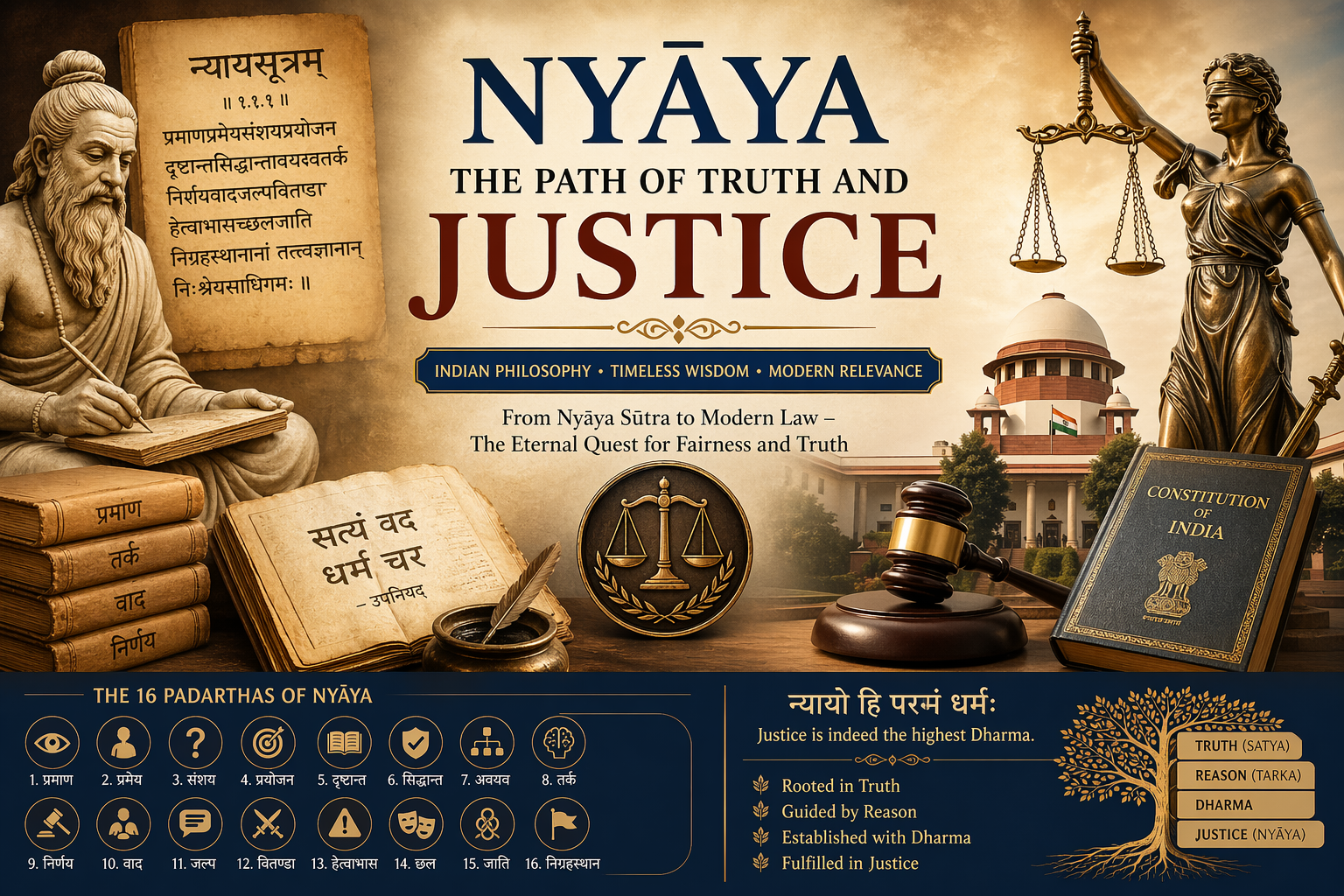
1. What is Justice? Is it synonymous with Nyāya?
Thank you for reading this post, don’t forget to subscribe!The English term Justice generally refers to fairness, equality, and adherence to law. The Sanskrit-Hindi term Nyāya (न्याय), however, carries a far deeper philosophical meaning.
Nyāya is not merely legal justice—it signifies:
- Logical reasoning
- Method of inquiry
- Moral correctness
- Truth-based judgment
Thus:
Justice ≈ Nyāya (in legal sense)
But Nyāya is broader—it is the science of reasoning that leads to truth and justice
2. Origin of Nyāya Philosophy
The Nyāya system was founded by Akshapada Gautama, the author of the Nyāya Sūtra.
Purpose of Nyāya:
- Attainment of true knowledge (Satya)
- Removal of ignorance (Avidyā)
- Achievement of liberation (Moksha)
Nyāya establishes that right knowledge is the foundation of justice
3. Meaning and Essence of Nyāya
The term Nyāya means:
- Rule or method
- Logical analysis
- Proper judgment
Core Principle:
Right Knowledge → Right Reasoning → Right Judgment → Justice
4. Nyāya Sūtra: The Foundational Text
The essence of Nyāya is captured in the famous opening aphorism:
Sanskrit Sūtra (Nyāya Sūtra 1.1.1):
“प्रमाणप्रमेयसंशयप्रयोजनदृष्टान्तसिद्धान्तावयवतर्कनिर्णयवादजल्पवितण्डाहेत्वाभासच्छलजातिनिग्रहस्थानानां तत्त्वज्ञानान्निःश्रेयसाधिगमः॥”
Meaning:
Knowledge of the sixteen categories leads to the attainment of the highest good (liberation).
5. The 16 Padārthas (Categories) of Nyāya
These sixteen categories form the backbone of reasoning and justice:
1. Pramāṇa (प्रमाण) – Means of valid knowledge
(Perception, inference, comparison, testimony)
2. Prameya (प्रमेय) – Object of knowledge
3. Saṁśaya (संशय) – Doubt
4. Prayojana (प्रयोजन) – Purpose or motive
5. Dṛṣṭānta (दृष्टान्त) – Example
6. Siddhānta (सिद्धान्त) – Established conclusion
7. Avayava (अवयव) – Structure of argument (five-step logic)
8. Tarka (तर्क) – Hypothetical reasoning
9. Nirṇaya (निर्णय) – Final conclusion
10. Vāda (वाद) – Truth-oriented debate
11. Jalpa (जल्प) – Debate for victory
12. Vitaṇḍā (वितण्डा) – Destructive criticism
13. Hetvābhāsa (हेत्वाभास) – Logical fallacy
14. Chala (छल) – Misinterpretation or trickery
15. Jāti (जाति) – Futile rejoinder
16. Nigrahasthāna (निग्रहस्थान) – Point of defeat
Key Insight:
These categories together create a complete system of logic, debate, and decision-making, forming the philosophical basis of justice.
6. Nyāya and Sources of Knowledge (Pramāṇa)
Nyāya recognizes four valid means of knowledge:
- Perception (Pratyakṣa)
- Inference (Anumāna)
- Comparison (Upamāna)
- Testimony (Śabda)
Example of Nyāya Logic:
“पर्वतो वह्निमान् धूमात्”
(The hill has fire because it has smoke)
Justice must rely on evidence-based reasoning
7. Nyāya in Vedas, Upanishads, and Vedānta
Though Nyāya developed later, its spirit exists in earlier traditions:
(A) Vedic Concept of Order (Ṛta)
“ऋतं सत्यं बृहद्”
Truth and cosmic order govern the universe.
(B) Upanishadic Teaching
From Brihadaranyaka Upanishad:
“सत्यं वद, धर्मं चर”
Speak truth, follow righteousness.
(C) Vedānta (Bhagavad Gītā)
In Bhagavad Gita:
“धर्मसंस्थापनार्थाय सम्भवामि युगे युगे” (4.8)
To restore Dharma, I manifest in every age.
Justice here is cosmic, moral, and spiritual
8. Nyāya, Dharma, and Justice: A Unified View
| Concept | Meaning |
| Nyāya | Logic and reasoning |
| Dharma | Moral duty |
| Justice | Fair application |
Indian philosophy integrates them as:
Nyāya → Dharma → Justice
9. Is Justice Absolute or Relative?
Justice is dynamic and context-dependent.
Over Time:
- Ancient: Duty-based (Dharma-centered)
- Medieval: Religious authority
- Modern: Rights and constitutional law
Nyāya itself supports reasoning and context, implying:
Justice evolves
It is partly relative
10. Nyāya and the Modern Justice System
Modern legal systems reflect Nyāya principles:
| Nyāya Concept | Modern Equivalent |
| Pramāṇa | Evidence |
| Tarka | Legal reasoning |
| Vāda | Court arguments |
| Nirṇaya | Judgment |
| Hetvābhāsa | Logical fallacies |
Courts today operate on Nyāya-like logical structures
11. Contemporary Perception of Justice
Today, justice is understood in multiple ways:
- Legal justice (courts, laws)
- Social justice (equality, inclusion)
- Moral justice (fairness)
Challenges:
- Delays in judiciary
- Inequality
- Subjective interpretations
Hence, people often perceive a gap:
Legal Justice ≠ Moral Justice
12. Philosophical Insight
Nyāya teaches:
Justice is not merely punishment or law
It is truth established through correct reasoning
13. Conclusion
Justice (Nyāya) in Indian philosophy is a comprehensive intellectual and ethical framework:
- Rooted in logic and knowledge
- Guided by Dharma
- Evolving with society
- Reflected in modern legal systems
Final Reflection:
“न्यायेन मार्गेण गच्छेत्”
Walk on the path of justice and truth.
Without truth, justice is incomplete.
Without reasoning, truth cannot be attained.
Leave a Reply