Introduction
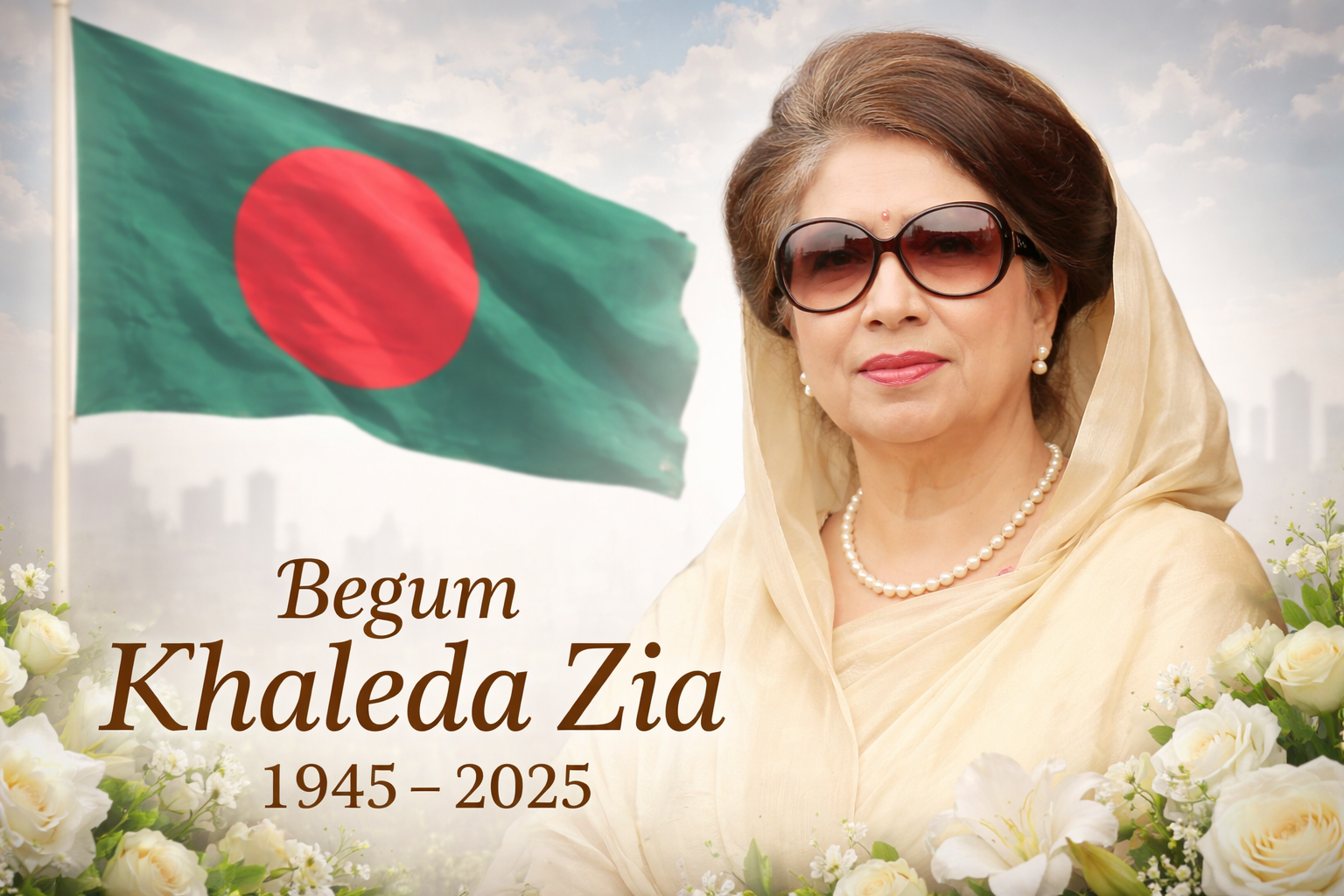
Thank you for reading this post, don’t forget to subscribe!Begum Khaleda Zia was a defining figure in Bangladesh’s political history — a woman who rose from relative obscurity to become the first female Prime Minister of a Muslim-majority democracy in South Asia. Her life was shaped by dramatic turns: tragic personal loss, political rivalry, democratic reform, controversy, imprisonment, and ultimately, her death on December 30, 2025 at the age of 80, which marked the close of one of the most consequential careers in Bangladeshi politics.
This blog explores her life story, political philosophy, policy toward India, her achievements and controversies, the return of her son Tarique Rahman from exile, and how the current religious and geopolitical dynamics in Bangladesh and South Asia are shaping up in the aftermath of her passing.
Early Life, Family & Education
Begum Khaleda Zia was born on 15 August 1945 in Dinajpur in undivided British India (now Bangladesh). There is slight historical uncertainty about her exact birth year, but sources generally place it in 1945.
- Parents: Iskandar Majumder and Taiyaba Majumder
- Early background: Middle-class family, far from political circles
- Education: She studied locally and attended Surendranath College in Dhaka but remained largely distant from student politics during her youth.
Her life took a dramatic turn when she married Major Ziaur Rahman, a decorated freedom fighter in Bangladesh’s 1971 Liberation War who later became President of Bangladesh. His assassination in 1981 catapulted her into the center of Bangladeshi politics.
Political Rise: From Widow to Leader of BNP
Khaleda Zia entered politics in 1984, becoming the chairperson of the Bangladesh Nationalist Party (BNP) — a party founded by her husband. This shift was less by choice and more driven by circumstances following her husband’s death and the political vacuum that formed afterwards.
She steadily emerged as a key opponent to military rule under General Hussain Muhammad Ershad, aligning briefly with opposition forces including Sheikh Hasina’s Awami League in the late 1980s to restore democracy.
Prime Ministership and National Governance
First Term (1991–1996)
Khaleda Zia became Prime Minister in 1991 after leading the BNP to victory in the first post-military rule democratic election. Her government:
- Restored parliamentary democracy under a reformed constitution
- Promoted economic liberalization and private sector participation
- Expanded education access, including free primary education and increases in female education participation
- Established macroeconomic reforms such as VAT, banking laws, and moves toward privatization.
Her tenure also ushered in landmark reforms to empower local governance and administrative decentralization.
Second and Subsequent Terms (1996–2006)
Khaleda Zia returned to power in 2001, partnering with ideological allies including Jamaat-e-Islami — a choice that later proved controversial. Her government faced serious challenges:
- Rising religious militancy and political violence
- A major grenade attack on opposition figures in 2004
- Growing criticism about law and order, governance, and electoral fairness
These issues tarnished her second term’s legacy, despite her continuing political appeal among nationalist voters.
Political Style and Philosophy
Khaleda Zia’s political approach blended Bangladeshi nationalism with a strong focus on sovereignty and democratic contestation. Her leadership style was often:
- High-intensity and confrontational, especially with political rivals
- Movement-based, relying on rallies, boycotts, and street politics
- Firmly rooted in party loyalty and tight control of BNP decision-making
This style sustained her mass appeal but also deepened political polarization in Bangladesh.
Controversies and Legal Battles
Khaleda Zia’s political journey was riddled with controversy, including:
- Multiple corruption convictions, especially over trust fund scandals
- Periods of imprisonment and house arrest, viewed by supporters as politically motivated
- Hostility with the Awami League government, which regularly targeted BNP leaders
Her fraught legal history reflected Bangladesh’s larger crisis of political recrimination and diminishing institutional neutrality.
Relationship and Policy Approach Toward India
Khaleda Zia’s approach toward India was shaped by deep caution and strategic restraint.
Perception of India
Her government often viewed India as a dominant regional presence, sometimes asserting undue influence in Bangladesh’s internal affairs — a perception common among nationalist factions in Dhaka.
Policy Implications
- Her tenure saw strained Indo–Bangladesh relations at times, especially on border management and trade tensions.
- However, towards the latter years of her influence, and especially in the period just before her death, the BNP’s posture softened, hinting at a more pragmatic and conciliatory stance with India.
This shift indicated evolving geopolitical priorities and a strategic reassessment ahead of upcoming electoral contests.
Return of Tarique Rahman: A New Political Chapter
In December 2025, Khaleda Zia’s elder son, Tarique Rahman, returned to Bangladesh after nearly 17–18 years of exile in London. He came back to lead the BNP ahead of a critical general election expected in February 2026 amid extraordinary political shifts.
His return followed the ousting of the long-ruling Awami League under Sheikh Hasina — who was sentenced to death in absentia in 2024 — and the establishment of an interim government led by Nobel laureate Muhammad Yunus.
Tarique has pledged unity across religious and social lines and positioned himself as a catalyst for democratic renewal. His leadership is expected to shape a more inclusive BNP strategy while moderating the hardline positions of earlier years.
Current Political Context: Interim Government & Elections
Bangladesh today finds itself in a fragile transitional phase:
- The interim government under Nobel Laureate Muhammad Yunus is steering the country toward elections after political unrest and a shift in power dynamics.
- The Awami League remains sidelined, with its leadership in exile or legally constrained, raising serious questions about electoral competitiveness.
This volatile landscape blends hope for democratic renewal with uncertainty over institutional integrity and political fairness.
Rising Religious Fundamentalism and Minorities
A growing concern in Bangladesh — as in parts of South Asia — is the rise of religious fundamentalism:
- Groups like Hefazat-e-Islam have expanded influence, sometimes expressing ideological solidarity with conservative elements across the region.
- This trend has heightened anxiety among religious minorities — particularly Hindus, Buddhists, and Christians — about their cultural and political rights.
- For India and regional geopolitics, this dynamic complicates shared priorities on secular governance, border stability, and communal harmony.
Balancing secular democratic traditions with pressures from conservative forces will be a litmus test for Bangladesh’s next political generation.
Legacy: Bengali Nationalism, Polarisation & Political Culture
Begum Khaleda Zia’s legacy is complex:
Contributions
- A trailblazer for women in Muslim-majority democracies
- Instrumental in restoring parliamentary democracy after military rule
- A charismatic opposition leader who maintained BNP’s prominence for decades
Critiques
- Leadership often amplified political polarization
- Controversial alliances and sporadic governance lapses tarnished her record
- Persistent legal battles consumed much of her later life
Her death on 30 December 2025 marked not just the passing of a leader but the close of a defining chapter in Bangladesh’s political evolution that intertwined personal sacrifice, political struggle, and national transformation.
Conclusion
Begum Khaleda Zia lived a life entwined with the heartbeats of Bangladesh’s modern political journey. From her dramatic entry into politics and repeated returns to power, to her legal struggles and eventual passing, she shaped — and was shaped by — the turbulent politics of her nation. The BNP’s future under Tarique Rahman, alongside the advancing challenges of religious extremism and democratic consolidation, will be the next test for Bangladesh. India and the broader South Asian region will watch closely, as Dhaka’s political currents invariably ripple outward.
Leave a Reply