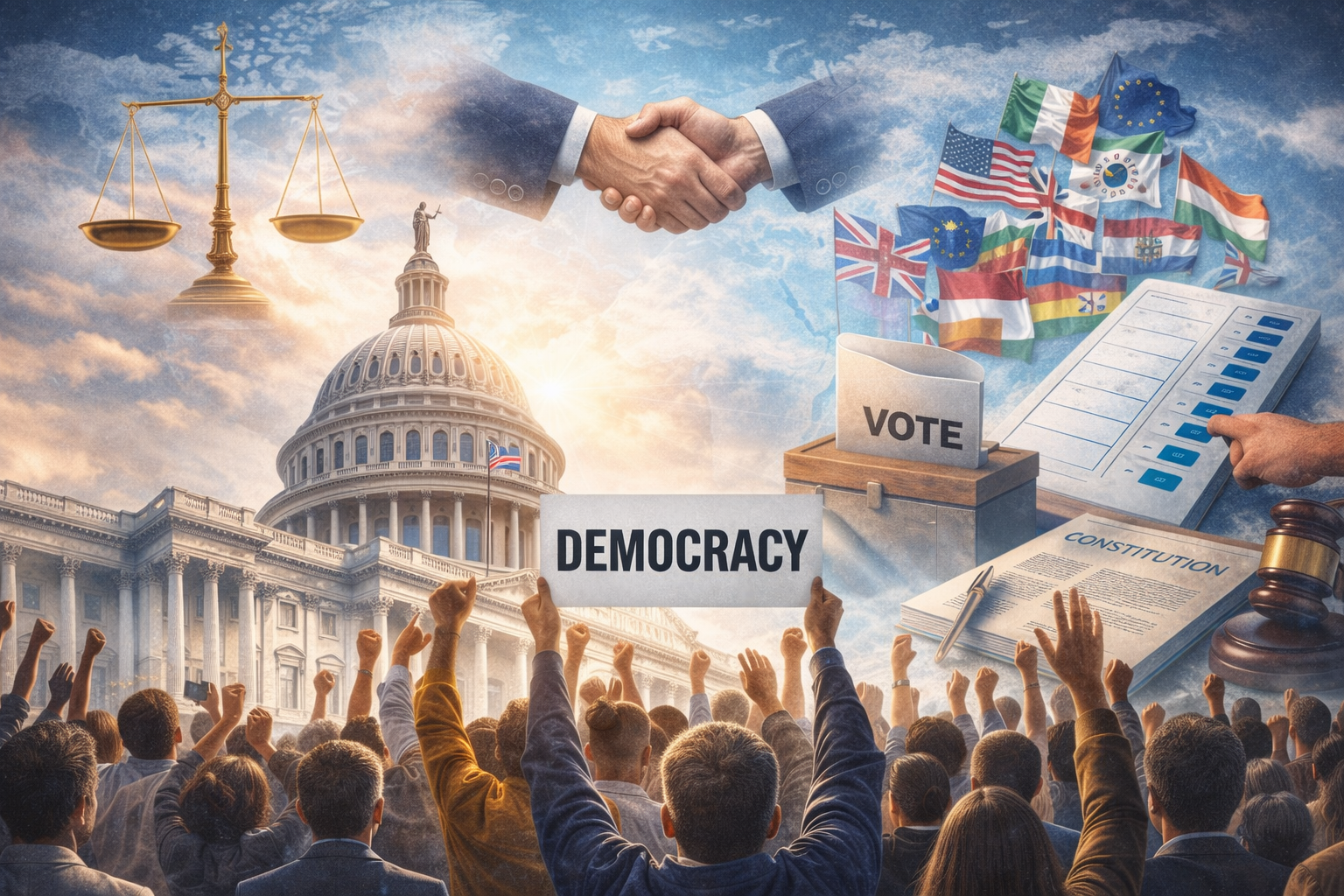
Introduction: Democracy as an Ever-Evolving Idea
Thank you for reading this post, don’t forget to subscribe!Democracy is more than a system of governance—it is a philosophy of power, a belief that legitimate authority flows from the consent of the governed. From the city-states of ancient Greece to modern constitutional democracies, democracy has continuously evolved, adapting to social change, technological advancement, and global power shifts.
Yet, democracy today faces unprecedented challenges—rising authoritarianism, democratic backsliding, misinformation, and geopolitical polarization. To understand its resilience and relevance, it is essential to examine its intellectual foundations, functional strengths, weaknesses, and future trajectory.
I. Defining Democracy: From Ancient to Modern Thinkers
1. Classical Definitions
“Democracy is when the indigent, and not the men of property, are the rulers.”
— Aristotle, Politics (4th century BCE)
Aristotle viewed democracy descriptively rather than normatively, identifying it as rule by the many—particularly the poor. He acknowledged its inclusiveness but warned against mob rule if unchecked by law.
“Our constitution is called a democracy because power is in the hands not of a minority but of the whole people.”
— Pericles, Funeral Oration (5th century BCE)
This early articulation linked democracy with equality before law and civic participation, forming the moral foundation of popular sovereignty.
2. Enlightenment and Modern Political Thought
“The legislative authority… belongs to the people.”
— John Locke, Two Treatises of Government (1689)
Locke’s conception of democracy emphasized consent, natural rights, and limited government, shaping liberal democratic thought.
“Democracy is the government of the people, by the people, for the people.”
— Abraham Lincoln, Gettysburg Address (1863)
Perhaps the most cited definition, Lincoln’s formulation highlights popular participation, representation, and welfare orientation.
“Democracy is a system in which rulers are selected by competitive elections.”
— Joseph Schumpeter, Capitalism, Socialism and Democracy (1942)
Schumpeter offered a minimalist, procedural definition—democracy as an institutional method rather than a moral ideal.
3. Contemporary Scholarly Definitions
“Democracy requires effective participation, voting equality, enlightened understanding, and control of the agenda.”
— Robert A. Dahl, On Democracy (1998)
Dahl broadened democracy beyond elections to include inclusion, information, and accountability.
“Democracy is a form of government in which rulers are held accountable to the ruled.”
— Adam Przeworski
This definition highlights democracy’s core strength: peaceful removal of power through institutional means.
II. Facets and Forms of Democracy
Democracy manifests in multiple forms:
- Direct Democracy – Citizens directly participate in decision-making (e.g., referendums).
- Representative Democracy – Elected representatives govern on behalf of citizens.
- Liberal Democracy – Combines democracy with constitutionalism, rule of law, and rights.
- Participatory Democracy – Emphasizes continuous citizen engagement beyond elections.
- Deliberative Democracy – Focuses on rational public discourse and consensus-building.
Each form reflects different societal needs and institutional capacities.
III. Why Democracy Is Considered the Best System of Governance
1. Political Legitimacy
Democracy derives authority from popular consent, making laws and institutions morally and politically legitimate.
2. Accountability and Transparency
Regular elections, free media, and independent institutions allow citizens to hold rulers accountable—something absent in authoritarian systems.
3. Protection of Rights
Democratic systems institutionalize civil liberties, minority rights, and human dignity, unlike totalitarian or autocratic regimes.
4. Peaceful Conflict Resolution
Democracy provides institutional mechanisms—courts, elections, legislatures—to resolve conflicts without violence.
5. Adaptive Governance
Democracies correct themselves through reforms, judicial review, and public pressure, making them more resilient over time.
In comparison:
- Authoritarian regimes may be efficient but lack accountability.
- Monarchies rely on heredity, not merit or consent.
- Military regimes prioritize order over liberty.
- Theocracies restrict pluralism and dissent.
IV. Challenges to Democracy in the Modern Era
1. Democratic Backsliding
Many democracies face erosion of institutions, weakening of checks and balances, and concentration of power.
2. Populism and Polarization
Populist leaders often undermine democratic norms by delegitimizing opposition, media, and courts.
3. Misinformation and Digital Manipulation
Social media has amplified fake news, echo chambers, and foreign interference, distorting public opinion.
4. Economic Inequality
Growing inequality reduces meaningful participation, turning democracy into a formal but unequal system.
5. Voter Apathy and Declining Trust
Low turnout and distrust in institutions weaken democratic legitimacy.
V. Democracy in the Present World Order and Geopolitics
The global democratic landscape is under pressure:
- Rising authoritarian powers challenge democratic norms internationally.
- Strategic narratives promote “efficiency over freedom.”
- Democracy is increasingly framed as slow or chaotic in crisis situations.
Yet, democratic alliances remain central to global governance—trade, climate action, human rights, and peacebuilding.
VI. The Future of Democracy: Decline or Reinvention?
Democracy’s future will depend on its ability to adapt:
Key Pathways Forward
- Institutional reforms to improve transparency and efficiency
- Digital democracy with safeguards against manipulation
- Civic education to strengthen democratic culture
- Inclusive growth to reduce economic disparities
- Global democratic cooperation to counter authoritarian influence
Democracy may not be perfect, but history shows it is the most self-correcting system ever devised.
Conclusion: Democracy as a Living Process
Democracy is not a destination but a continuous process of negotiation between power and people. Its strength lies not in the absence of conflict, but in its capacity to manage conflict peacefully and justly.
As Winston Churchill famously observed:
“Democracy is the worst form of government—except for all the others.”
In a fractured world order, democracy remains humanity’s most credible hope for freedom, dignity, and accountable governance.
Leave a Reply