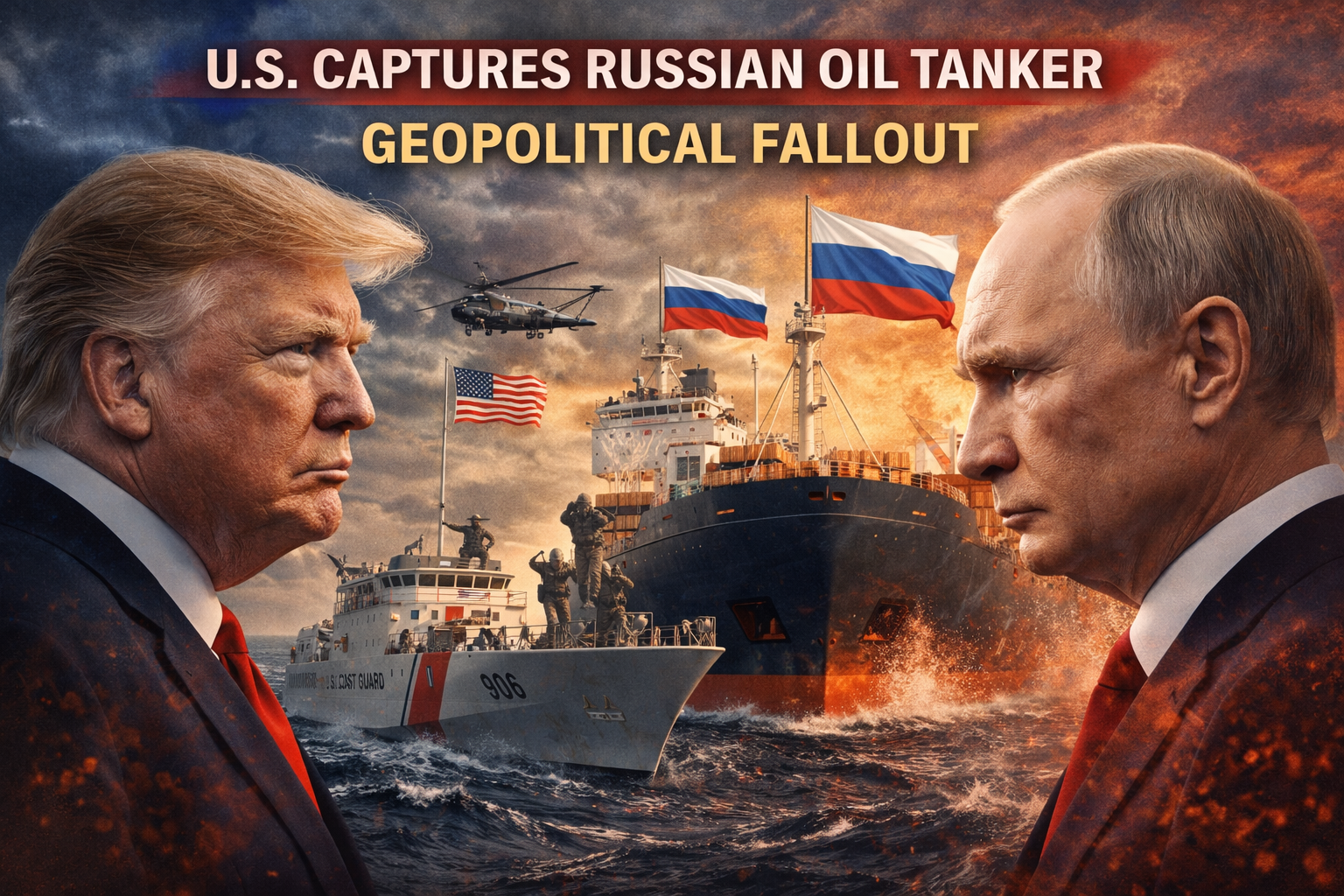
In early January 2026, U.S. forces captured a Russian-flagged oil tanker, the Marinera (previously Bella-1), in the North Atlantic after a weeks-long pursuit. The operation involved the U.S. Coast Guard, Navy, and support from the United Kingdom, and marked an unusually direct enforcement action against a vessel linked to a major power on the high seas.
Thank you for reading this post, don’t forget to subscribe!This event is far more than a dramatic naval episode; it is a flashpoint with deep geopolitical implications. From maritime law to international sanctions regimes and the balance of power between great powers, the seizure is resonating across capitals and impacting global perceptions of order, sovereignty, and enforcement norms.
What Happened: A Brief Recap
The U.S. seized the Marinera after a prolonged chase across the Atlantic. Originally under a sanctionable role—transporting Venezuelan and possibly Iranian oil—it reportedly tried to elude U.S. enforcement by changing names and flags, including obtaining Russian registration. U.S. authorities argue this justified seizure under sanctions enforcement, while Russia asserts the action violated international law governing high seas navigation.
International Law and Maritime Sovereignty
One of the most contentious aspects of the incident is its relation to maritime law:
Freedom of the Seas vs. Sanctions Enforcement
Under the United Nations Convention on the Law of the Sea, vessels legitimately registered under a state’s flag enjoy protections on the high seas. Russia has condemned the seizure as a violation of this principle and rejected U.S. claims that sanctions justify force against foreign-flagged vessels.
This raises critical questions:
- Can unilateral sanctions justify military seizure on international waters?
- Does enforcement of economic penalties translate into enforcement of maritime jurisdiction?
If the answer shifts toward broad sanction enforcement rights, the longstanding norm of freedom of navigation may be reinterpreted by larger powers, unsettling smaller states that rely on these protections.
Great Power Tensions: U.S.–Russia Dynamics
The tanker seizure has understandably intensified tensions between Washington and Moscow:
1. Moscow’s Response
Russia has described the operation as tantamount to “maritime piracy” and an unlawful use of force against a ship allegedly registered under its flag. Moscow has demanded the immediate return of the vessel and humane treatment of its crew.
Russian lawmakers have warned of retaliatory measures, including threats ranging from military counter-actions to broader strategic responses. Some rhetoric even suggests a readiness to escalate militarily if perceived national interests are threatened.
2. Potential for Direct Confrontation
Although direct naval clashes have thus far been avoided, the fact that Russian naval assets—including submarines—shadowed the tanker before its capture reflects how close this standoff came to a kinetic confrontation at sea.
This incident therefore acts as a harbinger of how miscalculations could escalate in futures where sanctions enforcement and power projection overlap.
Allies, Partnerships, and Global Perceptions
The United Kingdom’s support for the operation—providing surveillance aircraft and naval assistance—signals a strengthening of trans-Atlantic security ties, but not without controversy. European leaders are navigating a tricky diplomatic path: endorsing sanctions and pressure on Russia while also voicing concerns about unilateral actions that may undermine international norms.
Some countries, especially those outside the Western alliance system, view the event as evidence of increasing U.S. unilateralism. Beijing, Tehran, and Havana have criticised the seizure as an overreach of American power and an infringement on sovereignty.
Developing nations, particularly those reliant on maritime trade, are watching closely because of:
- Implications for freedom of navigation
- Precedent for sanctions enforcement across global waters
- Risks to commercial shipping insurance and trade flows
Oil Markets and Global Trade Risks
Even though the immediate supply impact of the Marinera capture on global oil markets appears limited, the broader signal is significant:
- Higher insurance premiums for tankers
- Shipping reroutes to avoid interception risk
- Hesitancy among carriers to engage with sanctioned states
This increases costs and uncertainty for global supply chains, particularly in energy-dependent economies. It also sharpens the geopolitical dimension of energy security.
A Test of International Order?
At its core, this incident tests two competing frameworks of global regulation:
1. Traditional Order
Based on:
- Respect for territorial sovereignty
- Freedom of navigation
- Multilateral dispute resolution
2. Sanctions-Driven Enforcement
Driven by:
- Broad interpretation of national sanctions
- Enforcement beyond borders
- Power projection under legal pretexts
The clash of these models plays out in real time on the open ocean—a symbolic and literal boundary for global norms.
What the World Is Watching
Different regional and global actors interpret the seizure through their own strategic lenses:
- European Union: Concerned about destabilising precedents while balancing pressure on Russia.
- Middle Eastern States: Question the extrapolation of sanctions enforcement to naval action.
- Asia (China, India): Observing cautionary lessons as they navigate their own energy and trade dependencies.
- Global South: Voicing alarm at perceived big-power overreach that could erode sovereign rights.
There is a growing consensus that unilateral enforcement of sanctions on the high seas introduces new risks for international relations, particularly in an era of heightened geopolitical competition.
Conclusion: A Watershed Moment on the High Seas
The U.S. seizure of a Russian-flagged oil tanker in the Atlantic Ocean is far more than a tactical victory in sanctions enforcement. It reflects:
- Evolving interpretations of maritime law
- A shift toward coercive international policy instruments
- Deepening U.S.–Russia rivalry
- Stress on existing global governance norms
In an age where economic sanctions are increasingly weaponised and geopolitical competition intensifies, this event serves as a stark reminder: the seas, once considered neutral spaces governed by collective law, are now arenas of power politics and strategic signalling.
How nations choose to interpret and respond to this incident will shape future norms of maritime sovereignty and international conflict management in the 21st century.
Leave a Reply