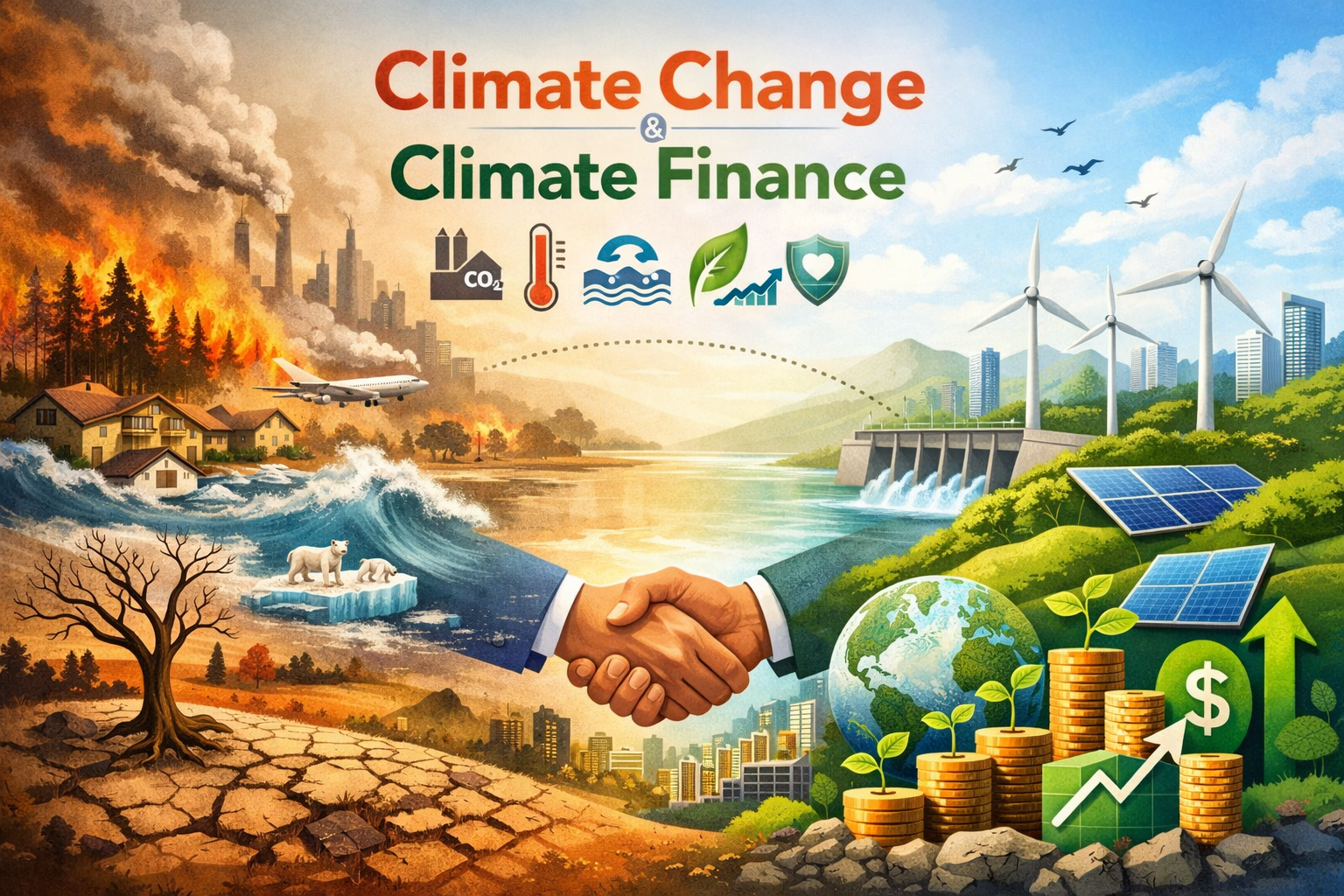
Climate change is no longer a distant environmental concern—it is a defining challenge of the 21st century. From record-breaking heatwaves to devastating floods, rising sea levels, and prolonged droughts, its effects are visible across continents. Scientific consensus, particularly under the guidance of the Intergovernmental Panel on Climate Change (IPCC), confirms that human activities—especially the burning of fossil fuels, deforestation, and unsustainable industrial practices—are driving unprecedented increases in greenhouse gas (GHG) concentrations in the atmosphere.
Thank you for reading this post, don’t forget to subscribe!Addressing climate change requires not only environmental awareness but also large-scale financial transformation. This is where climate finance becomes critical. By channelling funds toward low-carbon development and climate resilience, climate finance bridges the gap between ambition and action.
Understanding Climate Change: Causes and Consequences
1. Primary Drivers
- Fossil fuel combustion (coal, oil, and gas)
- Deforestation and land-use change
- Industrial agriculture and methane emissions
- Rapid urbanization and infrastructure expansion
These activities increase atmospheric concentrations of carbon dioxide (CO₂), methane (CH₄), and nitrous oxide (N₂O), intensifying the greenhouse effect.
2. Impacts Across Sectors
a. Environmental Impacts
- Melting glaciers and polar ice caps
- Biodiversity loss and ecosystem collapse
- Ocean acidification
b. Economic Impacts
- Agricultural productivity decline
- Infrastructure damage due to extreme events
- Increased insurance and disaster recovery costs
c. Social Impacts
- Climate-induced migration
- Health crises (heat stress, vector-borne diseases)
- Rising inequality, especially in vulnerable communities
Climate change disproportionately affects developing countries, despite their lower historical emissions. This imbalance underscores the need for climate justice and financial solidarity.
Global Climate Commitments: The Policy Framework
International climate action gained momentum through the Paris Agreement adopted at United Nations Framework Convention on Climate Change (UNFCCC). The agreement aims to:
- Limit global temperature rise to well below 2°C, preferably 1.5°C above pre-industrial levels
- Strengthen adaptive capacity
- Align financial flows with low-emission, climate-resilient pathways
In parallel, climate action is embedded in the United Nations Sustainable Development Goals (SDGs), especially SDG 13 (Climate Action).
However, commitments alone are insufficient without financing mechanisms to operationalize them.
What Is Climate Finance?
Climate finance refers to local, national, or transnational funding—drawn from public, private, and alternative sources—aimed at supporting mitigation and adaptation efforts.
It serves three core purposes:
- Mitigation – Reducing or preventing GHG emissions
- Adaptation – Adjusting systems to withstand climate impacts
- Loss and Damage – Addressing irreversible climate harm
How Climate Finance Supports Mitigation
Mitigation focuses on reducing emissions to slow global warming. Climate finance supports mitigation through:
1. Renewable Energy Investment
- Solar, wind, hydro, and green hydrogen projects
- Grid modernization and energy storage
- Decentralized clean energy access in rural areas
2. Energy Efficiency
- Green buildings
- Smart cities
- Efficient industrial processes
3. Sustainable Transport
- Electric vehicles (EVs)
- Public transportation infrastructure
- Rail and non-motorized mobility
4. Nature-Based Solutions
- Afforestation and reforestation
- Wetland restoration
- Carbon sequestration initiatives
Instruments such as green bonds, sustainability-linked loans, and carbon markets have emerged as key tools for channelling private capital toward mitigation projects.
Climate Finance and Adaptation: Building Resilience
While mitigation addresses the root causes, adaptation strengthens systems against unavoidable impacts.
1. Climate-Resilient Infrastructure
- Flood-resistant roads and bridges
- Cyclone shelters
- Climate-proof housing
2. Climate-Smart Agriculture
- Drought-resistant crops
- Efficient irrigation systems
- Agroforestry practices
3. Disaster Risk Reduction
- Early warning systems
- Coastal protection barriers
- Insurance mechanisms
Adaptation finance is especially crucial for Least Developed Countries (LDCs) and Small Island Developing States (SIDS), where climate impacts threaten survival.
Loss and Damage: Addressing Irreversible Impacts
Even with mitigation and adaptation, some damages are unavoidable. At recent climate negotiations, countries agreed to operationalize a Loss and Damage Fund to assist vulnerable nations facing irreversible destruction from climate disasters.
This marks a historic step toward recognizing climate responsibility and equity.
Sources of Climate Finance
Climate finance flows from multiple channels:
1. Public Finance
- Multilateral development banks (MDBs)
- Bilateral aid agencies
- Climate funds such as the Green Climate Fund
2. Private Finance
- Institutional investors
- Commercial banks
- Impact investment funds
3. Innovative Mechanisms
- Carbon pricing and emissions trading systems
- Blended finance (public-private partnerships)
- Sovereign green bonds
Mobilizing private capital is essential because public funds alone cannot meet the estimated trillions of dollars required annually for climate transition.
Key Challenges in Climate Finance
Despite progress, significant barriers remain:
1. Financing Gap
Developing countries require trillions annually, yet actual flows remain far below pledged amounts.
2. Access Constraints
Smaller and vulnerable countries often lack institutional capacity to access complex funding mechanisms.
3. Imbalance Between Mitigation and Adaptation
Mitigation receives the majority of funding, while adaptation—critical for vulnerable nations—remains underfunded.
4. Greenwashing Risks
Weak regulatory frameworks may allow investments labelled “green” without meaningful climate benefits.
Strengthening transparency, accountability, and monitoring systems is therefore essential.
The Role of Carbon Markets
Article 6 of the Paris Agreement enables countries to trade emission reductions. Well-regulated carbon markets can:
- Lower mitigation costs
- Encourage innovation
- Channel funds to developing countries
However, environmental integrity and social safeguards must be ensured to prevent exploitation.
Climate Finance and Sustainable Development
Climate finance is not only about emissions—it intersects with:
- Poverty reduction
- Gender equality
- Energy access
- Health security
- Food security
When aligned with national development strategies, climate finance accelerates green growth and job creation, particularly in renewable energy and sustainable infrastructure sectors.
The Way Forward: Scaling Climate Finance
To make climate finance transformative, several actions are necessary:
1. Align Global Financial Systems
Financial institutions must integrate climate risk into lending and investment decisions.
2. Reform Multilateral Development Banks
Enhance concessional financing and reduce borrowing costs for vulnerable nations.
3. Strengthen Domestic Financial Systems
Develop green taxonomies, sustainable finance frameworks, and climate budgeting.
4. Enhance Transparency and Accountability
Standardized reporting frameworks can prevent greenwashing and improve impact measurement.
5. Promote Just Transition
Ensure workers and communities dependent on fossil fuels are supported through retraining and social protection measures.
Conclusion: Finance as the Engine of Climate Action
Climate change is fundamentally a development and economic challenge as much as it is an environmental one. Science provides the warnings. Policy sets the direction. But finance drives implementation.
Climate finance, when mobilized at scale and allocated equitably, can:
- Reduce emissions
- Protect vulnerable populations
- Strengthen economic resilience
- Accelerate sustainable development
The global transition to a low-carbon and climate-resilient future is not optional—it is imperative. The question is not whether we can afford climate finance, but whether we can afford to delay it.
The coming decade will determine whether financial systems evolve fast enough to safeguard both the planet and future generations.
Leave a Reply