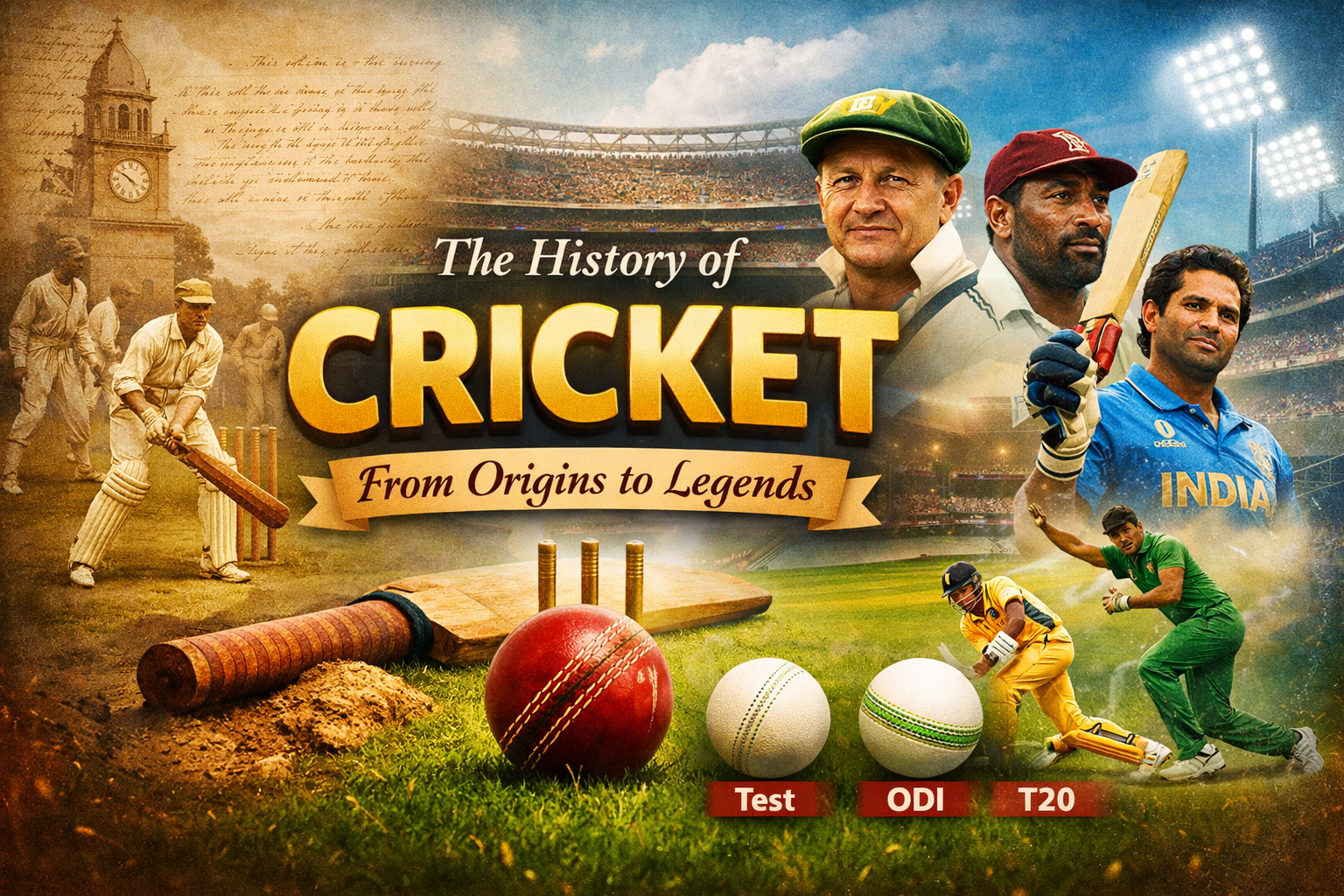
Introduction
Thank you for reading this post, don’t forget to subscribe!Cricket is not just a sport—it is an emotion, a culture, and in many countries like India, almost a religion. Played and watched by billions, cricket has evolved dramatically from a simple rural pastime into a highly commercialized global sport.
Origin and Discovery of Cricket
Cricket originated in southeast England during the late 16th century. There is no single “discoverer” of cricket—it evolved organically as a children’s game played in villages.
- The earliest references date back to 1598
- It was likely played by shepherds using a stick and ball
- By the 17th century, it became popular among adults
The first known international match was played in 1844 between United States and Canada.
Evolution of Cricket Over Time
1. Early Development (1600–1800)
- Transition from a rural game to an organized sport
- Formation of early cricket clubs
- Codification of rules
2. Colonial Expansion (1800–1900)
- Spread by the British Empire to:
- India
- Australia
- South Africa
3. International Era (1900–1970)
- Rise of Test cricket
- Formation of International Cricket Council (ICC)
4. Modern Era (1970–Present)
- Introduction of limited-overs cricket
- Commercial leagues like Indian Premier League (IPL)
🌐 How Many Countries Play Cricket Today?
As of today:
- 12 Full Member nations (Test-playing countries)
- Over 90 Associate Members
- Cricket is played in 100+ countries globally
Top cricket nations include:
- India
- England
- Australia
- Pakistan
Basics of Cricket
Objective
Score more runs than the opponent.
Players
- 11 players per team
Key Components
- Bat
- Ball
- Wicket (3 stumps)
Basic Rules
- Runs are scored by hitting the ball and running between wickets
- A batsman is out in several ways (bowled, caught, LBW, etc.)
- Teams alternate between batting and bowling
Evolution of Cricket Formats
1. Test Cricket (Traditional)
- Duration: 5 days
- Introduced in 1877
2. One Day Internationals (ODIs)
- Duration: ~8 hours
- Introduced in 1971
3. T20 Cricket
- Duration: ~3 hours
- Introduced in early 2000s
Changes in Last 25 Years
Cricket has transformed significantly:
Faster Formats
- Rise of T20 leagues like IPL
- Increased focus on entertainment
Commercialization
- Massive broadcasting deals
- Player auctions and sponsorships
Technology
- DRS (Decision Review System)
- Hawk-Eye tracking
Global Reach
- Expansion to new markets like United States and Afghanistan
Top 20 All-Time Cricket Legends
Here are some of the greatest players in cricket history:
- Sir Don Bradman
- Sachin Tendulkar
- Virat Kohli
- Jacques Kallis
- Ricky Ponting
- Brian Lara
- Muttiah Muralitharan
- Shane Warne
- Wasim Akram
- Imran Khan
- Kapil Dev
- Sunil Gavaskar
- Rahul Dravid
- Adam Gilchrist
- AB de Villiers
- MS Dhoni
- Kumar Sangakkara
- Steve Waugh
- Glenn McGrath
- Anil Kumble
Interesting Facts About Cricket
- Cricket is the second most popular sport globally after football
- The longest match lasted 12 days (timeless Test)
- Sachin Tendulkar is the only player with 100 international centuries
- The first Cricket World Cup was held in 1975
- Indian Premier League is among the richest sports leagues globally
Conclusion
Cricket’s journey from a humble English pastime to a global sporting giant reflects not just the evolution of a game, but also cultural exchange, technological advancement, and commercial growth. Today, it unites millions across continents, transcending boundaries and generations.
Leave a Reply