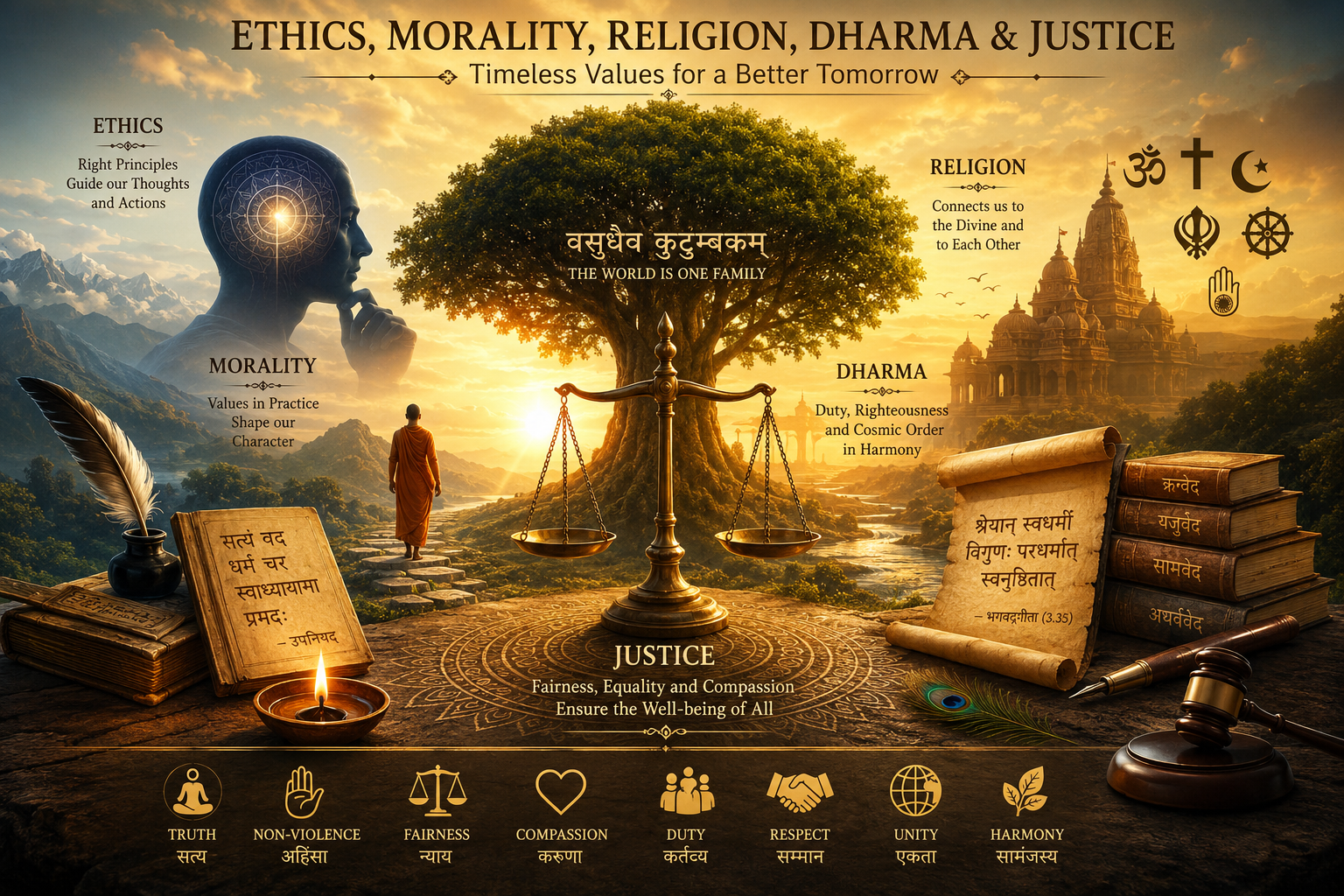
Introduction
Thank you for reading this post, don’t forget to subscribe!Human civilization has advanced remarkably in science, technology, economy, and governance. Yet one fundamental question remains as important as ever: How should human beings live?
This question has occupied philosophers, saints, lawgivers, and thinkers across civilizations. Concepts such as ethics, morality, religion, dharma, and justice emerged as guiding principles to regulate human life, preserve social order, and give deeper meaning to existence.
In the modern world—marked by artificial intelligence, consumerism, political polarization, ecological crisis, and mental unrest—these ancient principles are not obsolete. Rather, they have become more urgent.
India’s civilizational wisdom, rooted in the Vedas, Upanishads, Bhagavad Gita, Buddhist, Jain, and Sikh traditions, offers profound insights into these concepts.
This article explores these ideas comprehensively.
1. What is Ethics?
The word ethics comes from the Greek word ethos, meaning character.
Ethics refers to the systematic study of right and wrong conduct. It provides principles that guide human action.
Ethics asks:
- What is the right thing to do?
- What is good life?
- What is virtue?
- What are our duties?
Nature of Ethics
Ethics is:
- Rational
- Universal
- Reflective
- Normative
Unlike personal opinions, ethics seeks objective principles.
Types of Ethics
A. Normative Ethics
Deals with standards of conduct.
Examples:
- Duty-based ethics (Immanuel Kant)
- Consequentialism (Jeremy Bentham)
- Virtue ethics (Aristotle)
B. Applied Ethics
Practical fields:
- Bioethics
- Environmental ethics
- AI ethics
- Business ethics
Indian Perspective on Ethics
In Indian philosophy, ethics is deeply linked with dharma.
The Mahabharata says:
“धारणाद्धर्म इत्याहुर्धर्मो धारयति प्रजाः”
(That which sustains society is Dharma.)
Thus ethics is not merely individual but cosmic and social.
2. What is Morality?
Morality refers to actual beliefs, values, and practices regarding right and wrong.
If ethics is theory, morality is practice.
For example:
- Ethics says lying is wrong.
- Morality is when a person chooses truth.
Characteristics of Morality
- Personal
- Cultural
- Socially conditioned
- Emotional
Morality in Indian Thought
The famous Upanishadic injunction:
“सत्यं वद, धर्मं चर”
(Speak truth, practice righteousness.)
Morality begins with self-discipline.
In Yoga philosophy of Patanjali, morality begins with:
- Ahimsa (non-violence)
- Satya (truth)
- Asteya (non-stealing)
- Brahmacharya (self-control)
- Aparigraha (non-possessiveness)
These are called Yamas.
3. What is Religion?
Religion is an organized system of faith, worship, beliefs, and spiritual practices connecting humans to the divine.
The Latin root religare means “to bind.”
Religion binds:
- Human to God
- Human to society
- Human to higher purpose
Functions of Religion
- Gives meaning to life
- Provides moral code
- Builds community
- Offers hope
Indian Understanding of Religion
In India, religion is broader than belief.
Sanatana tradition includes:
- Knowledge
- Conduct
- Duty
- Liberation
The Bhagavad Gita says:
“यदा यदा हि धर्मस्य ग्लानिर्भवति…”
Religion in Indian tradition is less about conversion and more about realization.
4. What is Dharma?
Dharma is one of the deepest concepts in Indian philosophy.
It cannot be translated fully into English.
Dharma means:
- Duty
- Righteousness
- Cosmic order
- Law of being
- Essential nature
Fire’s dharma is to burn.
Water’s dharma is to flow.
Human dharma is to live truthfully.
Types of Dharma
- Svadharma (personal duty)
- Rajdharma (duty of ruler)
- Samaj Dharma (social duty)
- Sanatan Dharma (eternal principles)
In Bhagavad Gita:
“श्रेयान् स्वधर्मो विगुणः”
(Better one’s own duty imperfectly done.)
Why Dharma is Unique
Unlike religion, dharma is dynamic and contextual.
It asks:
“What is right in this situation?”
This makes it highly relevant today.
5. What is Justice?
Justice means fairness, equality, rights, and proper order.
It concerns:
- Distribution of resources
- Punishment
- Rights
- Duties
Types of Justice
A. Distributive Justice
Fair distribution.
B. Corrective Justice
Rectifying wrongs.
C. Social Justice
Eliminating inequality.
D. Procedural Justice
Fair processes.
Justice in Indian Thought
Ancient India linked justice to Rajdharma.
In Arthashastra, Chanakya emphasizes:
The king’s duty is public welfare.
Justice was not merely legal but moral.
Modern India’s Constitution reflects this:
- Justice
- Liberty
- Equality
- Fraternity
These values echo ancient wisdom.
Difference Between Ethics, Morality, Religion, Dharma and Justice
| Concept | Meaning | Scope |
| Ethics | Principles of right conduct | Philosophical |
| Morality | Personal practice of right conduct | Individual |
| Religion | Faith-based system | Spiritual/social |
| Dharma | Duty and cosmic order | Universal/contextual |
| Justice | Fairness and rights | Social/legal |
They overlap but are distinct.
Indian Knowledge Tradition (IKS) on These Concepts
India’s knowledge system integrates all these seamlessly.
A. Vedic Thought
ऋत (Rta) = cosmic order
Dharma emerged from Rta.
B. Upanishadic Wisdom
“ईशावास्यमिदं सर्वम्”
Everything is interconnected.
Hence ethics becomes ecological.
C. Bhagavad Gita
The Gita synthesizes:
- Duty
- Ethics
- Justice
- Spirituality
It teaches Nishkama Karma (selfless action).
D. Buddhism
Gautama Buddha taught:
- Right action
- Right speech
- Compassion
Morality is central.
E. Jain Philosophy
Mahavira emphasized:
- Ahimsa
- Aparigraha
- Anekantavada
Highly relevant in violent modern societies.
F. Sikh Philosophy
Guru Nanak taught:
- Honest living
- Equality
- Service
Relevance in Modern Times
1. In Politics
Corruption grows when ethics decline.
Justice sustains democracy.
2. In Technology
AI needs ethics.
Without moral limits, technology can harm humanity.
3. In Business
Profit without ethics creates exploitation.
Ethical capitalism is essential.
4. In Family Life
Morality builds trust.
Truth sustains relationships.
5. In Environment
Indian philosophy teaches reverence for nature.
This is crucial for climate change.
6. In Global Peace
Religious intolerance creates conflict.
Dharma teaches coexistence.
“वसुधैव कुटुम्बकम्”
(The world is one family.)
This ancient Indian idea is modern humanity’s need.
Challenges in Modern Society
Despite their importance:
- Consumerism weakens morality
- Materialism reduces spirituality
- Identity politics distorts religion
- Legalism ignores justice
- Individualism weakens duty
This creates existential emptiness.
The Way Forward
Modern humanity must balance:
- Science with ethics
- Rights with duties
- Religion with tolerance
- Freedom with responsibility
- Law with justice
Indian philosophy offers a powerful framework:
Truth (Satya)
Non-violence (Ahimsa)
Duty (Dharma)
Compassion (Karuna)
Selfless Action (Nishkama Karma)
These can guide the future.
Conclusion
Ethics tells us what is right.
Morality helps us live it.
Religion gives faith.
Dharma gives duty.
Justice creates fairness.
Together they form the foundation of civilization.
Modernity without morality becomes dangerous.
Power without justice becomes oppressive.
Religion without ethics becomes fanaticism.
Freedom without dharma becomes chaos.
India’s ancient wisdom reminds us:
“सत्यमेव जयते नानृतम्”
(Truth alone triumphs, not falsehood.)
This is not merely a national motto—it is a civilizational truth.
In an age of speed, confusion, and fragmentation, returning to ethics, morality, dharma, and justice may not just be a philosophical choice—it may be humanity’s necessity.
Leave a Reply