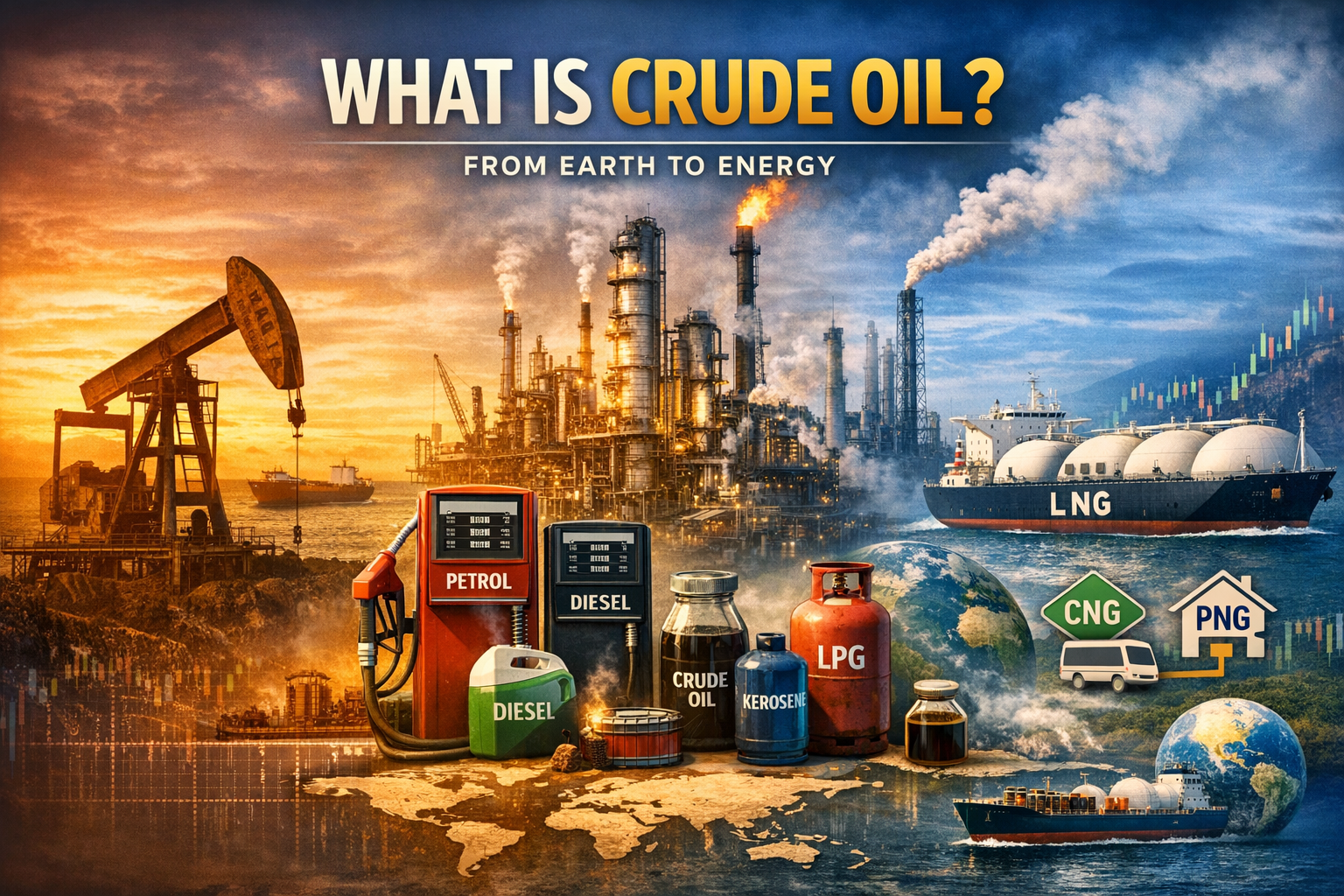
Introduction
Thank you for reading this post, don’t forget to subscribe!Crude oil is often called the “black gold” of the modern world—and rightly so. It powers transportation, industries, economies, and even geopolitics. From the fuel in your car to plastics, medicines, and fertilizers—crude oil is deeply embedded in our daily lives.
This blog takes you through the entire journey of crude oil—from its origin deep inside the Earth to its transformation into fuels like petrol, diesel, and beyond.
What is Crude Oil?
Crude oil (also known as petroleum) is a naturally occurring liquid fossil fuel composed mainly of hydrocarbons (carbon + hydrogen compounds) found beneath the Earth’s surface.
- It ranges in colour from yellow to black
- Contains impurities like sulphur, nitrogen, and metals
- Formed over millions of years from dead marine organisms under heat and pressure
In simple terms:
Crude oil = raw, unprocessed energy resource extracted from underground.
How is Crude Oil Extracted?
The extraction of crude oil involves advanced geological and engineering techniques:
1. Exploration
- Scientists use seismic surveys to locate oil reserves.
2. Drilling
- Wells are drilled on land or offshore to reach oil reservoirs.
3. Extraction
- Oil flows naturally due to underground pressure
- If pressure declines, pumps or water/gas injection are used
4. Transportation
- Oil is transported via pipelines, ships, or tankers to refineries
Globally, millions of barrels of oil are extracted daily using these methods.
How is Crude Oil Refined?
Crude oil cannot be used directly—it must be refined.
Step 1: Fractional Distillation
- Oil is heated in a refinery tower
- Different components separate based on boiling points
Step 2: Conversion Processes
- Cracking: Breaks heavy molecules into lighter fuels
- Reforming: Improves fuel quality
Step 3: Treatment
- Removes sulphur and impurities
This process converts crude oil into usable fuels and petrochemicals.
Products Derived from Crude Oil
| Fraction | Product | Use |
| Light gases | LPG | Cooking fuel |
| Naphtha | Petrochemicals | Plastics |
| Petrol (Gasoline) | Fuel | Cars & Aviation |
| Kerosene | Fuel | lamps |
| Diesel | Fuel | Trucks, generators |
| Heavy oil | Fuel oil | Ships, industries |
| Residue | Bitumen | Roads |
Crude oil is not just fuel—it is the backbone of modern industry.
Types of Crude Oil
Crude oil varies widely and is classified as:
Based on Sulphur Content
- Sweet crude (low sulphur, cleaner)
- Sour crude (high sulphur, needs more refining)
Based on Density (API Gravity)
- Light crude (easy to refine)
- Heavy crude (thick, difficult)
Four main types:
- Light Sweet
- Light Sour
- Heavy Sweet
- Heavy Sour
What is Natural Gas?
Natural gas is a gaseous fossil fuel mainly composed of methane found in underground reservoirs.
It is often found:
- Alongside crude oil (associated gas)
- Independently in gas fields
What are CNG, PNG, and LNG?
All are forms of natural gas, but processed differently:
| Type | Full Form | Description | Use |
| CNG | Compressed Natural Gas | Gas compressed at high pressure | Vehicles |
| PNG | Piped Natural Gas | Gas supplied via pipelines | Homes |
| LNG | Liquefied Natural Gas | Gas cooled to liquid form (-162°C) | Transport/export |
These are same fuel, different forms depending on storage and transport.
How Crude Oil and Natural Gas are Connected
- Both are hydrocarbon fossil fuels
- Often found in the same reservoirs
- Gas is lighter and sits above oil underground
- LPG (cooking gas) is a by-product of refining crude oil or processing natural gas
Global Oil Trade & Supply Chain
Crude oil follows a three-stage value chain:
1. Upstream
- Exploration and extraction
2. Midstream
- Transportation (pipelines, tankers)
3. Downstream
- Refining and distribution
Major oil trade routes include:
- Strait of Hormuz
- Suez Canal
- Malacca Strait
Oil is traded globally and priced mainly in US dollars, influencing global economies.
Top Crude Oil Producing Countries (Approximate Data)
| Rank | Country | Production Share (%) | Approx. Production (Million barrels/day) |
| 1 | USA | ~20% | ~13 |
| 2 | Saudi Arabia | ~13% | ~10 |
| 3 | Russia | ~12% | ~10 |
| 4 | Canada | ~6% | ~5 |
| 5 | Iraq | ~5% | ~4 |
| 6 | China | ~5% | ~4 |
| 7 | UAE | ~4% | ~3 |
| 8 | Brazil | ~4% | ~3 |
| 9 | Iran | ~4% | ~3 |
| 10 | Kuwait | ~3% | ~2.5 |
These countries dominate global oil supply and influence prices.
Economic Importance of Crude Oil
- Accounts for a major share of global energy consumption
- Drives inflation and economic growth
- Key input for industries like:
- Transportation
- Manufacturing
- Agriculture (fertilizers)
Challenges & Concerns
Environmental Issues
- Major contributor to climate change
- Air pollution and oil spills
Resource Depletion
- Non-renewable resource
Geopolitical Conflicts
- Oil-rich regions often face conflicts
Future of Oil & Energy Transition
- Shift towards renewable energy (solar, wind)
- Growth of electric vehicles (EVs)
- Increasing importance of natural gas as cleaner fuel
However, oil will remain crucial in the near future.
Interesting Facts
- Oil provides over 90% of transport energy globally
- It takes millions of years to form but seconds to burn
- Used in making:
- Plastics
- Medicines
- Cosmetics
- Synthetic fibres
Conclusion
Crude oil is not just a fuel—it is the foundation of modern civilization. From powering economies to shaping geopolitics, its influence is unmatched. However, as the world moves towards sustainability, understanding oil’s lifecycle helps us appreciate both its value and its limitations.
Leave a Reply