Introduction
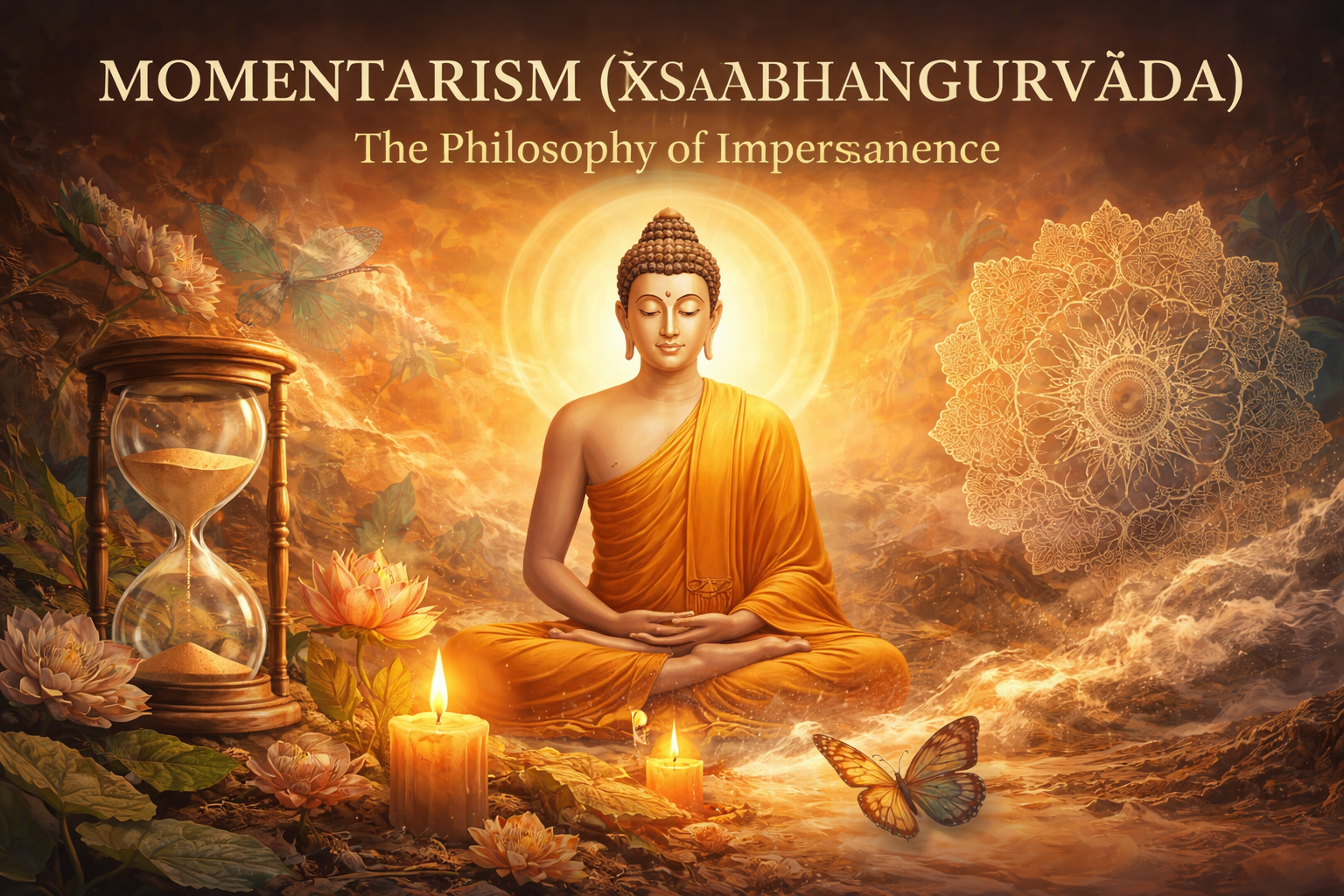
Thank you for reading this post, don’t forget to subscribe!In a world where change is the only constant, the ancient Indian philosophical doctrine of Momentarism (Kṣhaṇabhaṅgurvāda) offers a strikingly relevant perspective. Rooted in Buddhist philosophy, this doctrine asserts that everything in existence is fleeting—existing only for a moment before transforming into something new.
Propounded and deeply influenced by the teachings of Gautama Buddha, Momentarism is not just a metaphysical theory but a practical guide to understanding life, suffering, and liberation. In today’s fast-paced, uncertain world, its insights are more valuable than ever.
What is Momentarism?
Momentarism is the philosophical view that:
- All entities—material or mental—exist only for a single moment (kṣhaṇa)
- Continuity is an illusion created by rapid succession
- Nothing remains identical even for two consecutive moments
For example:
- A flowing river appears continuous, but its water is constantly changing
- A flame looks stable, yet it is a continuous process of combustion
Thus, reality is not static—it is a dynamic flow of momentary events.
Historical Background and Development
The foundation of this doctrine lies in the teachings of Gautama Buddha, particularly in the concept of Anitya (impermanence).
Later philosophers systematized it:
- Nagarjuna emphasized the emptiness (śūnyatā) of all phenomena
- Vasubandhu developed a psychological interpretation of momentariness
A similar idea appears in Western thought:
- Heraclitus famously argued that everything is in constant flux
Why Did Momentarism Originate?
This philosophy emerged as a response to fundamental existential questions:
1. Understanding Suffering (Dukkha)
Human life is marked by dissatisfaction. Momentarism explains that:
- We suffer because we cling to permanence
- We expect stability in an inherently unstable world
2. Challenging the Idea of a Permanent Self
Contrary to many traditions, Buddhism rejects the idea of an eternal soul:
- The “self” is merely a collection of changing experiences
3. Explaining Reality Scientifically (Philosophically)
Momentarism provides a rational explanation:
- Everything arises due to causes and conditions
- Nothing exists independently or permanently
Core Concepts of Momentarism
1. Impermanence (Anitya)
Everything is transient:
- Objects decay
- Emotions change
- Life itself is temporary
Even mountains erode, civilizations fall, and thoughts vanish.
2. No-Self (Anātman)
There is no permanent “I”:
- What we call identity is a bundle of:
- Thoughts
- Memories
- Sensations
Just like a movie is a series of frames, the self is a series of moments.
3. Dependent Origination (Pratītyasamutpāda)
Every phenomenon arises due to causes:
- Nothing exists independently
- Each moment is linked to the previous one
Life is a chain of cause and effect, not a fixed entity.
Real-Life Examples of Momentarism
1. Technology and Trends
- Social media trends rise and fall within days
- What is viral today is forgotten tomorrow
A clear reflection of momentariness.
2. Human Emotions
- Happiness, anger, sadness—all are temporary
- No emotion lasts forever
Understanding this reduces emotional suffering.
3. Relationships
- Relationships evolve over time
- Expectations of permanence often lead to disappointment
Accepting change improves emotional resilience.
4. Career and Economy
- Jobs, industries, and skills constantly evolve
- Adaptability becomes essential
Momentarism aligns with the idea of lifelong learning.
Relevance in the Contemporary World
1. Mental Health and Well-being
Modern life is full of stress and anxiety. Momentarism teaches:
- “This too shall pass”
- Pain and problems are temporary
This mindset fosters resilience and calmness.
2. Mindfulness and Present Living
Momentarism supports mindfulness practices:
- Focus on the present moment
- Avoid overthinking the past or future
This leads to better mental clarity and peace.
3. Consumerism and Materialism
In a consumer-driven society:
- People attach identity to possessions
- Momentarism reminds us that material things are temporary
Encourages minimalism and contentment.
4. Climate Change and Sustainability
Understanding impermanence:
- Highlights the fragility of ecosystems
- Encourages responsible living
Promotes sustainable behaviour.
How Momentarism Leads to Enlightenment
Momentarism is not just theoretical—it is deeply practical.
1. Detachment (Non-attachment)
- Realizing impermanence reduces attachment
- Less attachment = less suffering
2. Acceptance of Change
- Life becomes easier when we accept change
- Resistance to change creates pain
3. Awareness and Mindfulness
- Observing moment-to-moment changes increases awareness
- Leads to deeper self-understanding
4. Liberation (Nirvana)
- When attachment and ignorance end, suffering ceases
- This state is called Nirvana
Thus, Momentarism is a pathway to inner freedom and enlightenment.
Critical Evaluation
While powerful, Momentarism has also been debated:
Strengths
- Provides a realistic view of life
- Helps reduce suffering
- Encourages adaptability
Criticism
- Extreme momentariness may seem to deny continuity
- Raises questions about memory and identity
However, Buddhist philosophers argue that causal continuity explains these concerns.
Core Message of Momentarism
“Nothing is permanent. Understanding this truth is the key to freedom.”
Conclusion
Momentarism (Kṣhaṇabhaṅgurvāda) is not merely an ancient philosophical doctrine—it is a timeless guide to living wisely. In an era defined by rapid change, uncertainty, and constant flux, its message resonates deeply.
By understanding that everything is temporary, we learn to:
- Let go of unnecessary attachments
- Live fully in the present
- Accept life as it unfolds
Ultimately, this philosophy leads us toward peace, clarity, and enlightenment—making it profoundly relevant in both ancient and modern contexts.
Leave a Reply