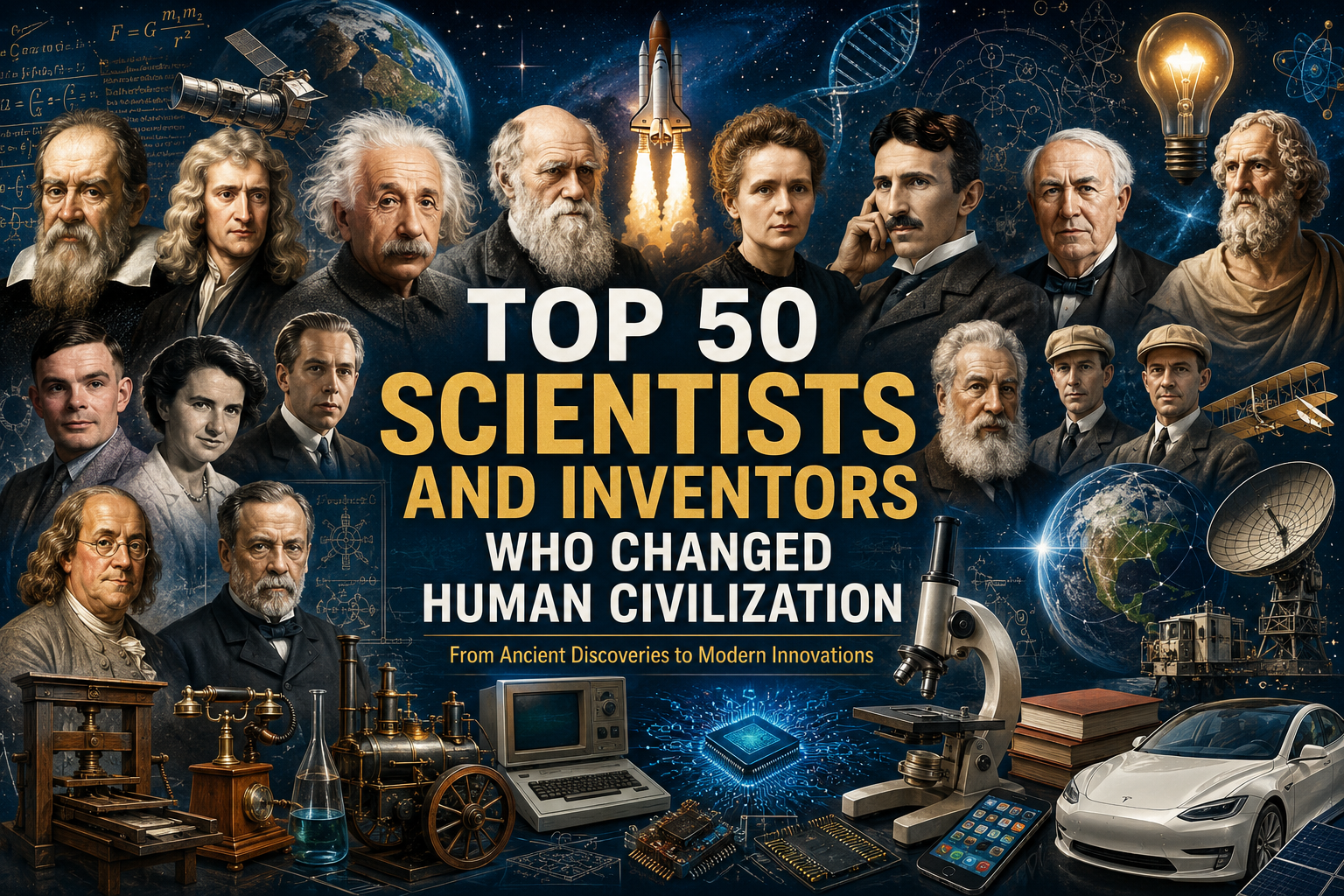
Top 50 Scientists and Inventors Who Changed Human Civilization Forever
Thank you for reading this post, don’t forget to subscribe!Human civilization progressed not merely through political empires or economic systems, but through the revolutionary ideas of scientists and inventors who transformed the way humanity lives, thinks, communicates, travels, heals, and understands the universe.
The modern world—with electricity, airplanes, medicine, computers, satellites, the internet, and artificial intelligence—is the cumulative outcome of centuries of scientific inquiry and technological innovation. These pioneers accelerated the pace of development and fundamentally altered the course of history.
This list highlights 50 of the most influential scientists, inventors, and innovators whose discoveries changed humanity forever.
1. Isaac Newton
Contribution:
- Laws of Motion and Gravity
Impact:
Founded classical physics and modern engineering.
2. Albert Einstein
E = mc^2
Contribution:
- Theory of Relativity
Impact:
Revolutionized modern physics, cosmology, and nuclear science.
3. Galileo Galilei
Contribution:
- Modern observational astronomy
Impact:
Established evidence-based scientific inquiry.
4. Charles Darwin
Contribution:
- Theory of Evolution
Impact:
Changed biology and understanding of life.
5. Nikola Tesla
Contribution:
- AC electricity system
Impact:
Enabled electrification of the modern world.
6. Thomas Edison
Contribution:
- Electric bulb and phonograph
Impact:
Transformed lighting and communication.
7. Marie Curie
Contribution:
- Radioactivity research
Impact:
Advanced cancer treatment and nuclear science.
8. Louis Pasteur
Contribution:
- Germ theory and pasteurization
Impact:
Revolutionized healthcare and food safety.
9. Alexander Fleming
Contribution:
- Discovery of Penicillin
Impact:
Saved millions of lives through antibiotics.
10. Michael Faraday
Contribution:
- Electromagnetic induction
Impact:
Foundation of electric motors and generators.
11. James Clerk Maxwell
Contribution:
- Electromagnetic theory
Impact:
Enabled wireless communication technology.
12. Alan Turing
Contribution:
- Foundations of computing and AI
Impact:
Laid the basis for modern computers.
13. Johannes Kepler
Contribution:
- Laws of planetary motion
Impact:
Advanced astronomy and space science.
14. Gregor Mendel
Contribution:
- Genetics
Impact:
Father of modern genetics.
15. Archimedes
Contribution:
- Mechanics and buoyancy
Impact:
Advanced engineering and mathematics.
16. Stephen Hawking
Contribution:
- Black hole theory
Impact:
Expanded understanding of the universe.
17. Rosalind Franklin
Contribution:
- DNA imaging
Impact:
Critical to genetic science.
18. Niels Bohr
Contribution:
- Atomic structure theory
Impact:
Advanced quantum mechanics.
19. Dmitri Mendeleev
Contribution:
- Periodic table
Impact:
Organized modern chemistry.
20. Sigmund Freud
Contribution:
- Psychoanalysis
Impact:
Influenced psychology and mental health studies.
21. Benjamin Franklin
Contribution:
- Electricity research
Impact:
Advanced electrical science.
22. C. V. Raman
Contribution:
- Raman Effect
Impact:
Revolutionized spectroscopy.
23. Jagadish Chandra Bose
Contribution:
- Wireless communication research
Impact:
Pioneer in radio science.
24. Tim Berners-Lee
Contribution:
- World Wide Web
Impact:
Transformed global communication.
25. Srinivasa Ramanujan
Contribution:
- Number theory
Impact:
Influenced advanced mathematics and computing.
26. James Watt
Contribution:
- Steam engine improvements
Impact:
Powered the Industrial Revolution.
27. Alexander Graham Bell
Contribution:
- Telephone
Impact:
Revolutionized communication.
28. Wright brothers
Contribution:
- Powered airplane
Impact:
Changed global transportation forever.
29. Johannes Gutenberg
Contribution:
- Printing press
Impact:
Accelerated education and knowledge dissemination.
30. Nikolaus Otto
Contribution:
- Internal combustion engine
Impact:
Enabled automobiles and modern transport.
31. Guglielmo Marconi
Contribution:
- Radio communication
Impact:
Transformed mass communication.
32. John Bardeen
Contribution:
- Transistor invention
Impact:
Foundation of modern electronics.
33. Robert Oppenheimer
Contribution:
- Atomic bomb research
Impact:
Changed global geopolitics and energy science.
34. Jonas Salk
Contribution:
- Polio vaccine
Impact:
Saved millions from paralysis.
35. Ada Lovelace
Contribution:
- First computer algorithm
Impact:
Considered first computer programmer.
36. Claude Shannon
Contribution:
- Information theory
Impact:
Foundation of digital communication.
37. George Washington Carver
Contribution:
- Agricultural innovation
Impact:
Improved sustainable farming methods.
38. Edward Jenner
Contribution:
- Smallpox vaccine
Impact:
Started modern immunization.
39. Carl Linnaeus
Contribution:
- Biological classification system
Impact:
Organized biological sciences.
40. Antoine Lavoisier
Contribution:
- Modern chemistry foundations
Impact:
Established conservation of mass.
41. Werner Heisenberg
Contribution:
- Uncertainty Principle
Impact:
Revolutionized quantum physics.
42. Enrico Fermi
Contribution:
- Nuclear reactor development
Impact:
Advanced nuclear energy.
43. Richard Feynman
Contribution:
- Quantum electrodynamics
Impact:
Deepened particle physics understanding.
44. Rachel Carson
Contribution:
- Environmental science advocacy
Impact:
Sparked global environmental movements.
45. Jane Goodall
Contribution:
- Chimpanzee behavioral studies
Impact:
Changed understanding of animal intelligence.
46. Katherine Johnson
Contribution:
- NASA orbital calculations
Impact:
Critical to space exploration success.
47. Subrahmanyan Chandrasekhar
Contribution:
- Stellar evolution theory
Impact:
Advanced astrophysics and black hole science.
48. Homi J. Bhabha
Contribution:
- Nuclear science in India
Impact:
Foundation of India’s atomic energy program.
49. Elon Musk
Contribution:
- Electric vehicles and private space industry
Impact:
Accelerated renewable transport and commercial space exploration.
50. Steve Jobs
Contribution:
- Smartphone and personal computing revolution
Impact:
Changed digital lifestyle and consumer technology.
Major Areas Where These Scientists Changed Humanity
1. Healthcare and Medicine
Vaccines, antibiotics, genetics, and medical imaging drastically improved life expectancy and public health.
2. Industrial Revolution
Steam engines, electricity, and machines transformed economies and productivity.
3. Transportation Revolution
Cars, airplanes, and engines connected the world faster than ever before.
4. Communication Revolution
Telephone, radio, internet, and computing reshaped human interaction globally.
5. Space and Astronomy
Scientific discoveries enabled satellites, GPS systems, and space missions.
6. Digital and AI Revolution
Computers, semiconductors, algorithms, and AI transformed every sector of society.
Common Qualities of Great Scientists
These transformative minds shared several traits:
- Curiosity and creativity
- Persistence despite failures
- Critical thinking
- Courage to challenge conventional beliefs
- Dedication to solving human problems
Ethical Challenges of Scientific Progress
While science improved humanity tremendously, it also created challenges:
- Nuclear weapons
- Environmental degradation
- AI ethics and surveillance
- Technological inequality
- Data privacy concerns
Thus, scientific progress must always remain guided by ethics, sustainability, and human welfare.
Conclusion
The modern world stands upon the shoulders of scientists and inventors whose ideas transformed civilization. Their discoveries accelerated human development across healthcare, communication, transportation, agriculture, industry, computing, and space exploration.
These 50 pioneers not only changed their own era but permanently reshaped humanity’s future. Their legacy reminds us that scientific inquiry, innovation, and rational thinking remain the greatest driving forces behind civilization and progress.
As humanity enters new frontiers such as artificial intelligence, biotechnology, quantum computing, and interplanetary exploration, future generations of scientists will continue carrying forward this extraordinary legacy of discovery and transformation.
Leave a Reply