Imagine switching on a brain cell with light
Thank you for reading this post, don’t forget to subscribe!What if a tiny flash of light could activate a selected group of brain cells? What could that reveal about movement, memory, or the mysterious workings of the human brain?
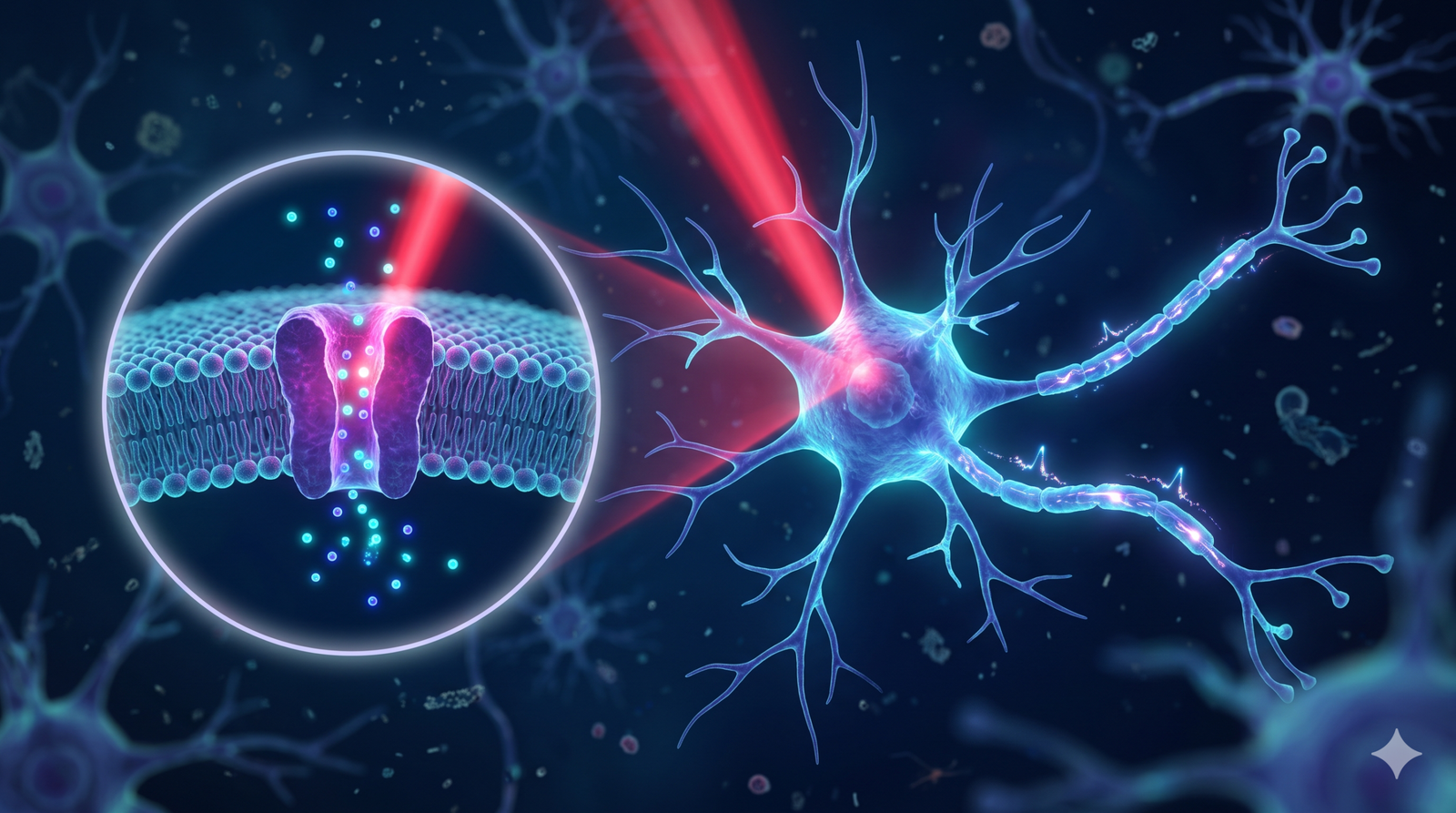
This isn’t science fiction. It is the idea behind optogenetics, a technique that combines genetics and light to control selected nerve cells.
The 2026 Nobel Prize in Physiology or Medicine recognized the pioneering discoveries that made optogenetics possible. The fascinating part? The story began with a microscopic green alga—not a human brain.
1. Meet the Nobel laureates
The 2026 Nobel Prize was awarded to Karl Deisseroth, Peter Hegemann and Georg Nagel for discoveries leading to optogenetics.
- Peter Hegemann, a biophysicist, investigated how microorganisms detect light.
- Georg Nagel, an electrophysiologist, helped demonstrate that light-sensitive proteins could produce electrical currents in cells.
- Karl Deisseroth, a neuroscientist, helped establish how these proteins could be used to control the activity of selected neurons.
Their work brought together molecular biology, physics and neuroscience. It wasn’t one isolated discovery, but a chain of scientific advances that transformed how researchers investigate the brain.
2. The tiny alga behind a huge discovery
Meet Chlamydomonas reinhardtii, a single-celled green alga found in freshwater.
It has no brain or nervous system, yet it responds to light. This behaviour, called phototaxis, helps it navigate its environment.
Researchers investigating this response discovered light-sensitive proteins called channel rhodopsins.
In 2002, Georg Nagel and colleagues showed that channelrhodopsin-1 could produce an electrical current when exposed to light—even when expressed in another cell.
Imagine a microscopic gate that opens when light strikes it. That is a useful analogy for channel rhodopsin, although the real protein is a molecular ion channel, not a mechanical switch.
The next question was extraordinary: could this protein make a nerve cell respond to light?
3. How does optogenetics work?
A neuron is a specialized cell that communicates using electrical signals and chemical messengers.
Its membrane maintains an electrical difference called the membrane potential. When charged particles called ions move across that membrane, the electrical state of the neuron changes.
Optogenetics uses this natural electrical machinery in a new way.
Step 1: Select the cells
Scientists use genetic methods to make particular neurons produce light-sensitive proteins.
Step 2: Deliver light
An optical system sends the appropriate light to the target cells.
Step 3: Change electrical activity
Light-sensitive channels open, allowing ions to move and altering the neuron’s membrane potential.
Step 4: Observe the response
Researchers measure how manipulating those neurons affects a biological process.
For activating channel rhodopsins, light generally allows positive ions to enter the cell, making its electrical potential less negative. This is called depolarization. If the change is sufficient, the neuron may fire an action potential.
Other optogenetic proteins can inhibit neuronal activity.
The breakthrough is that scientists can experimentally manipulate selected neurons instead of merely observing their activity.
4. Explore the science
Optogenetics can control every neuron in a human brain.
Optogenetics helps test whether particular neural circuits contribute to behaviour.
Channel rhodopsins were discovered in human neurons.
Optogenetics is an established cure for Parkinson’s disease and depression.
5. Why does this discovery matter?
Imagine researchers observing a group of neurons becoming active when an animal moves.
Does that activity help produce the movement, or is it simply a response to it?
Optogenetics lets researchers test such questions by activating or inhibiting selected circuits and measuring what happens.
For example, researchers have used optogenetics to investigate movement-related circuits in the basal ganglia, a network involved in motor control. Experiments in animal models have helped reveal how particular pathways influence movement and Parkinsonian symptoms.
It has also become a valuable tool in research on sensory processing, learning, reward and stress-related behaviour.
But there is an important distinction: changing the activity of a neural circuit does not automatically explain a complex human behaviour or emotion. The brain works through interconnected networks, and experimental results depend on the cells, timing and conditions involved.
Could it become a medical treatment?
Researchers have explored optogenetic approaches for retinal disorders such as retinitis pigmentosa.
In 2021, a clinical research report described partial recovery of visual function in a person with advanced retinal degeneration following an experimental optogenetic treatment combined with special light-delivery goggles.
This was an important proof of concept, not a cure for blindness.
For neurological and psychiatric disorders, optogenetics remains largely a research technique. Gene delivery, immune responses, safe light access and precise cell targeting are major challenges.
The promise is real, but the gap between laboratory research and established treatment remains substantial.
6. An Indian connection
The early channel rhodopsin research also involved Suneel Kateriya, an Indian scientist whose work contributed to understanding light-sensitive proteins in Chlamydomonas.
His research formed part of an international effort involving scientists from different institutions and countries.
This is an important reminder that discoveries with global significance can emerge from fundamental research conducted far from the laboratories where their eventual applications are developed.
The story of optogenetics is not about one scientist or one country. It is about scientific collaboration—and the surprising journey of a microscopic organism’s light-sensing machinery into neuroscience.
7. A final thought
The story of optogenetics begins with a deceptively simple question: how does a tiny alga respond to light?
Years of investigation turned the answer into a powerful tool for studying the living brain.
That is the beauty of curiosity-driven research. Scientists do not always know where a discovery will lead. They follow evidence, test ideas, and build knowledge that others can use in unexpected ways.
The 2026 Nobel Prize in Physiology or Medicine celebrates this journey—from understanding nature to finding new ways to investigate its mysteries.
A flash of light does not reveal every secret of the mind. But it gives researchers a remarkable new way to ask questions about how the brain works.
References
- Official Nobel Prize announcement
- Nagel et al. (2002), Channelrhodopsin-1, Science
- Nagel et al. (2003), Channelrhodopsin-2, PNAS
- Boyden et al. (2005), Optical control of neural activity, Nature Neuroscience
- Kravitz et al. (2013), Optogenetic control of basal ganglia circuitry, Nature
- Sahel et al. (2021), Optogenetic therapy for retinal degeneration, Nature Medicine
Leave a Reply