El Niño: The Climate Phenomenon That Influences the Entire Planet
Thank you for reading this post, don’t forget to subscribe!The Earth’s climate system is deeply interconnected. A change in sea surface temperature in one part of the world can trigger droughts, floods, cyclones, crop failures, and heatwaves thousands of kilometres away. One of the most powerful examples of this interconnectedness is the phenomenon known as El Niño.
El Niño is not merely a regional weather anomaly in the Pacific Ocean; it is a global climatic force capable of reshaping rainfall patterns, affecting food production, influencing economies, altering marine ecosystems, and impacting billions of human lives.
Understanding El Niño is therefore essential for scientists, policymakers, farmers, businesses, and ordinary citizens alike.
What Does the Term “El Niño” Mean?
The term El Niño is Spanish for “The Little Boy” or “Christ Child.”
It was originally used by Peruvian and Ecuadorian fishermen during the 17th century to describe the unusual warming of Pacific Ocean waters that typically appeared around Christmas time. Since the event often emerged near the birth of Jesus Christ, fishermen named it “El Niño.”
Later, scientists adopted the term to describe a much larger ocean-atmosphere climatic phenomenon.
Its opposite phase is called La Niña, meaning “The Little Girl.”
What is El Niño?
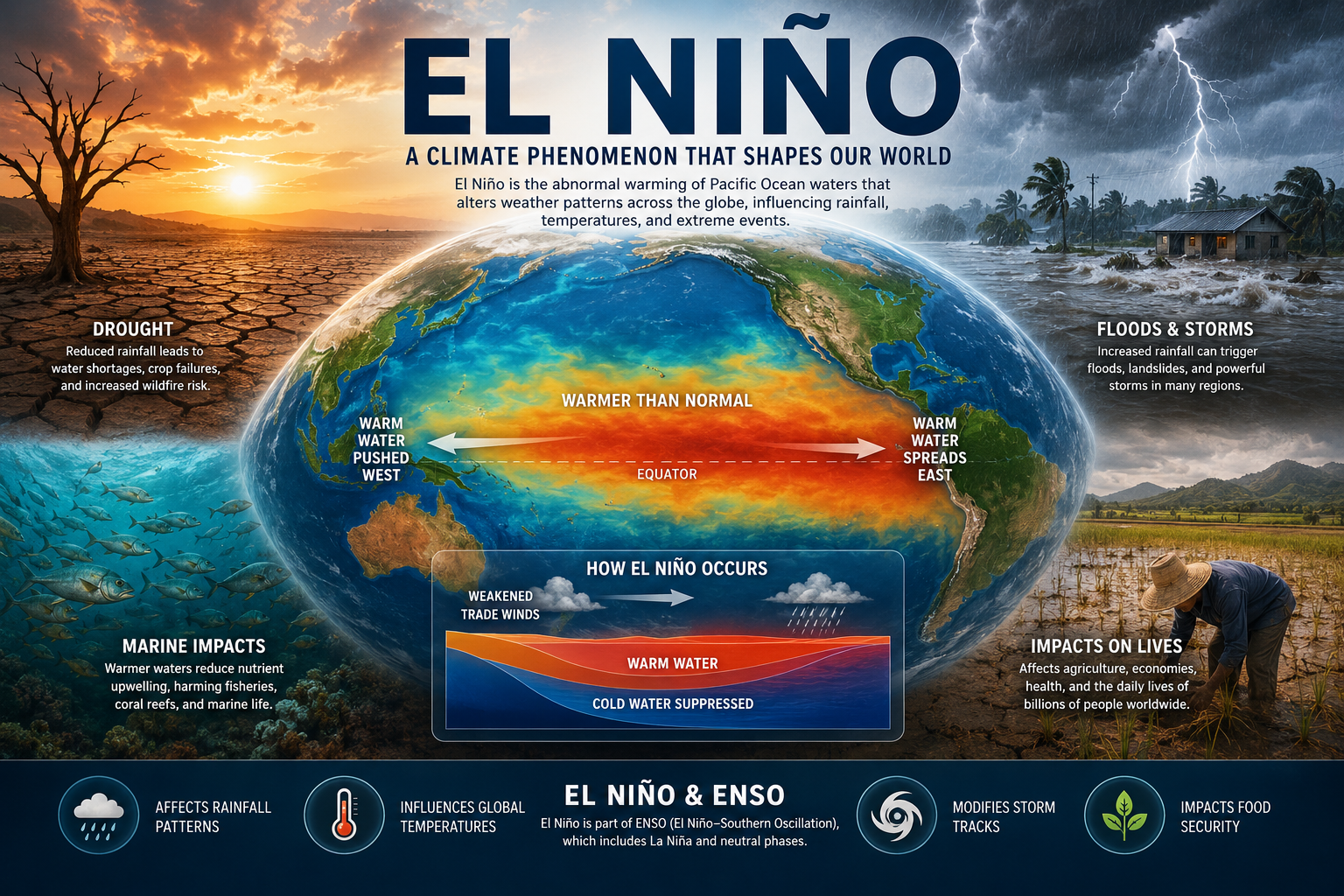
El Niño is a climatic phenomenon characterized by the abnormal warming of surface waters in the central and eastern equatorial Pacific Ocean.
Under normal conditions, strong trade winds push warm ocean water westward toward Indonesia and Australia. During El Niño years, these trade winds weaken or even reverse, allowing warm water to spread eastward toward the coast of South America.
This warming disrupts atmospheric circulation, rainfall patterns, ocean currents, and weather systems across the globe.
In scientific terms, El Niño is part of a broader climate cycle known as the El Niño–Southern Oscillation (ENSO).
Understanding ENSO: The Larger Climate System
ENSO stands for:
- El Niño → Warm phase
- La Niña → Cool phase
- Southern Oscillation → Atmospheric pressure changes across the Pacific Ocean
The concept combines both oceanic and atmospheric changes occurring in the tropical Pacific.
The Three Phases of ENSO
| Phase | Ocean Temperature | Trade Winds | Global Impact |
| El Niño | Warmer than normal | Weak | Droughts, floods, warming |
| Neutral | Near average | Normal | Stable conditions |
| La Niña | Cooler than normal | Strong | Heavy rainfall, cooler conditions |
Thus, El Niño and La Niña are opposite phases of the same coupled ocean-atmosphere system.
How Does El Niño Occur?
The formation of El Niño involves complex interactions between the ocean and atmosphere.
Step-by-Step Process
1. Normal Pacific Conditions
Under normal circumstances:
- Trade winds blow from east to west across the equatorial Pacific.
- Warm water accumulates near Indonesia and Australia.
- Cold nutrient-rich water rises near Peru through a process called upwelling.
- This creates balanced atmospheric circulation known as the Walker Circulation.
2. Weakening of Trade Winds
During El Niño:
- Trade winds weaken significantly.
- Warm water starts moving eastward toward South America.
- Upwelling of cold-water declines.
3. Ocean Warming
As warm water spreads eastward:
- Sea surface temperatures rise abnormally.
- Evaporation and cloud formation shift eastward.
4. Atmospheric Changes
The movement of heat alters:
- Air pressure systems
- Jet streams
- Storm tracks
- Rainfall distribution
This creates worldwide climatic disturbances.
The Scientific Concept Behind El Niño
El Niño is fundamentally based on the concept of ocean-atmosphere coupling.
The atmosphere and oceans constantly exchange:
- Heat
- Moisture
- Momentum
- Energy
A small disturbance in ocean temperature can influence atmospheric circulation, which in turn further modifies ocean conditions — creating a feedback loop.
One important mechanism involved is the Bjerknes Feedback, proposed by meteorologist Jacob Bjerknes.
According to this theory:
- Weak trade winds warm the eastern Pacific.
- Warm waters weaken trade winds further.
- This amplifies El Niño conditions.
Who First Proposed the Scientific Concept?
The understanding of El Niño evolved gradually through contributions from multiple scientists.
Early Observations
Peruvian fishermen first identified the warming phenomenon centuries ago.
Sir Gilbert Walker and Southern Oscillation
In the early 20th century, Gilbert Walker discovered periodic atmospheric pressure variations between the Pacific and Indian Oceans.
He called this phenomenon the Southern Oscillation.
Walker was actually studying why Indian monsoons sometimes failed.
Jacob Bjerknes and Modern ENSO Theory
In the 1960s, Jacob Bjerknes connected Pacific Ocean warming with atmospheric pressure changes.
He established the modern scientific explanation of ENSO.
Thus:
- Walker explained the atmospheric component.
- Bjerknes linked atmosphere and ocean interactions.
Together, they laid the foundation of modern ENSO science.
Different Scholarly Perspectives on El Niño
Scientists continue to debate several aspects of El Niño.
1. Natural Climate Variability Theory
Some climatologists argue El Niño is a naturally recurring ocean-atmosphere oscillation that has existed for thousands of years.
According to this view:
- ENSO is part of Earth’s natural climate rhythm.
- Human influence may not be necessary for its occurrence.
2. Climate Change Intensification Theory
Another group believes global warming is increasing:
- Frequency
- Intensity
- Unpredictability
of extreme El Niño events.
Rising ocean temperatures may strengthen ENSO variability.
3. Chaos and Nonlinear Dynamics Perspective
Some researchers view ENSO as a nonlinear chaotic system where:
- Small disturbances create large climatic outcomes.
- Long-term prediction remains difficult.
This explains why El Niño forecasting still carries uncertainty.
4. Paleo-Climatic Perspective
Climate historians studying coral reefs, sediments, and ice cores suggest ENSO patterns existed even in ancient climatic periods.
However, evidence indicates modern ENSO events may be becoming more extreme.
Why is El Niño So Important for Global Climate?
El Niño redistributes heat across the Pacific Ocean, influencing atmospheric circulation worldwide.
It acts like a giant climatic “switch” affecting weather systems across continents.
Global Impacts of El Niño
1. Impact on Monsoons
El Niño often weakens the Indian monsoon.
This can lead to:
- Reduced rainfall
- Agricultural stress
- Water shortages
- Food inflation
India carefully monitors ENSO because agriculture and food security depend heavily on monsoon performance.
2. Droughts
El Niño commonly causes droughts in:
- Australia
- Indonesia
- Parts of India
- Southern Africa
Droughts affect:
- Crop production
- Hydropower
- Drinking water supply
3. Floods
Some regions receive excessive rainfall during El Niño years.
Examples include:
- Peru
- Ecuador
- Southern United States
- East Africa
This can trigger:
- Flooding
- Landslides
- Infrastructure damage
4. Heatwaves and Global Temperature Rise
Strong El Niño years often become the hottest years globally because heat stored in oceans is released into the atmosphere.
Many record-breaking global temperatures have coincided with El Niño events.
5. Cyclones and Hurricanes
El Niño influences tropical storm activity differently across oceans.
Atlantic Ocean
- Usually fewer hurricanes
Pacific Ocean
- Often stronger cyclone activity
6. Marine Ecosystem Damage
Reduced upwelling near South America decreases nutrients in ocean waters.
This harms:
- Fish populations
- Coral reefs
- Marine biodiversity
Peru’s anchovy fisheries are especially vulnerable.
El Niño and Human Civilization
El Niño has major socio-economic consequences.
Agriculture
Crop yields can decline because of:
- Droughts
- Floods
- Heat stress
Majorly affected crops include:
- Rice
- Wheat
- Maize
- Soybean
Economy
El Niño can influence:
- Inflation
- Commodity prices
- Energy demand
- Insurance losses
Global economic losses from severe El Niño events can reach hundreds of billions of dollars.
Health
El Niño affects disease patterns by changing temperature and rainfall.
It may increase:
- Malaria
- Dengue
- Cholera
- Heat-related illnesses
Migration and Conflict
Climate stress can intensify:
- Rural distress
- Food insecurity
- Water disputes
- Human displacement
Thus, El Niño has geopolitical implications as well.
What is La Niña?
La Niña is the opposite phase of El Niño.
It occurs when:
- Trade winds strengthen
- Cold water upwelling intensifies
- Eastern Pacific becomes cooler than normal
La Niña often causes:
- Stronger Indian monsoon
- Flooding in Australia
- Cooler global temperatures
However, it can also trigger destructive floods and cyclones.
El Niño vs La Niña
| Feature | El Niño | La Niña |
| Pacific Temperature | Warmer | Cooler |
| Trade Winds | Weak | Strong |
| Indian Monsoon | Weaker | Stronger |
| Global Temperature | Higher | Lower |
| Peru Fisheries | Harmed | Improved |
| Australian Rainfall | Reduced | Increased |
Can El Niño Be Predicted?
Modern meteorology uses:
- Satellites
- Ocean buoys
- Climate models
- AI-based forecasting
to predict ENSO events several months in advance.
Organizations such as the World Meteorological Organization and National Oceanic and Atmospheric Administration continuously monitor Pacific conditions.
However, precise intensity prediction remains challenging because ENSO is highly complex.
El Niño and Climate Change: A Growing Concern
One of the most debated scientific questions today is:
Will climate change make El Niño stronger?
Research suggests:
- Warmer oceans may intensify extreme ENSO events.
- Climate variability may become more unstable.
- Weather extremes could become more frequent.
If true, future El Niño events may produce more severe:
- Heatwaves
- Floods
- Droughts
- Food crises
This makes climate adaptation and resilience planning increasingly important.
Important Historical El Niño Events
1982–83 El Niño
One of the strongest events of the 20th century.
1997–98 El Niño
Caused devastating global weather disruptions and massive economic losses.
2015–16 El Niño
Contributed to record global temperatures and severe droughts.
These events highlighted how deeply interconnected the world’s climate system truly is.
Conclusion
El Niño is far more than a warming of Pacific Ocean waters. It is a powerful global climatic phenomenon that demonstrates the interconnected nature of Earth’s atmosphere, oceans, ecosystems, and human societies.
From ancient fishermen in Peru to modern satellite-based climate science, the understanding of El Niño has evolved into one of the most important fields in meteorology and climate research.
Its relationship with ENSO and La Niña helps scientists understand global climate variability, monsoon behaviour, drought cycles, flood risks, and future climate uncertainty.
As climate change accelerates, understanding El Niño becomes even more critical for humanity’s future. Governments, scientists, farmers, industries, and citizens must strengthen climate preparedness, early warning systems, sustainable resource management, and international cooperation to reduce the risks associated with increasingly volatile climate systems.
In many ways, El Niño reminds humanity that the Earth functions as one interconnected planetary system — where changes in one ocean can influence the destiny of millions across continents.
Leave a Reply