Introduction
Thank you for reading this post, don’t forget to subscribe!Few phrases in human civilization possess the moral force, philosophical depth, and timeless relevance of “Satyameva Jayate” (सत्यमेव जयते). These three Sanskrit words have inspired generations, guided nations, and reminded humanity of a simple yet profound truth: Truth alone triumphs.
The phrase is not merely a slogan inscribed beneath the State Emblem of India. It is a civilizational ideal rooted in India’s ancient spiritual heritage and philosophical traditions. It encapsulates the essence of righteousness, ethical conduct, and the ultimate victory of truth over falsehood.
In an age characterized by misinformation, propaganda, artificial intelligence, digital manipulation, and declining trust in institutions, the message of “Satyameva Jayate” has become more relevant than ever before.
This article explores the origin, history, philosophical meaning, cultural significance, and contemporary relevance of this immortal maxim.
What Does “Satyameva Jayate” Mean?
The Sanskrit phrase is composed of three words:
- Satya (सत्य) = Truth
- Eva (एव) = Alone, indeed, only
- Jayate (जयते) = Triumphs, prevails, wins
Thus, the literal translation is:
“Truth alone triumphs.”
However, the philosophical meaning extends beyond mere factual correctness. In Indian thought, Satya represents:
- Truthfulness in speech
- Integrity in action
- Purity in intention
- Alignment with cosmic order (ऋत – Rta)
- Ultimate Reality (Brahman)
Therefore, “Satyameva Jayate” signifies that truth, righteousness, and moral integrity ultimately prevail over deceit, injustice, and falsehood.
The Origin of “Satyameva Jayate”
The phrase originates from the Mundaka Upanishad, one of the principal Upanishads associated with the Atharva Veda.
The complete verse reads:
Sanskrit Verse
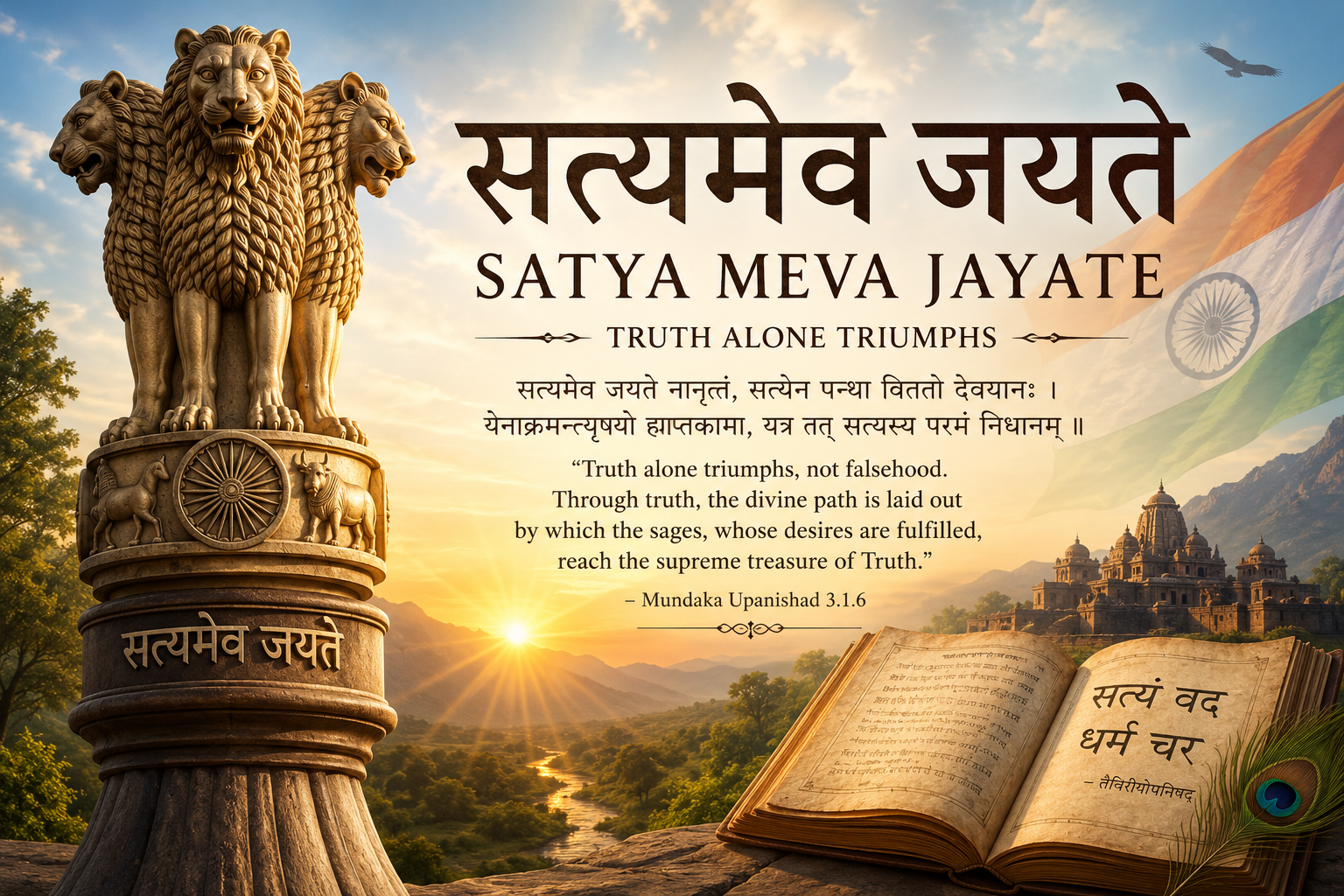
सत्यमेव जयते नानृतं
सत्येन पन्था विततो देवयानः।
येनाक्रमन्त्यृषयो ह्याप्तकामा
यत्र तत् सत्यस्य परमं निधानम्॥
Mundaka Upanishad (3.1.6)
Transliteration
Satyameva Jayate Nanritam
Satyena Pantha Vitato Devayanah
Yenakramanty Rishayo Hyaptakama
Yatra Tat Satyasya Paramam Nidhanam
Meaning
“Truth alone triumphs, not falsehood. Through truth, the divine path is spread out by which the sages, whose desires have been fulfilled, reach the supreme treasure of Truth.”
This verse presents truth not merely as a moral virtue but as a path leading to spiritual liberation and ultimate reality.
Historical Background of the Mundaka Upanishad
The Mundaka Upanishad is believed to have been composed between 800 BCE and 500 BCE, making it over 2,500 years old.
The Upanishad is structured into three parts and primarily discusses:
- Nature of Brahman (Ultimate Reality)
- Self-knowledge (Atma Vidya)
- Higher and lower knowledge
- Spiritual liberation (Moksha)
The text emphasizes that worldly achievements are temporary, whereas truth and wisdom lead to eternal fulfilment.
In this context, “Satyameva Jayate” serves as a declaration that truth is not merely ethically superior but spiritually transformative.
The Concept of Truth in Indian Philosophy
To understand “Satyameva Jayate,” one must understand the Indian conception of truth.
1. Truth as Cosmic Order (ऋत)
In the Vedic tradition, truth is linked to Rta (ऋत), the cosmic order governing the universe.
The sun rises according to truth.
The seasons change according to truth.
The universe functions according to truth.
Living truthfully means aligning oneself with this universal order.
2. Truth as Moral Conduct
The ancient Indian educational tradition emphasized truthfulness as the highest virtue.
A famous instruction from the Taittiriya Upanishad states:
सत्यं वद। धर्मं चर॥
Satyam Vada, Dharmam Chara
Meaning:
“Speak the truth. Follow righteousness.”
This teaching formed the ethical foundation of Indian civilization.
3. Truth as Ultimate Reality
The Upanishads describe Brahman, the Supreme Reality, as Truth itself.
Another famous Sanskrit expression says:
सत्यं ज्ञानमनन्तं ब्रह्म।
Meaning:
“Brahma is Truth, Knowledge, and Infinity.”
Thus, truth is not only a virtue but also the highest reality.
Adoption as India’s National Motto
After India’s independence in 1947, the Constituent Assembly sought symbols that reflected India’s civilizational values.
On 26 January 1950, when India became a Republic, the Government adopted the Lion Capital of Ashoka as the State Emblem.
Beneath the emblem, the words:
सत्यमेव जयते
were inscribed in Devanagari script.
Since then, “Satyameva Jayate” has served as the National Motto of India.
It appears on:
- Indian currency notes
- Government documents
- Passports
- Judicial institutions
- Official seals
- National awards and certificates
The motto symbolizes the commitment of the Indian Republic to truth, justice, and ethical governance.
Mahatma Gandhi and the Power of Truth
No discussion of truth in India is complete without mentioning Mahatma Gandhi.
Gandhi transformed truth into a political force through Satyagraha, which means:
“Insistence on Truth” or “Holding firmly to Truth.”
For Gandhi:
- Truth was God.
- Non-violence was the method.
- Justice was the objective.
He famously stated:
“Truth never damages a cause that is just.”
India’s freedom struggle demonstrated that truth and moral courage could defeat even the mightiest empire.
“Satyameva Jayate” in Indian Scriptures
The importance of truth is repeatedly emphasized throughout Indian literature.
From the Mahabharata
न सत्यात् परमो धर्मः।
Meaning:
“There is no Dharma higher than Truth.”
सत्यं ब्रूयात् प्रियं ब्रूयात्।
Meaning:
“Speak the truth and speak it pleasantly.”
This teaches that truth should be expressed with wisdom and compassion.
From the Bhagavad Gita
In Bhagavad Gita, truthfulness is described as a divine quality.
अहिंसा सत्यमक्रोधः त्यागः शान्तिरपैशुनम्।
Meaning:
“Non-violence, truthfulness, absence of anger, renunciation, peace…”
Truth is thus considered essential for spiritual growth.
Lessons from “Satyameva Jayate”
1. Truth Builds Trust
Every successful relationship—personal, social, or professional—is built on trust.
Truth creates trust.
Trust creates cooperation.
Cooperation creates progress.
2. Falsehood Provides Temporary Gains
History repeatedly shows that deception may succeed temporarily but ultimately collapses.
Empires have fallen.
Frauds have been exposed.
Corruption has been punished.
Truth endures longer than falsehood.
3. Moral Courage is Essential
Truth often demands courage.
Speaking truth against injustice, corruption, and oppression requires strength of character.
“Satyameva Jayate” teaches us that moral courage is a prerequisite for social transformation.
4. Truth Leads to Inner Peace
A truthful life reduces internal conflict.
Ancient sages understood that honesty aligns thought, speech, and action, leading to mental harmony and spiritual growth.
Relevance in the Digital Age
The twenty-first century presents new challenges to truth.
Fake News and Misinformation
Social media has enabled information to travel instantly.
Unfortunately, false information often spreads faster than verified facts.
“Satyameva Jayate” reminds citizens to:
- Verify sources
- Think critically
- Avoid spreading misinformation
- Respect facts and evidence
Artificial Intelligence and Deepfakes
Advanced technologies can now create realistic fake images, videos, and voices.
In such an environment, commitment to truth becomes increasingly important for preserving democracy and social trust.
Governance and Public Administration
Transparent governance depends on:
- Accountability
- Honesty
- Evidence-based policymaking
- Ethical leadership
The motto continues to guide public institutions toward integrity and public service.
Scientific Research
Science itself is built upon the pursuit of truth.
Researchers must:
- Report findings honestly
- Avoid manipulation of data
- Follow ethical standards
Scientific progress is impossible without respect for truth.
Universal Relevance Beyond India
Although rooted in Indian philosophy, the message of “Satyameva Jayate” is universal.
Almost every civilization has celebrated truth:
- Ancient Greek philosophers sought truth through reason.
- Confucian traditions emphasized sincerity.
- Abrahamic traditions regard truthfulness as a divine virtue.
- Modern democracies depend upon truthful institutions.
Thus, “Truth Alone Triumphs” is a message for all humanity.
Challenges to Living Truthfully
Despite its importance, truthfulness remains difficult because:
- People fear consequences.
- Society sometimes rewards shortcuts.
- Power can distort facts.
- Personal biases cloud judgment.
The challenge is not merely knowing the truth but living according to it.
This is why the Upanishadic sages considered truth a lifelong discipline.
Conclusion
“Satyameva Jayate” is far more than India’s national motto. It is a timeless declaration of humanity’s highest aspiration. Emerging from the wisdom of the Mundaka Upanishad, it teaches that truth is not merely a moral preference but the very foundation of justice, harmony, knowledge, and spiritual fulfilment.
In a world increasingly shaped by misinformation, polarization, and technological manipulation, the ancient wisdom of the Upanishads shines with renewed relevance. Truth may sometimes appear delayed, challenged, or overshadowed by falsehood, but history repeatedly demonstrates that deception is temporary while truth is enduring.
The sages of ancient India understood a profound reality: civilizations flourish when they are rooted in truth and decline when they abandon it.
As individuals, citizens, and global communities, the message remains as powerful today as it was thousands of years ago:
सत्यमेव जयते नानृतम्
“Truth alone triumphs, not falsehood.”
This timeless ideal continues to inspire humanity toward a more ethical, just, and enlightened future.
Leave a Reply