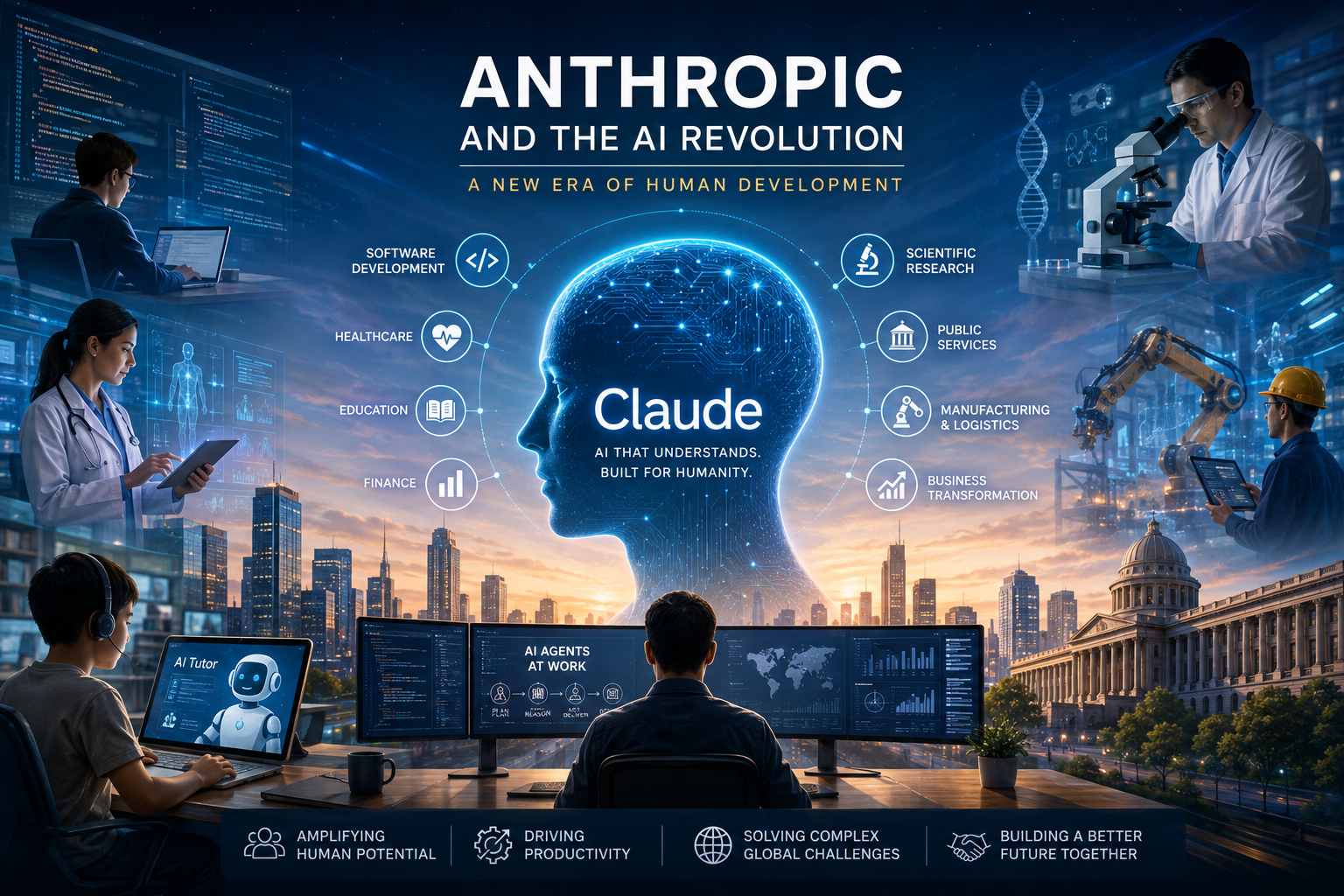
Anthropic and the AI Revolution: Is Artificial Intelligence Entering a New Era of Human Development?
Thank you for reading this post, don’t forget to subscribe!Artificial intelligence has moved beyond the stage of being merely a technological curiosity. It is increasingly becoming a general-purpose technology capable of changing how knowledge is created, software is developed, businesses are organised, scientific research is conducted and public services are delivered.
Among the companies at the centre of this transformation is Anthropic.
Founded around the idea that increasingly powerful AI systems must be developed with safety, reliability and human control at their core, Anthropic has evolved remarkably quickly. Its Claude family of AI models has moved from being an advanced conversational assistant to becoming a platform for coding, research, reasoning, computer interaction and increasingly autonomous AI agents.
The significance of Anthropic therefore goes beyond the success of another technology company. It raises a much larger question:
Are we witnessing another technological revolution—or the beginning of a fundamentally different phase of human development?
The answer may depend not only on how intelligent AI becomes, but on how societies choose to integrate it into economies, institutions and everyday life.
From a Research Laboratory to an AI Powerhouse
Anthropic emerged in 2021, founded by researchers and entrepreneurs including Dario Amodei and Daniela Amodei. The company’s initial identity was distinctive: rather than treating AI safety as an afterthought, it positioned AI safety and reliability at the centre of frontier AI development.
Anthropic describes itself as an AI safety and research company focused on building AI systems that are “reliable, interpretable, and steerable.” It operates as a Public Benefit Corporation, with a stated long-term objective of developing advanced AI for humanity’s benefit.
Its development can broadly be understood through several stages:
1. The safety-first foundation
Anthropic’s early research focused heavily on alignment, interpretability and controllability.
One of its most important ideas was Constitutional AI—an approach intended to give an AI system explicit principles and values to guide its behaviour, rather than relying exclusively on large amounts of human feedback.
This produced a different philosophy of AI development:
Capability + Safety + Interpretability + Human oversight
rather than capability alone.
2. Claude enters the market
Anthropic introduced Claude as its principal AI assistant in 2023. Claude rapidly evolved from a conversational system into a more capable general-purpose AI platform.
Claude 2 introduced significantly stronger reasoning and longer-context capabilities, while the Claude 3 family—Haiku, Sonnet and Opus—expanded the range from fast, lower-cost applications to more sophisticated reasoning.
3. From chatbot to multimodal workplace assistant
The next transformation came with Claude 3.5 and capabilities such as computer use.
Instead of simply answering a question, Claude could increasingly interact with computers—looking at screens, moving cursors, clicking buttons and typing. Anthropic described this capability as allowing developers to direct Claude to use computers in ways similar to people.
This is an important transition.
The traditional chatbot model is:
Human → Question → AI → Answer
The emerging agentic model is:
Human → Objective → AI → Planning → Tools → Actions → Result
That difference may ultimately be more important than improvements in chatbot conversation.
From Claude 3 to Claude 4 and Beyond
Anthropic’s development accelerated rapidly.
Claude 4, launched in May 2025, substantially expanded capabilities in coding, reasoning and AI agents. Anthropic highlighted the ability of Claude Opus 4 to work on complex, long-running tasks involving thousands of steps.
By 2026, Anthropic had moved further toward agentic AI—systems capable of undertaking extended sequences of work rather than merely responding to individual prompts.
Its Economic Index observed that Claude usage was increasingly shifting from ordinary conversations toward long-running agentic tasks, particularly through products such as Claude Code and Cowork.
In July 2026, Anthropic introduced Claude Opus 5, describing it as a major improvement for long-running agents, coding and professional work.
This evolution can be represented simply:
Chatbot → Assistant → Copilot → Agent → Digital Worker
The final stage is potentially transformative.
What Exactly Is Anthropic Disrupting?
Anthropic is not simply competing with conventional software companies.
It is helping change the underlying architecture of computing.
For decades, software development broadly followed this model:
Human identifies problem → Programmer writes code → Software executes predetermined instructions.
Generative AI introduces another layer:
Human describes objective → AI interprets objective → AI generates code → AI tests/modifies code → AI interacts with tools → Human supervises.
The programmer is therefore moving from being exclusively a code producer toward becoming an architect, reviewer, orchestrator and problem solver.
This has enormous consequences.
The Traditional IT System Is Being Reconfigured
The traditional IT industry was built around specialised layers:
- Business analyst
- Project manager
- UI/UX designer
- Programmer
- Database administrator
- Tester
- DevOps engineer
- Documentation specialist
- Support team
AI increasingly overlaps with many of these functions.
A sufficiently capable AI agent can potentially:
- understand requirements;
- write software;
- generate documentation;
- analyse databases;
- identify bugs;
- write tests;
- operate development tools;
- research technical solutions;
- produce reports;
- create interfaces;
- automate repetitive support tasks.
This does not mean that all IT professionals will disappear.
It means the production function of software is changing.
The scarce resource may gradually move away from writing code toward:
problem definition + domain knowledge + system architecture + judgement + verification.
Anthropic’s own research illustrates the scale of this change. Its analysis of roughly 500,000 coding-related interactions found disproportionate use of Claude in computer-related work and examined how Claude Code could independently perform chains of complex coding tasks.
The Rise of the AI-Native Enterprise
Traditional companies generally purchase software to support their employees.
The emerging model is different.
Companies may increasingly build AI workers directly into their business processes.
Consider a simple example.
Traditional customer service
Customer → Call centre → Employee → Software → Database → Response
AI-enabled customer service
Customer → AI agent → Database/API → Reasoning → Response
The employee remains important for complex, sensitive or exceptional cases, but routine cases can increasingly be automated.
The same principle can apply to:
- banking;
- insurance;
- legal services;
- consulting;
- education;
- healthcare administration;
- logistics;
- manufacturing;
- government services;
- financial analysis;
- software development.
Anthropic’s Economic Index suggests that enterprise use is already becoming substantially more automated than ordinary consumer use.
This is one of the most important developments in the AI economy.
AI Is Moving From “Information” to “Action”
The internet revolutionised access to information.
Search engines allowed humans to find information.
Cloud computing allowed organisations to access computing resources.
Smartphones put computing in everyone’s hands.
Generative AI introduced a new interface: natural language as a means of controlling computation.
Agentic AI potentially takes this one step further.
The user does not merely ask:
“How do I do this?”
The user increasingly asks:
“Do this.”
That is a profound change.
The computer is moving from being a passive tool to becoming a semi-autonomous collaborator.
How Anthropic Could Transform Different Sectors
1. Software and IT
This is perhaps the most immediate area of disruption.
AI can assist with:
- programming;
- debugging;
- testing;
- documentation;
- code migration;
- cybersecurity analysis;
- system maintenance;
- software architecture.
The consequence may be that small teams can build products that previously required much larger engineering teams.
This could dramatically lower the cost of software creation.
2. Education
AI could fundamentally change education.
Instead of one teacher delivering the same explanation to 40 students, an AI tutor could potentially provide personalised explanations according to each student’s:
- learning speed;
- language;
- existing knowledge;
- weaknesses;
- interests;
- preferred learning style.
But there is an important danger.
If students outsource thinking rather than use AI to improve thinking, education could become weaker rather than stronger.
The challenge is therefore not:
AI versus teachers
but:
AI + teachers + students versus inefficient education systems.
3. Healthcare
AI can assist in:
- medical research;
- literature review;
- clinical documentation;
- administrative processes;
- patient communication;
- drug discovery;
- medical coding;
- decision support.
The greatest potential may not be replacing doctors but increasing the amount of cognitive work that one skilled professional can perform.
However, healthcare requires extremely high standards of accuracy, privacy, accountability and human oversight.
4. Scientific Research
This may ultimately be one of AI’s greatest contributions.
Researchers spend enormous amounts of time:
- reading literature;
- analysing data;
- writing code;
- developing hypotheses;
- preparing experiments;
- documenting findings.
AI can increasingly assist with many of these tasks.
If AI accelerates the research cycle from:
Hypothesis → Experiment → Analysis → Publication
to:
AI-assisted hypothesis → simulation → experiment → analysis → new hypothesis
the rate of scientific discovery could increase substantially.
Anthropic itself has identified scientific and educational applications as growing areas of Claude usage.
5. Government and Public Administration
For developing countries, this may be particularly significant.
AI can support:
- policy analysis;
- translation;
- citizen services;
- data analysis;
- programme monitoring;
- document processing;
- grievance redressal;
- regulatory analysis;
- parliamentary research;
- public communication.
A government department that previously required several layers of manual processing may eventually be able to accomplish the same task through integrated AI systems.
But this creates a crucial requirement:
AI must strengthen public institutions rather than replace institutional accountability.
6. Finance and Business
AI can transform:
- financial analysis;
- risk assessment;
- fraud detection;
- customer service;
- investment research;
- compliance;
- accounting;
- forecasting.
The advantage will increasingly belong to organisations capable of combining AI with proprietary data, human expertise and strong decision-making systems.
The AI Productivity Revolution
The economic question is perhaps the most important.
Will AI simply replace workers, or will it make workers substantially more productive?
The evidence suggests that both effects are possible.
The 2026 Stanford AI Index reports productivity gains from AI in several structured and measurable tasks, including customer support, software development and marketing. At the same time, it notes that productivity gains are smaller in tasks requiring deeper reasoning and that excessive reliance on AI may create long-term learning risks.
Anthropic’s own research provides an interesting perspective.
Its Economic Index tracks how Claude is actually used rather than relying solely on theoretical predictions. Its January 2026 analysis found more than 3,000 distinct work tasks in its sample, while the ten most common tasks accounted for 24% of Claude.ai usage. It also found that augmentation—AI supporting human work—accounted for slightly more than half of sampled Claude.ai conversations.
This suggests that the immediate future may not be simply:
Humans versus AI
but:
Humans working with AI versus humans working without AI.
That distinction could become economically decisive.
The Dark Side: Jobs, Inequality and Human Dependency
Every major technological revolution creates winners and losers.
The Industrial Revolution displaced some forms of manual labour while creating new industries.
Computers eliminated many clerical tasks but created enormous technology sectors.
AI may do something different.
Earlier technologies primarily automated physical labour or repetitive information processing.
Generative AI increasingly automates portions of cognitive labour.
That means the disruption could reach:
- programmers;
- analysts;
- accountants;
- designers;
- translators;
- lawyers;
- researchers;
- consultants;
- customer-service professionals;
- content creators;
- administrative workers.
Anthropic’s 2026 survey of 81,000 Claude users found that workers in occupations more exposed to AI expressed greater concerns about displacement, particularly among early-career respondents. At the same time, people reported productivity gains, particularly through being able to take on a broader range of tasks.
This creates a paradox:
The same technology that makes an individual worker more productive may reduce the number of workers required to produce the same output.
That is one of the central economic questions of the AI age.
The “Experience Paradox”
There may also be an unexpected consequence.
Traditionally:
Junior employee → learns → gains experience → becomes expert.
But if AI performs much of the junior-level work, how will future professionals acquire experience?
This could create an experience bottleneck.
Companies may need fewer entry-level workers, but society still needs people who will eventually become senior experts.
Anthropic’s research is beginning to examine precisely these questions around AI use, learning curves, skills and labour-market transitions.
Therefore, education and employment systems may need to be redesigned around AI-augmented apprenticeship, rather than simply trying to preserve old job structures.
AI and the Developing World
The AI revolution could either narrow or widen global inequality.
For countries such as India, the opportunity is enormous.
India has:
- a large young population;
- a major technology workforce;
- a strong services sector;
- large-scale digital infrastructure;
- expanding internet access;
- significant public digital platforms.
AI could allow developing countries to leapfrog certain stages of development.
A small enterprise in a tier-2 Indian city could potentially access:
- world-class translation;
- software development;
- financial analysis;
- marketing;
- legal drafting;
- research assistance;
at a fraction of historical costs.
But there is also a danger.
Countries with greater access to:
- computing power;
- advanced models;
- capital;
- data;
- specialised talent;
may capture a disproportionate share of the economic gains.
An IMF study warns that AI’s economic impact could be uneven across countries and that advanced economies may experience substantially larger growth effects unless lower-income countries improve AI preparedness and access.
Therefore, AI policy is not merely a technology policy.
It is becoming a development policy.
Anthropic’s Unique Position: AI Safety as a Core Principle
What distinguishes Anthropic from many traditional technology companies is its emphasis on safety and interpretability.
Anthropic explicitly describes AI safety as a scientific discipline and works across alignment, interpretability, societal impacts and frontier red-teaming.
Its Constitutional AI approach attempts to make the behavioural principles of AI more explicit and understandable.
This matters because increasingly autonomous AI creates a new question:
Who controls the machine when the machine can increasingly perform the work itself?
The answer cannot simply be “the programmer.”
As AI agents gain access to:
- computers;
- databases;
- financial systems;
- enterprise software;
- scientific tools;
- communication systems;
the question of permission, verification and accountability becomes fundamental.
Is Anthropic a Paradigm Shift?
Here we need to be careful.
It would be premature to claim that Anthropic alone represents a paradigm shift comparable to agriculture, writing, the printing press, electricity or industrialisation.
Anthropic is one company within a much larger AI ecosystem.
But the technology it is helping develop could represent a paradigm shift.
Why?
Because the underlying relationship between humans and machines is changing.
Previous model
Human → Machine → Output
AI model
Human → AI → Machine → Output
And potentially:
Agentic model
Human → Objective → AI → Planning → Tools → Action → Evaluation → Outcome
The machine is no longer simply executing instructions written in advance.
It is increasingly interpreting objectives and determining intermediate steps.
That is qualitatively different.
From the Industrial Revolution to the Intelligence Revolution
Human development has passed through several major technological transitions.
Agricultural Revolution
Humans learned to systematically produce food.
↓
Industrial Revolution
Humans learned to systematically produce physical goods.
↓
Information Revolution
Humans learned to systematically process and transmit information.
↓
AI Revolution
Humans are beginning to systematically augment and automate cognitive work.
If this trajectory continues, the AI revolution could become the Intelligence Revolution.
The defining resource would no longer be only land, labour or capital.
It would increasingly be:
Compute + Data + Models + Human Intelligence + Energy.
But Humanity Must Avoid the “Productivity Trap”
There is an important danger in celebrating AI productivity without considering human development.
A society can become technologically richer without becoming socially better.
If AI produces:
- higher GDP;
- faster software;
- greater corporate profits;
but simultaneously creates:
- unemployment;
- inequality;
- loss of skills;
- concentration of economic power;
- misinformation;
- surveillance;
- social isolation;
then technological progress does not automatically translate into human progress.
The ultimate objective should therefore not be:
Maximum AI capability.
It should be:
Maximum sustainable human welfare from AI.
That is a much more demanding objective.
The Future: Humans + AI, Not Humans versus AI
The most likely future is not one in which AI simply replaces humanity.
It is one in which the boundary between human and machine work becomes increasingly blurred.
A doctor may work with an AI research agent.
A scientist may work with an AI laboratory assistant.
A policymaker may work with an AI policy analyst.
A teacher may work with an AI tutor.
A programmer may work with several AI coding agents.
A small business owner may effectively have access to a virtual team of AI specialists.
This could create an extraordinary expansion of individual capability.
The historical unit of productivity may shift from:
one person + one computer
to:
one person + a network of intelligent agents.
That could be one of the most important economic transformations of the 21st century.
The Real Question Is Not Whether AI Will Change Humanity
It already is.
The more important question is:
What kind of humanity will emerge from the AI revolution?
If AI is deployed responsibly, it could accelerate:
- scientific discovery;
- education;
- healthcare;
- productivity;
- innovation;
- public administration;
- poverty reduction;
- accessibility;
- entrepreneurship.
The IMF’s modelling illustrates the potential scale of the productivity effect: under one high-productivity scenario, AI-related productivity gains could raise global output by around 2.4% after five years and nearly 4% after ten years relative to the model’s baseline. These are model-based scenarios, not forecasts guaranteed to occur.
But if poorly governed, AI could amplify:
- inequality;
- misinformation;
- cyber threats;
- concentration of power;
- labour displacement;
- dependency;
- institutional weakness.
Therefore, AI capability must advance together with human capability and institutional capability.
Conclusion: Anthropic and the Beginning of a New Chapter
Anthropic’s journey—from a small AI safety-focused research organisation to one of the world’s most consequential frontier AI companies—captures the extraordinary speed of the current AI revolution.
Its evolution from Claude as a conversational assistant to increasingly capable reasoning, coding and agentic systems demonstrates something larger than a product cycle.
It demonstrates the transformation of computing itself.
The computer is becoming less of a tool that humans manually operate and more of a system that can understand objectives, reason through problems, use tools and execute complex sequences of work.
That transformation could reshape IT, business, education, science, healthcare, government and virtually every knowledge-intensive industry.
But the ultimate measure of success should not be how powerful AI becomes.
It should be whether humanity becomes more capable, more equitable, more creative and more prosperous because of it.
Anthropic’s own philosophy recognises the central paradox: AI may become one of the most transformative—and potentially dangerous—technologies in human history, while the same technology may create enormous benefits if developed and governed responsibly.
Perhaps, therefore, the most accurate way to describe the present moment is not that AI is replacing humans.
It is that humanity is developing a new form of intelligence infrastructure.
The Industrial Revolution gave humanity machines that could multiply physical power.
The digital revolution gave humanity machines that could multiply information-processing power.
The AI revolution may give humanity machines that multiply cognitive power.
If that happens—and if its benefits are broadly shared—the rise of AI may eventually be remembered not merely as another technological revolution, but as the beginning of a new chapter in the history of human development.
The central challenge of our generation will be to ensure that the intelligence we create remains ultimately in the service of human flourishing.
Leave a Reply