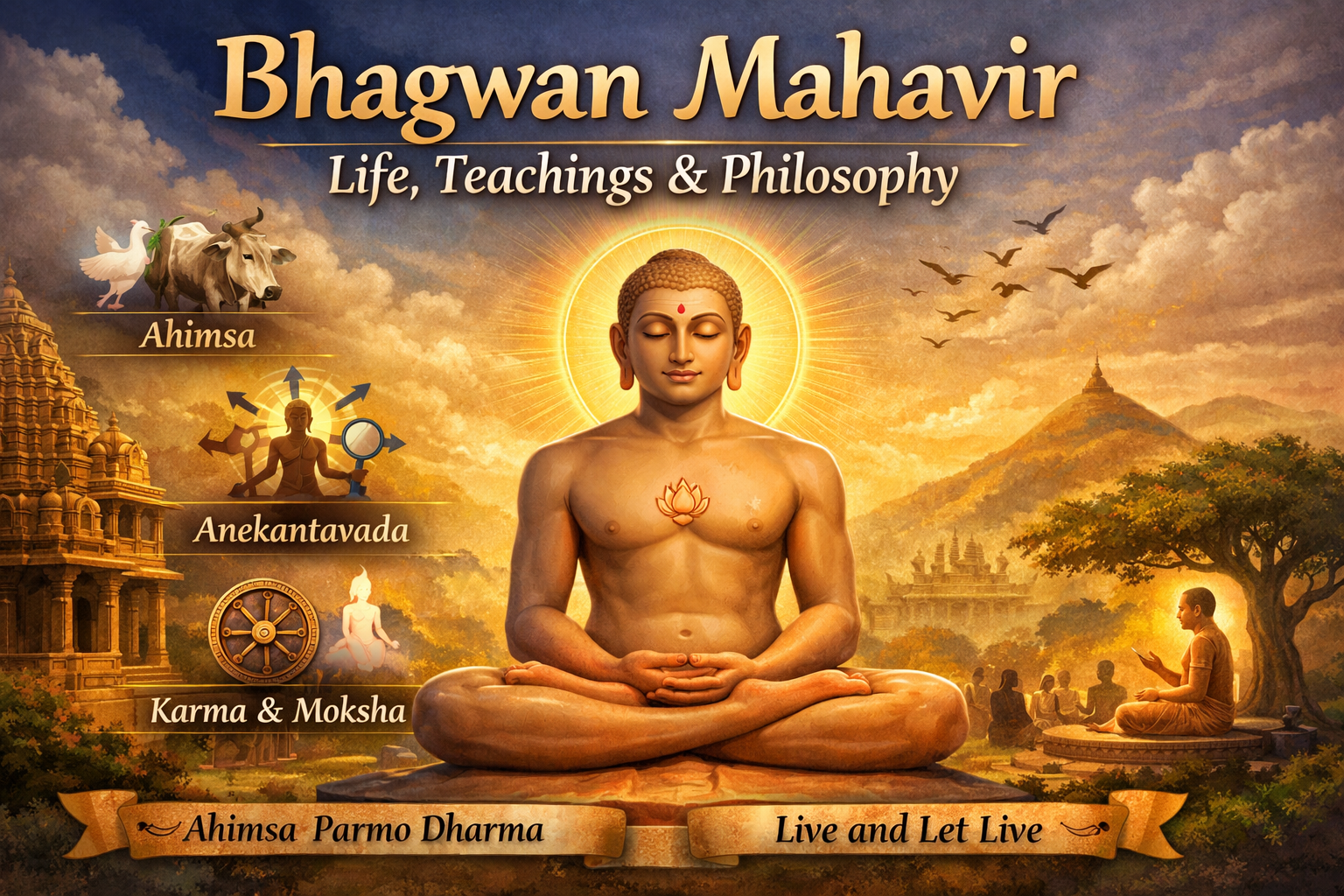
Introduction
Thank you for reading this post, don’t forget to subscribe!Bhagwan Mahavir, the 24th Tirthankara of Jainism, stands among the greatest spiritual figures in Indian history. His teachings of non-violence (Ahimsa), truth (Satya), and renunciation have shaped not only Jain philosophy but also influenced global thinkers and movements—including leaders like Mahatma Gandhi.
Mahavir’s life represents the ultimate journey from material attachment to spiritual liberation (moksha). His philosophy remains deeply relevant in today’s world, marked by conflict, environmental crises, and ethical dilemmas.
Birth and Early Life
Bhagwan Mahavir was born in 599 BCE in Kundagrama, near present-day Vaishali in Bihar.
Parents and Family
- Father: King Siddhartha, a ruler of the Jnatrika clan
- Mother: Queen Trishala, also known as Priyakarini
- He was born into a royal Kshatriya family
At birth, he was named Vardhamana, meaning “one who grows or increases prosperity.” According to Jain texts, his birth brought prosperity and happiness to the kingdom.
Why is He Called “Mahavir”?
The name Mahavir, meaning “Great Hero”, was given to him due to his extraordinary courage and fearlessness.
Several legends highlight his bravery:
- He remained calm even when attacked by animals or hostile beings
- He showed complete control over fear and physical suffering
- His spiritual courage surpassed worldly valour
Thus, Mahavir symbolizes inner strength—the victory over self, not others.
Renunciation and Spiritual Quest
At the age of 30, Mahavir renounced his royal life in search of truth and liberation.
He undertook:
- Severe austerities
- Deep meditation
- Complete detachment from material possessions
For 12 years, he practiced intense penance, enduring:
- Hunger and thirst
- Physical hardships
- Social rejection
Finally, he attained Kevala Jnana (omniscience)—the highest spiritual knowledge.
Historical Context: Kings and Era
Mahavir lived during a transformative period in ancient India, around the 6th century BCE.
Prominent rulers of his time included:
- Bimbisara
- Ajatashatru
This era also saw the rise of other spiritual traditions, including Buddhism, founded by Gautama Buddha.
Teachings of Bhagwan Mahavir
Mahavir did not claim to create a new religion but revived and restructured existing Jain traditions.
Core Teachings (Five Great Vows – Panch Mahavrata)
- Ahimsa (Non-violence)
Do not harm any living being—physically, mentally, or verbally. - Satya (Truthfulness)
Always speak the truth without causing harm. - Asteya (Non-stealing)
Do not take anything not willingly given. - Brahmacharya (Celibacy/Chastity)
Control of desires and sensual pleasures. - Aparigraha (Non-possession)
Renounce material attachment and greed.
Philosophy of Mahavir
Mahavir’s philosophy is deeply logical, ethical, and universal.
1. Ahimsa (Non-Violence)
Ahimsa is the cornerstone of Jain philosophy.
- Every living being, from humans to microorganisms, has a soul
- Violence leads to karmic bondage
- Compassion leads to liberation
This principle later influenced global peace movements.
2. Anekantavada (Theory of Multiple Perspectives)
Mahavir taught that truth is not absolute but multifaceted.
- Reality can be understood from different viewpoints
- No single perspective holds complete truth
- Encourages tolerance and intellectual humility
This idea promotes dialogue and coexistence in diverse societies.
3. Syadvada (Theory of Conditional Predication)
Closely related to Anekantavada, Syadvada teaches:
- Statements are conditional (“maybe,” “from a certain perspective”)
- Truth depends on context
This avoids dogmatism and rigid thinking.
4. Karma and Liberation
Mahavir emphasized:
- Karma binds the soul to the cycle of birth and death
- Liberation (moksha) is achieved through:
- Right faith (Samyak Darshan)
- Right knowledge (Samyak Jnana)
- Right conduct (Samyak Charitra)
Important Sutras and Principles
Some of Mahavir’s core philosophical expressions include:
- “Ahimsa Parmo Dharma” (Non-violence is the highest religion)
- “Live and let live”
- “Parasparopagraho Jivanam”
(All life is bound together by mutual support and interdependence)
These principles highlight ecological balance, coexistence, and ethical living.
Why is Bhagwan Mahavir Worshipped in Jainism?
Mahavir is revered because:
- He achieved perfect knowledge and liberation
- He showed a practical path to moksha
- He redefined ethics with universal applicability
- He emphasized self-discipline over ritualism
For Jains, he is not a god in the creator sense but a perfected soul (Siddha) who serves as an ideal.
Mahavir and Jain Community
Mahavir organized his followers into a structured community:
- Monks (Muni)
- Nuns (Aryika)
- Laymen (Shravaka)
- Laywomen (Shravika)
This system ensured the preservation and spread of Jain teachings.
Death and Nirvana
Mahavir attained nirvana (liberation) in 527 BCE at Pawapuri.
This day is celebrated as Diwali in Jain tradition.
Relevance of Mahavir’s Teachings Today
In modern times, Mahavir’s teachings are more relevant than ever:
1. Non-violence in a Violent World
Promotes peace, tolerance, and conflict resolution.
2. Environmental Sustainability
Aparigraha encourages minimalism and conservation.
3. Intellectual Tolerance
Anekantavada supports diversity of thought.
4. Ethical Living
His teachings promote honesty, discipline, and compassion.
Conclusion
Bhagwan Mahavir was not just a religious leader but a philosopher of humanity. His teachings transcend religion and offer a universal guide for ethical and spiritual living.
In an age of excess, conflict, and division, Mahavir’s message is clear:
Control desires, respect all life, and seek truth with humility.
His life remains a timeless beacon, guiding humanity toward peace, harmony, and liberation.
Leave a Reply