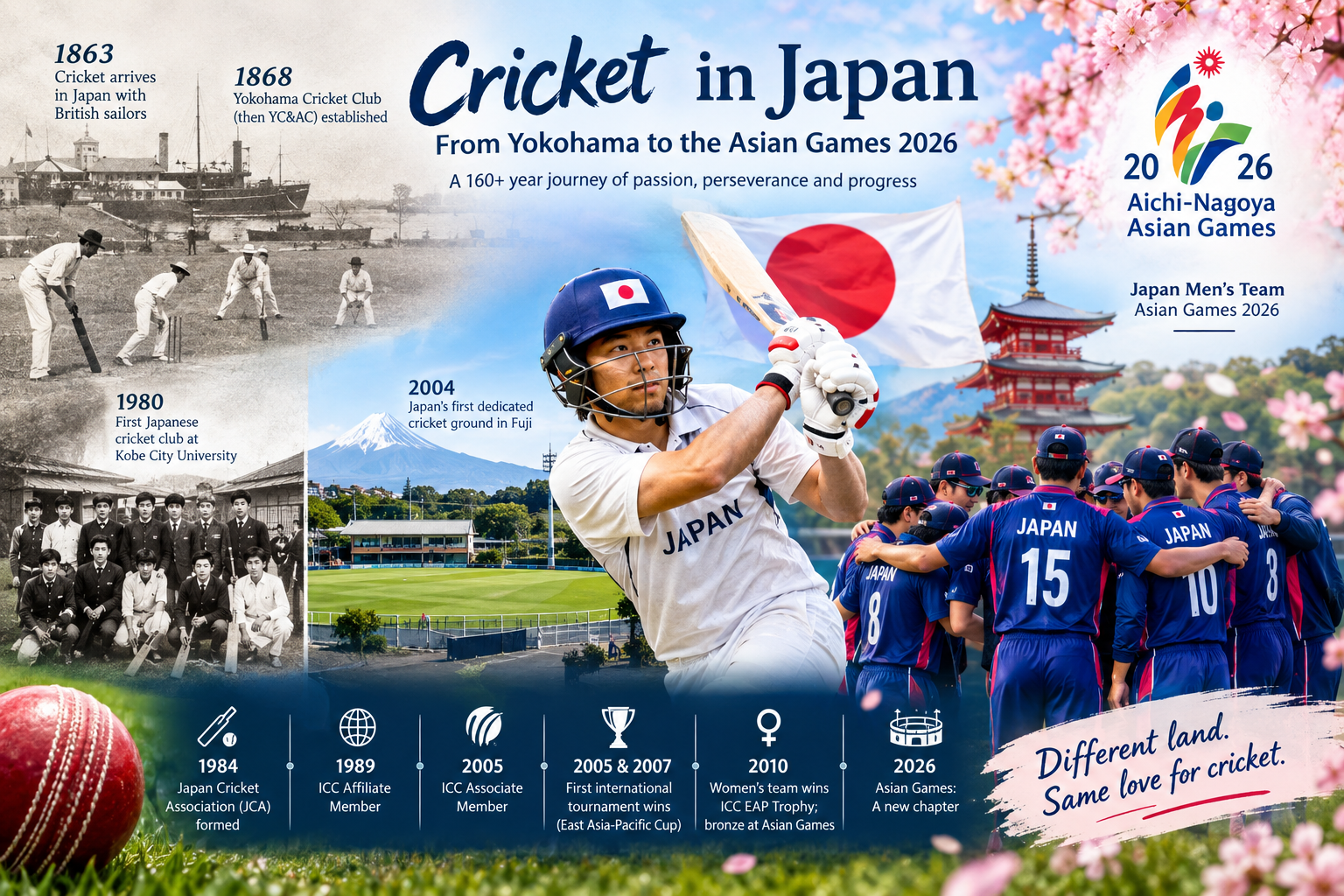
Cricket may not be the first sport associated with Japan, but its story in the country stretches back more than 160 years. From a game played largely by British expatriates to a growing Japanese sport with a national team competing at the Aichi-Nagoya Asian Games 2026, Japan’s cricket journey is one of gradual but remarkable evolution.
Thank you for reading this post, don’t forget to subscribe!From British Sailors to Japan’s First Cricket Club
Cricket was first played in Japan in 1863, introduced by the British during the final years of the Tokugawa period. Five years later, in 1868, the Yokohama Cricket Club—today known as the Yokohama Country & Athletic Club (YC&AC)—was established by Scottish tea merchant J.P. Mollison.
Unlike baseball, introduced around the same period and rapidly embraced by Japanese society, cricket initially remained largely within expatriate communities. Its transformation into a Japanese sport began much later.
In 1980, Professor Makoto Yamada established the first cricket club comprising Japanese members at Kobe City University of Foreign Studies. Universities subsequently became important centres of development, with Keio University (1987), Chuo University (1989) and Senshu University (1989) developing cricket programmes.
Building a National Cricket Structure
The Japan Cricket Association (JCA) was founded in 1984. Japan became an ICC Affiliate Member in 1989 and an ICC Associate Member in 2005, marking an important step in its international development.
Japan’s men’s team made its recognised international tournament debut in the 1996 Asian Cricket Council Trophy. A major breakthrough came in 2005, when Japan won the ICC East Asia-Pacific Cricket Cup in Vanuatu, its first international tournament victory in 11-a-side cricket. It repeated the achievement in 2007 and entered the World Cricket League.
Women’s cricket also developed steadily. Japan’s women’s team made its international tournament debut at the 2003 IWCC Trophy, won the ICC EAP Women’s Cricket Trophy in 2010, and claimed a bronze medal at the 2010 Asian Games.
A New Generation
Japan’s development model is unusual. Many players combine cricket with university education or full-time professional careers. School and university bukatsu (extracurricular club activities) have helped introduce the sport to young Japanese players. The country also built its first dedicated cricket ground in Fuji in 2004.
Among the current generation, Makoto Taniyama has become particularly notable. A leg-spinner, he became Japan’s leading wicket-taker in international cricket during the 2026 East Asia-Pacific T20 World Cup Qualifier.
Japan at the Asian Games 2026
The 2026 Aichi-Nagoya Asian Games represent another landmark. Japan’s men’s team has been placed in Group A with Afghanistan and Nepal, with matches scheduled at Korogi Park in Nisshin.
Japan Men’s Squad – Asian Games 2026
Kendel Kadowaki-Fleming (Captain), Charlie Hara-Hinze, Benjamin Ito-Davis, Alester Kadowaki-Fleming, Kohei Kubota, Jake Kusuda-Nairn, Wataru Miyauchi, Reo Sakurano-Thomas, Alex Shirai-Patmore, Shoma Sugaya-Slater, Declan Suzuki-McComb, Tsuyoshi Takada, Ibrahim Takahashi, Makoto Taniyama and Lachlan Yamamoto-Lake.
Ten members of this squad also represented Japan at the delayed 2022 Asian Games, while Jake Kusuda-Nairn received his first national-team selection.
Another historic moment arrived on 22 September 2026, when Japan faced India in a men’s T20 International for the first time, just before the Asian Games.
From a British naval introduction in 1863 to a Japanese national side entering a major Asian multi-sport event, cricket in Japan has travelled a long and fascinating road. Its next chapter may be written by a generation for whom cricket is no longer an imported curiosity, but a sport of their own.
Leave a Reply