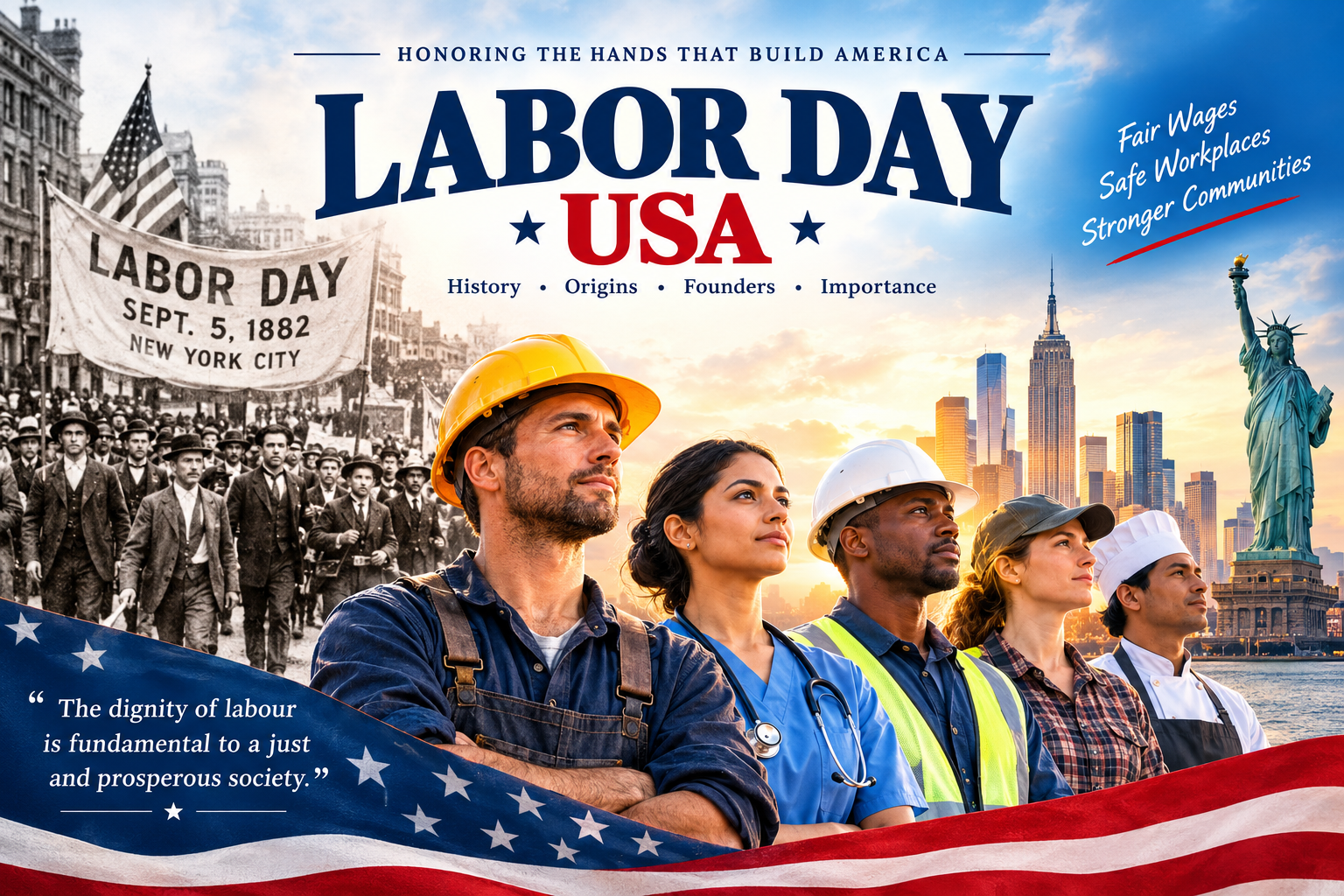
Every year, on the first Monday of September, the United States celebrates Labor Day—a federal holiday honouring the economic and social contributions of American workers. For many Americans, it marks the unofficial end of summer. But behind the picnics, parades and holiday sales lies a powerful history of workers’ struggles, trade unions and the fight for dignity at work.
Thank you for reading this post, don’t forget to subscribe!How Did Labor Day Begin?
Labor Day emerged during the rapid industrialisation of late-19th-century America, when factory and industrial workers often faced long working hours, low wages, unsafe workplaces and limited labour rights.
The first major Labor Day celebration took place in New York City on September 5, 1882. Around 10,000 workers participated in a parade organised by the Central Labor Union, followed by speeches, a picnic and festivities. The event demonstrated the growing strength and solidarity of organised labour.
The idea quickly spread. By 1894, numerous states had adopted Labor Day as a holiday. On June 28, 1894, President Grover Cleveland signed legislation establishing the first Monday of September as a national legal holiday.
Who Were the Champions?
The origins of Labor Day are associated particularly with two labour leaders: Peter J. McGuire and Matthew Maguire.
Peter McGuire, a prominent carpenter and trade-union leader, advocated a dedicated holiday celebrating workers and was later a co-founder of the American Federation of Labor (AFL).
However, historical research also strongly credits Matthew Maguire, a machinist and secretary of New York’s Central Labor Union, with proposing the holiday. Thus, there is no absolute consensus over who deserves to be called the sole “father” of Labor Day.
Another important figure was Eugene V. Debs, whose American Railway Union became central to the famous Pullman Strike of 1894, a major confrontation between workers, employers and the federal government. The violence surrounding the strike intensified national debate about labour relations and workers’ rights.
Why Is Labor Day Important?
Labor Day is more than a day off. It represents the historic struggle for fair wages, reasonable working hours, workplace safety, collective bargaining and human dignity.
Many rights now taken for granted were shaped by generations of workers and labour organisers who demanded a greater share of the prosperity they helped create.
Today, Labor Day therefore carries a simple but enduring message: America’s economic strength is ultimately built by its workers. From factory floors to offices, farms to laboratories, the holiday recognises the people whose labour sustains the nation’s economy and society.
Labor Day is not merely a celebration of work—it is a reminder that the dignity of labor is fundamental to a just and prosperous society.
Leave a Reply