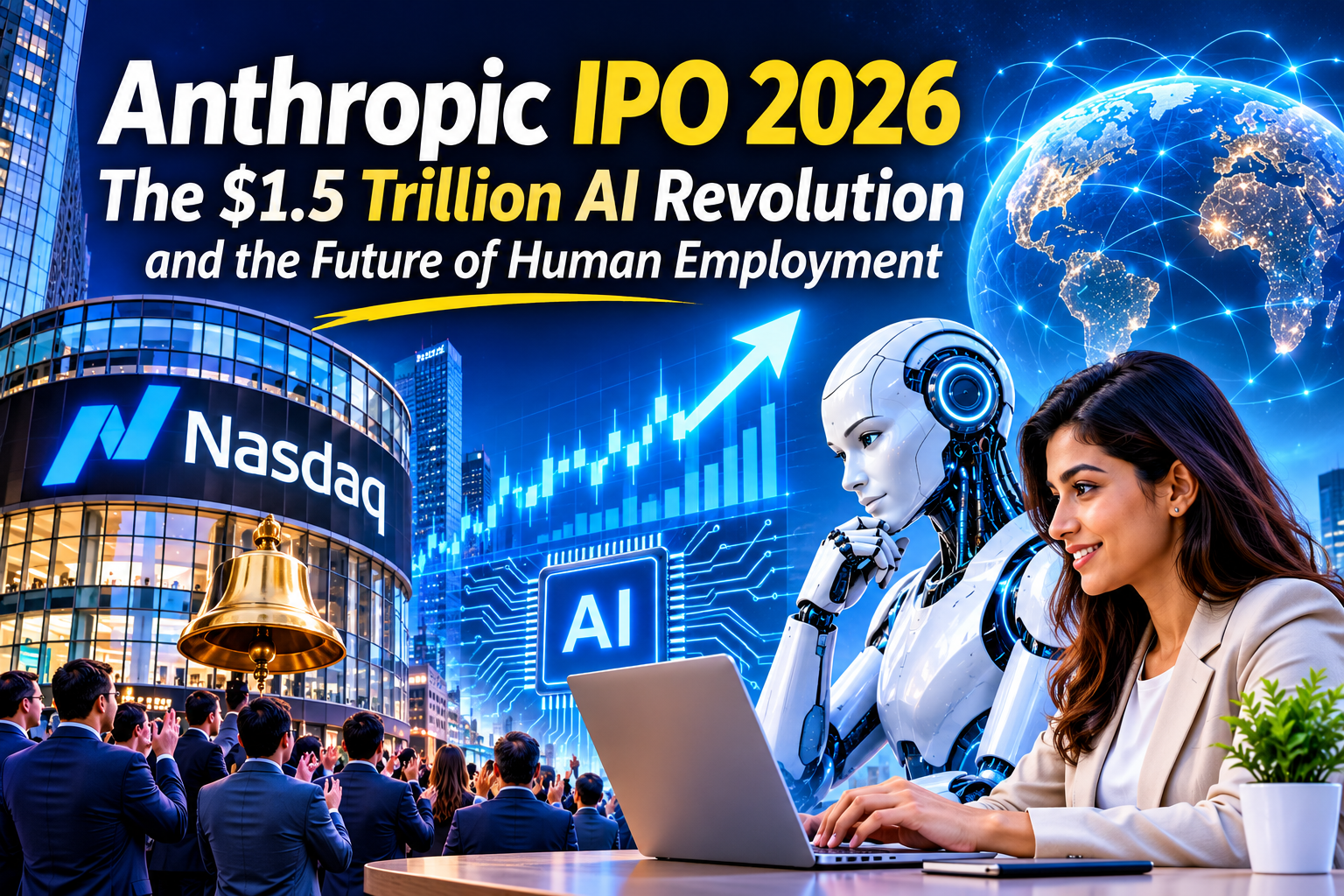
Artificial intelligence is no longer just a technological innovation; it is becoming one of the most valuable economic forces in the world. The November 2026 initial public offering (IPO) of Anthropic, the company behind the popular AI assistant Claude, represents a landmark moment in this transformation. With an IPO valuation of approximately $1.5 trillion, Anthropic has demonstrated the extraordinary financial potential of artificial intelligence.
Thank you for reading this post, don’t forget to subscribe!But why is a company established in 2021 attracting such an enormous valuation? What makes its technology commercially valuable? How will its growth affect industries, employment and the global economy? More importantly, will AI create new opportunities for humanity or replace millions of existing jobs?
The Anthropic IPO is not simply a financial market story. It offers a glimpse into the future of technology, business and human work.
1. What Is Anthropic?
Anthropic is an American artificial intelligence company founded in 2021 by former OpenAI employees, including siblings Dario Amodei and Daniela Amodei.
The company was established with a strong emphasis on developing powerful AI systems while prioritising safety, reliability and responsible innovation.
Its flagship product, Claude, is an advanced AI assistant capable of writing, analysing documents, generating computer code, conducting research and assisting with complex professional assignments.
Anthropic has attracted substantial investment and strategic partnerships from major technology companies, including Amazon, Google and NVIDIA.
Unlike traditional software companies, Anthropic is developing AI systems that can increasingly perform intellectual and professional tasks rather than simply execute predefined instructions.
2. Anthropic IPO 2026: A Historic Financial Milestone
Anthropic’s much-anticipated public offering reached a historic milestone in November 2026. The company listed on Nasdaq under the ticker symbol ANT, with trading commencing on 19 November.
The major IPO details are as follows:
| Particulars | Details |
| Company | Anthropic, PBC |
| IPO date | 19 November 2026 |
| Stock exchange | Nasdaq |
| IPO price | $83 per share |
| Shares offered | Approximately 980 million |
| IPO valuation | Approximately $1.5 trillion |
| Public capital raised | Approximately $81.3 billion |
| Additional private placement | Approximately $26 billion |
The IPO attracted extraordinary investor interest, reflecting growing confidence in the commercial future of artificial intelligence. Contemporary reports also indicated expectations of a strong opening above the IPO price.
The listing has become a landmark in technology financing, demonstrating how quickly AI companies have moved from research laboratories into the centre of global financial markets.
3. Why Is Anthropic Valued at $1.5 Trillion?
Anthropic’s extraordinary valuation reflects more than its existing products. Investors are betting on its future ability to transform the global economy.
First, rapid revenue growth: Anthropic has experienced remarkable commercial expansion, driven by increasing demand for Claude subscriptions, enterprise services and API access. Its reported annualised revenue run rate reached approximately $81 billion in October 2026. This is a run-rate estimate, not actual annual revenue.
Second, enterprise adoption: Businesses are increasingly integrating AI into software development, financial analysis, customer support, research and administrative operations.
Third, technological capabilities: Claude’s ability to analyse complex information, generate code and assist with multi-step assignments creates substantial commercial opportunities.
Fourth, strategic partnerships: Relationships with major cloud computing and semiconductor companies provide access to the infrastructure necessary for developing advanced AI systems.
Finally, future market potential: Investors believe AI could become as economically important as electricity, the internet and cloud computing.
However, a high valuation reflects expectations, not guaranteed future profitability.
4. How Is Anthropic Disrupting Different Industries?
Anthropic’s technology has applications across several economic sectors.
- Information technology: Claude Code assists developers with programming, debugging, testing and software maintenance, potentially reducing development time and costs.
- Banking and finance: AI can support financial analysis, fraud detection, compliance, risk assessment and customer services.
- Healthcare: AI can assist medical researchers with literature reviews, drug discovery and clinical documentation, although medical decisions require professional oversight.
- Education: Intelligent assistants can provide personalised learning, support teachers and help researchers analyse information.
- Legal services: Contract analysis, legal research and document preparation can become faster and more efficient.
- Government: AI can support policy research, administrative processes, programme monitoring and public service delivery.
- Media and marketing: Content creation, translation, advertising and audience analysis are increasingly being automated.
The larger transformation is that AI is moving beyond answering questions towards completing complex assignments.
5. Will Anthropic Replace Human Employment?
Perhaps the most significant concern surrounding the AI revolution is its impact on employment.
Unlike earlier technological revolutions that primarily automated physical labour, advanced AI can perform many cognitive tasks traditionally undertaken by educated professionals.
Routine administration, data entry, basic content writing, customer support, accounting assistance and entry-level programming could face substantial automation.
However, this does not mean all these occupations will disappear. Many will evolve.
Three employment trends are likely to emerge:
- Job displacement: Organisations may reduce recruitment where AI can perform routine tasks more efficiently.
- Job transformation: Professionals will increasingly use AI to improve productivity and focus on decision-making, creativity and supervision.
- New employment opportunities: AI governance, cybersecurity, data management, AI auditing and human-AI workflow management could generate new occupations.
For India, the implications are particularly important. Its large IT, business process outsourcing and services sectors could experience considerable restructuring.
The country must therefore invest in digital literacy, analytical thinking, technical education and continuous reskilling.
The future may not belong exclusively to humans or machines, but to people who can work effectively with intelligent systems.
6. What Is the Future of Anthropic?
Anthropic has considerable opportunities, but its long-term success will depend on its ability to convert technological leadership into sustainable financial performance.
Its future growth could come from autonomous AI agents, enterprise automation, scientific research, healthcare applications and international expansion.
Competition will also intensify. Companies such as OpenAI, Google DeepMind and Meta are investing heavily in advanced AI.
Anthropic must continue improving model performance, affordability, reliability and security to maintain its competitive position.
Nevertheless, significant risks remain. Its enormous computing commitments, infrastructure expenditure, competition and profitability challenges could affect future performance. Its reported third-quarter 2026 operating loss of approximately $567 million illustrates that rapid revenue growth does not automatically guarantee profits.
7. Is Anthropic’s IPO a New Industrial Revolution?
Anthropic’s IPO raises an important question: are investors witnessing the beginning of a genuine industrial revolution or another technology investment bubble?
There are strong reasons to believe AI will transform the global economy. Its applications are expanding rapidly, businesses are adopting it and productivity improvements are becoming increasingly measurable.
However, excessive valuations, infrastructure costs and uncertain profitability create financial risks.
The dot-com boom provides an important historical lesson: the internet revolution was genuine, but not every internet company survived.
Similarly, AI may transform the world without every AI company becoming a successful long-term investment.
Conclusion: The Future Must Remain Human-Centred
Anthropic’s $1.5 trillion IPO valuation represents a defining moment in the commercial development of artificial intelligence. It demonstrates that intelligence itself is becoming an increasingly valuable economic resource.
AI has the potential to improve healthcare, expand educational access, accelerate scientific discoveries and make businesses and governments more efficient. At the same time, it could disrupt traditional employment, increase economic inequality and challenge existing professional structures.
For countries such as India, the priority should be to embrace technological innovation while preparing the workforce for changing employment requirements.
Governments, businesses and educational institutions must work together to ensure that AI-driven productivity translates into inclusive economic growth.
Ultimately, the success of the AI revolution should not be measured only by company valuations, stock prices or technological capabilities. It should also be measured by improvements in human welfare, employment opportunities and quality of life.
The most important question of the AI era is not whether machines can become more intelligent, but whether humanity can use that intelligence to build a more productive, equitable and sustainable world.
Editorial note: This article reflects the IPO information and reporting available as of 19 November 2026. Financial figures should be read alongside the company’s official SEC filings. The IPO valuation is not a guarantee of future share performance. This is an informational article, not investment advice.
Leave a Reply