Blog

  • Nicolás Maduro: Life, Ideology, Political Career and Venezuela’s Defiant Stand in a Changing World Order

    Nicolás Maduro: Life, Ideology, Political Career and Venezuela’s Defiant Stand in a Changing World Order

    Introduction

    Nicolás Maduro is one of the most controversial and consequential political figures in contemporary Latin American politics. As the successor to Hugo Chávez and President of Venezuela since 2013, Maduro has presided over a period marked by economic collapse, political polarization, international sanctions, and intense geopolitical confrontation—particularly with the United States.

    To his supporters, Maduro is a symbol of resistance against imperialism and external interference. To his critics, he represents authoritarianism, mismanagement, and democratic erosion. Understanding Nicolás Maduro requires going beyond headlines to examine his background, ideology, leadership style, and the strategic calculations that shape his confrontation with global powers.

    Early Life and Background

    Nicolás Maduro Moros was born on 23 November 1962 in Caracas, Venezuela, into a working-class family. His upbringing was shaped by modest economic circumstances and exposure to trade union activism—an experience that deeply influenced his political worldview.

    Unlike many Latin American leaders who come from elite or military backgrounds, Maduro’s political identity emerged from grassroots labour movements, particularly among public transport workers.

    Educational Background

    Maduro did not follow a conventional academic path. He completed his basic schooling in Venezuela but did not pursue a university degree. Instead, his political education was largely experiential:

    • Training in trade union organizing
    • Exposure to leftist political movements
    • Informal ideological formation through Marxist and socialist literature
    • Political mentorship under Hugo Chávez

    This non-elite background later became both a political asset and a criticism point—praised by supporters as “man of the people” credentials and criticized by opponents as a lack of technocratic competence.

    Entry into Politics and Rise Under Hugo Chávez

    Maduro’s political rise is inseparable from Hugo Chávez, the architect of Venezuela’s Bolivarian Revolution.

    Key Milestones:

    • 1990s: Active in the Bolivarian movement supporting Chávez
    • 2000: Elected to the National Assembly
    • 2005–2006: President of the National Assembly
    • 2006–2013: Foreign Minister of Venezuela

    As Foreign Minister, Maduro became the international face of Chávez’s anti-imperialist diplomacy, strengthening ties with:

    • Cuba
    • Russia
    • China
    • Iran
    • Left-leaning Latin American governments

    In 2013, shortly before his death, Chávez publicly named Maduro as his political successor.

    Presidency: Consolidation of Power

    Maduro won the 2013 presidential election by a narrow margin. His presidency has since been defined by:

    • Economic crisis
    • Political unrest
    • International isolation
    • Institutional centralization of power

    Governance Characteristics:

    • Strong executive control
    • Reduced independence of state institutions
    • Frequent use of emergency powers
    • Reliance on security forces and loyal political cadres

    Maduro governs in a highly polarized environment, where legitimacy is continuously contested both domestically and internationally.

    Ideology: Bolivarian Socialism

    Maduro identifies as a socialist, deeply aligned with Chávez’s Bolivarian ideology, which blends:

    • Marxist thought
    • Anti-imperialism
    • Latin American nationalism
    • Social welfare populism

    Core Ideological Beliefs:

    • State control over strategic resources (especially oil)
    • Redistribution through social programs
    • Rejection of U.S. dominance in global affairs
    • Advocacy of a multipolar world order

    Maduro sees Venezuela’s struggle as part of a broader global resistance against Western political and economic dominance.

    Leadership and Working Style

    Maduro’s leadership style differs significantly from Chávez’s charismatic populism.

    Key Traits:

    • Bureaucratic and institutional control rather than mass charisma
    • Heavy reliance on the military and security apparatus
    • Emphasis on loyalty over dissent within the ruling party
    • Frequent nationalist and anti-foreign rhetoric

    Critics argue that this style has deepened authoritarian tendencies, while supporters see it as necessary for survival under pressure.

    Economic Crisis and Governance Challenges

    Under Maduro, Venezuela experienced one of the worst economic collapses in modern history, characterized by:

    • Hyperinflation
    • Collapse of oil production
    • Mass migration
    • Decline in living standards

    Maduro attributes much of the crisis to U.S. and Western sanctions, while critics cite mismanagement, corruption, and policy failures.

    Why Maduro Confronts the United States

    Maduro’s confrontation with the U.S. is driven by multiple factors:

    1. Ideological Opposition

    The U.S. is viewed as the principal adversary of socialist governance and Latin American sovereignty.

    2. Sanctions and Political Pressure

    Washington has imposed:

    • Financial sanctions
    • Oil export restrictions
    • Diplomatic isolation

    Maduro views resistance as essential to regime survival.

    3. Domestic Legitimacy

    External confrontation helps consolidate internal support by framing opposition as foreign-backed.

    4. Geopolitical Alliances

    Partnerships with China, Russia, Iran, and Cuba provide strategic alternatives to Western systems.

    Maduro’s Approach to Current Global Geopolitics

    Maduro positions Venezuela within a multipolar global order, emphasizing:

    • Support for BRICS-aligned worldviews
    • Opposition to Western interventionism
    • Advocacy of South-South cooperation
    • Strategic balancing among global powers

    He has openly supported:

    • Russia’s resistance to NATO expansion
    • China’s global economic initiatives
    • Regional Latin American autonomy

    International Perception and Influence

    Globally, Maduro’s influence is limited but symbolically significant:

    • Seen as a symbol of resistance among anti-Western governments
    • Viewed skeptically by democratic institutions
    • Central figure in debates over sovereignty vs. human rights

    Despite isolation, Maduro has demonstrated political resilience, remaining in power longer than many analysts predicted.

    Evaluation: A Polarizing Legacy

    Nicolás Maduro’s legacy is complex and deeply divisive.

    Strengths (Supporters’ View):

    • Defiance against foreign intervention
    • Preservation of state sovereignty
    • Continuation of social-justice rhetoric

    Criticisms:

    • Democratic erosion
    • Economic mismanagement
    • Human rights concerns
    • Emigration crisis

    Conclusion

    Nicolás Maduro is not merely a national leader but a product of Venezuela’s historical struggle between sovereignty, socialism, and global power politics. His confrontation with the United States reflects not only personal ideology but also structural tensions in the international system.

    Whether history judges him as a defender of national independence or a leader who presided over national decline will depend on how Venezuela navigates its economic recovery, political reconciliation, and reintegration into the global community.

  • What is U.S.–Venezuela Conflict ?: Causes, Geopolitics & Global Impact

    What is U.S.–Venezuela Conflict ?: Causes, Geopolitics & Global Impact

    Introduction

    Tensions between the United States and Venezuela — long simmering — have escalated dramatically in late 2025 into early January 2026, with reports of U.S. military strikes in Caracas and claims that Venezuelan President Nicolás Maduro has been captured. This has pushed the two nations to the brink of open confrontation, raising alarm worldwide about regional security, global trade, and geopolitical stability.

    1. What’s Happening Now?

    In early January 2026, multiple explosions were reported in Caracas and across northern Venezuela. The U.S. launched air and special operations strikes, with President Donald Trump claiming that Nicolás Maduro and his wife were captured. Venezuela denounced the attacks as “illegal military aggression,” declared a national emergency, and warned of intensified resistance.

    The situation has triggered:

    • Venezuela’s declaration of emergency.
    • Strong condemnation from allies like Colombia and Cuba.
    • Fears of wider regional escalation.
    • Disruption to regional airspace and travel advisory warnings.

    2. Root Causes Behind the Conflict

    a. Longstanding Political Breakdown

    Venezuela has faced years of political turmoil, disputed elections, economic collapse, and mass protests since 2018 — paving the way for unstable governance and legitimacy crises.

    b. U.S. Sanctions & Designations

    The U.S. has imposed sanctions on Venezuelan officials and institutions, accusing the Maduro regime of corruption, human rights abuses, and narco-terrorism — including designating the “Cartel de los Soles” a terrorist organization.

    c. Military Buildup & Caribbean Tensions

    From late 2025, the U.S. significantly increased its naval and air presence in the Caribbean — the largest such buildup in decades — framed as counter-drug and regional security operations. Venezuela strongly rebuffed this as an aggressive formation aimed at regime change.

    d. Drug Trafficking Claims

    The U.S. asserts Venezuelan facilities and gangs play a major role in cocaine distribution to U.S. markets, justifying military and law enforcement pressure. Venezuela denies this and sees it as a pretext for broader intervention.

    e. Oil, Resources & Strategic Interests

    Venezuela holds the world’s largest proven oil reserves, making it geopolitically critical for global energy markets. U.S. policy aims to influence control over energy exports and limit Russian and Chinese footholds in the region.

    f. Global Power Rivalry

    Venezuela’s growing ties with China and Russia — economically and militarily — have turned it into a flashpoint in broader U.S.–China–Russia competition, particularly in what Washington considers its strategic hemisphere.

    3. Geopolitics: Why It Matters Beyond Bilateral Dispute

    a. Monroe Doctrine Legacy

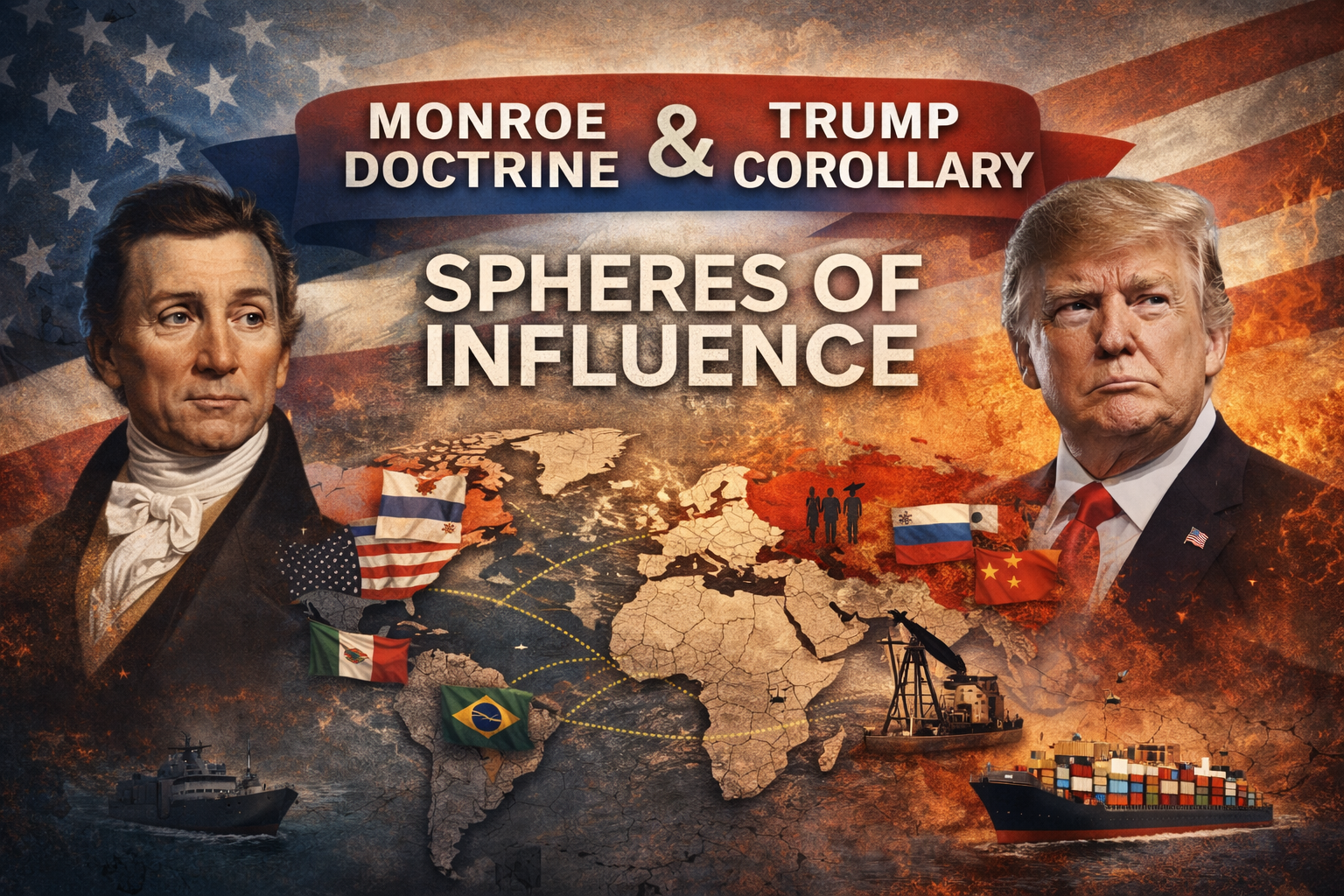
    The U.S. historically views Latin America as its sphere of influence. Venezuela’s alliances with rival powers challenge that paradigm.

    b. Influence of China & Russia

    Beijing has invested massively in Venezuelan oil infrastructure and loans, while Moscow has supplied military aid — transforming a regional standoff into a global geostrategic question.

    c. Latin American Regional Stability

    Neighbouring countries — including Colombia, Brazil, and Caribbean nations — fear refugee flows, border tensions, and economic disruption if war spreads.

    d. Global Energy Market Volatility

    Any conflict or sanctions impacting Venezuelan oil affects crude pricing, supply chains, and investments — influencing markets from North America to Asia.

    4. Consequences for Regional Security & Global Trade

    a. Security Risks

    • Increased militarization of the Caribbean.
    • Spillover risks into Caribbean and South American nations.
    • Heightened refugee and humanitarian crises.

    b. Economic Disruption

    • Global oil price instability.
    • Trade disruptions due to naval blockades or airspace closures.
    • Foreign investment pullbacks in Latin America.

    c. Business & Investment

    Foreign businesses face higher risk premiums, restricted operations, and potential target sanctions or trade blockades as geopolitical tensions sour investor confidence.

    5. Why Both Countries Are Locked In

    For the USA

    • Wants to curb alleged narco-trafficking and terrorism threats.
    • Aims to counter Chinese and Russian influence in its hemisphere.
    • Sees Venezuela’s political system as destabilizing regionally.

    For Venezuela

    • Maduro’s government sees U.S. actions as a threat to sovereignty.
    • Mobilizes internal political legitimacy through external pressure.
    • Depends on alliances with China, Russia, and others for economic survival.

    6. Potential Solutions & Negotiations

    Although tension has sharply escalated, analytical consensus suggests a combination of:

    Diplomacy & Third-Party Mediation

    Engaging regional blocs (e.g., OAS, UN, CARICOM) or neutral countries to broker ceasefire and political negotiation.

    Incremental De-escalation

    Withdrawal of some U.S. military assets, phased easing of sanctions in return for credible reforms, with monitoring by international observers.

    Addressing Root Causes

    Economic reforms in Venezuela, anti-drug cooperation, assurances on resource governance, and confidence-building measures could reduce incentives for conflict.

    Humanitarian Focus

    Prioritising migrant support, food and medicine delivery corridors, and refugee assistance to de-politicize the crisis.

    Without calibrated diplomacy, the conflict risks becoming protracted and costly for civilians and the region.

    7. Impact on Global Geopolitics

    If the U.S.–Venezuela standoff turns into prolonged conflict:

    • It complicates U.S. strategic focus already strained by Ukraine, Middle East, and China competition.
    • It could spur greater cooperation between Russia & China as counterweights.
    • Investment and trade flows would shift as markets price in supply disruptions and security risks.
    • Regional alliances might realign, affecting future U.S.–Latin America engagement.

    Conclusion

    The crisis between the United States and Venezuela is not just a bilateral dispute — it is a multidimensional geopolitical standoff rooted in political legitimacy, resource control, anti-drug policy, hemispheric influence, and global power rivalry. Its consequences are far-reaching — from regional stability to global energy markets and investor confidence. While immediate war has not officially been declared, 2026 has begun with one of the most serious escalations in recent U.S.–Latin America relations, making diplomatic solutions urgent not only for these two nations but for global security and economic resilience.

  • Mountain Lion: The Silent Ghost of the Wilderness

    Mountain Lion: The Silent Ghost of the Wilderness

    Introduction

    Quiet, powerful, and rarely seen, the mountain lion is one of the most mysterious predators on Earth. Known by many names—cougar, puma, panther, or catamount—this majestic big cat has inspired awe, fear, and folklore across the Americas. Despite its wide range, it remains a master of invisibility, often living close to humans without ever being noticed.

    Scientific Identity

    • Common Name: Mountain Lion
    • Scientific Name: Puma concolor
    • Family: Felidae

    The name Puma concolor literally means “cat of one colour,” referring to its sleek, uniform coat that helps it blend seamlessly into its surroundings.

    Physical Specialties: What Makes the Mountain Lion Unique

    The mountain lion is built for stealth and speed rather than brute strength.

    Key Special Features

    • Powerful hind legs capable of leaping up to 18 feet vertically and over 40 feet horizontally
    • Flexible spine for rapid acceleration
    • Sharp retractable claws for gripping prey
    • Excellent night vision, nearly six times better than humans
    • Long tail used for balance while running or climbing

    Unlike lions, mountain lions do not roar. Instead, they communicate through growls, hisses, whistles, and haunting screams—often mistaken for human cries.

    Geographical Distribution: Where Do Mountain Lions Live?

    Mountain lions have the widest range of any wild land mammal in the Western Hemisphere.

    They are found in:

    • North America (western United States, Canada, Florida)
    • Central America
    • South America (from Colombia to southern Chile)

    They once ranged across most of North America but were eliminated from many eastern regions due to hunting and habitat loss. Today, conservation efforts are helping some populations slowly recover.

    Preferred Habitat

    Mountain lions are highly adaptable, but they prefer environments that offer cover and prey.

    Ideal Habitats Include:

    • Mountain ranges
    • Dense forests
    • Grasslands
    • Deserts
    • Swamps (notably the Florida panther)

    Their key requirement is seclusion and prey availability, not a specific climate.

    Diet: What Is the Mountain Lion’s Favourite Meal?

    Mountain lions are obligate carnivores and apex predators.

    Primary Prey

    • Deer (their most favoured and frequent prey)
    • Elk
    • Moose calves

    Secondary Prey

    • Raccoons
    • Rabbits
    • Porcupines
    • Coyotes
    • Livestock (occasionally)

    They typically hunt alone, stalking prey silently before delivering a powerful bite to the neck or skull.

    Hunting Behaviour and Lifestyle

    • Solitary animals, except mothers with cubs
    • Mostly crepuscular and nocturnal
    • Territories can range from 50 to 1,000 square kilometres
    • They often cache food, covering kills with leaves and soil to return later

    A single mountain lion can help regulate deer populations, making it a crucial species for ecosystem balance.

    Reproduction and Life Cycle

    • Females give birth every 2–3 years
    • Litter size: 1–6 cubs
    • Cubs stay with their mother for up to two years
    • Lifespan:
      • 8–13 years in the wild
      • Up to 20 years in captivity

    Mother mountain lions are highly protective and teach cubs hunting skills through observation and practice.

    How Dangerous Is a Mountain Lion to Humans?

    Despite their fearsome reputation, mountain lion attacks on humans are extremely rare.

    Key Facts

    • Fewer than 30 fatal attacks in North America in over 100 years
    • Most encounters occur during hiking or jogging
    • Children and solitary individuals are more vulnerable

    Safety Tips

    • Maintain eye contact
    • Do not run
    • Appear larger
    • Back away slowly

    Mountain lions generally avoid humans and attack only when threatened, starving, or protecting cubs.

    Role in Ecosystem and Contribution to Nature

    Mountain lions are a keystone species.

    Their Ecological Importance

    • Control herbivore populations
    • Prevent overgrazing
    • Maintain biodiversity
    • Support healthier forests and grasslands

    Regions with mountain lions often show improved ecological balance compared to areas where they are absent.

    Conservation Status and Threats

    • IUCN Status: Least Concern (globally)
    • Major Threats:
      • Habitat fragmentation
      • Road accidents
      • Illegal hunting
      • Human-wildlife conflict

    Some subspecies, like the Florida panther, remain endangered and require ongoing protection.

    Mountain Lion in Culture and Myth

    Mountain lions feature prominently in:

    • Native American mythology
    • Folklore and legends
    • Modern wildlife symbolism

    They often represent strength, independence, and guardianship.

    Conclusion

    The mountain lion is not just a predator—it is a symbol of wilderness resilience. Silent yet powerful, elusive yet influential, it plays a vital role in maintaining ecological harmony. Understanding this magnificent animal helps replace fear with respect and highlights the importance of conserving wild spaces where both humans and mountain lions can coexist.

  • Tommy Lee Jones: The Life, Legacy, and Latest Chapter of a Hollywood Legend

    Tommy Lee Jones: The Life, Legacy, and Latest Chapter of a Hollywood Legend

    Introduction

    Tommy Lee Jones is widely regarded as one of the most formidable and intellectually grounded actors in American cinema. Known for his stern authority, emotional restraint, and deeply human performances, Jones has built a career that spans more than five decades. From Westerns and political thrillers to blockbuster science fiction and historical dramas, he has consistently chosen roles that reflect substance over spectacle.

    As of 2026, his life reflects both towering professional achievement and profound personal loss — making his journey not only cinematic but deeply human.

    Early Life and Family Background

    Tommy Lee Jones was born on September 15, 1946, in San Saba, Texas, a small town that shaped his grounded worldview. He was raised primarily in Midland, Texas, by his parents:

    • Clyde C. Jones, an oil-field worker and cowboy
    • Lucille Marie Jones, a schoolteacher, police officer, and beauty shop owner

    His parents’ marriage was turbulent, involving separation and reconciliation, which exposed him early to life’s complexities. Jones has Cherokee ancestry, and his rural upbringing instilled in him a strong sense of discipline, independence, and resilience — qualities that would later define many of his screen characters.

    Education: A Scholar-Athlete Turned Artist

    Jones attended St. Mark’s School of Texas, one of the state’s most prestigious institutions, before earning a football scholarship to Harvard University. At Harvard, he studied English Literature and graduated in 1969.

    Notably, he shared a dormitory room for four years with Al Gore, who would later become Vice President of the United States. While Jones excelled academically and athletically, it was theatre and classical literature that ultimately shaped his future.

    After graduating, he consciously chose acting over professional football, a decision that would alter the course of American cinema.

    Early Acting Career

    Jones began his professional acting career in theatre and television, gaining recognition on the soap opera One Life to Live in the early 1970s. His film debut came with Love Story (1970), followed by years of character roles that sharpened his craft.

    During this period, he developed a reputation for seriousness, discipline, and emotional depth — traits that later distinguished him from many of his contemporaries.

    Rise to Stardom and Iconic Roles

    The 1990s marked his ascent to global recognition. His portrayal of U.S. Marshal Samuel Gerard in The Fugitive (1993) earned him the Academy Award for Best Supporting Actor, solidifying his place among Hollywood’s elite.

    Other defining performances include:

    • JFK (1991) — as Clay Shaw
    • Men in Black series — revealing his impeccable deadpan comedic timing
    • No Country for Old Men (2007) — a chilling, morally complex performance
    • Lincoln (2012) — as Thaddeus Stevens, earning another Oscar nomination

    His work is marked by intellectual rigor, moral ambiguity, and emotional restraint.

    Director, Writer, and Creative Thinker

    Tommy Lee Jones is also an accomplished director and writer. His most celebrated directorial work, The Three Burials of Melquiades Estrada (2005), won him Best Actor at the Cannes Film Festival and showcased his deep engagement with themes of justice, borders, and human dignity.

    He later directed The Homesman (2014), further affirming his artistic seriousness beyond mainstream cinema.

    Personal Life, Marriages, and Children

    Jones has been married three times:

    1. Kate Lardner (1971–1978)
    2. Kimberlea Cloughley (1981–1996)
    3. Dawn Laurel (married in 2001, present)

    He had two children, Austin Jones and Victoria Jones, from his second marriage.

    • Austin Jones is a composer and actor who collaborated with his father on film projects.
    • Victoria Jones appeared in minor roles as a child and largely lived outside the public eye as an adult.

    Tragic Loss: Death of His Daughter (2026)

    On January 1, 2026, Tommy Lee Jones’s daughter Victoria Jones was found deceased in a hotel in San Francisco at the age of 34. Authorities responded to a medical emergency, and she was pronounced dead at the scene. At the time of reporting, officials stated that the cause of death was under investigation, with no immediate signs of foul play disclosed publicly.

    Victoria had appeared briefly in films connected to her father, including Men in Black II and The Three Burials of Melquiades Estrada. The family has requested privacy during this period of mourning.

    This tragic event marks one of the most painful chapters in Jones’s personal life and stands in stark contrast to his otherwise private and disciplined public persona.

    Life Beyond Cinema

    Despite global fame, Tommy Lee Jones remains deeply connected to Texas ranch life. He owns ranches, participates in equestrian sports and polo, and is known for his preference for rural solitude over Hollywood glamour.

    Internationally, he became a cultural icon in Japan through his long-running appearance as “Alien Jones” in Suntory Coffee Boss commercials, demonstrating his global appeal beyond cinema.

    Contribution to Society and American Culture

    Tommy Lee Jones’s contribution extends beyond box-office success:

    • He elevated serious, literate acting in mainstream cinema
    • Preserved and modernized the American Western tradition
    • Portrayed law, justice, and moral conflict with realism
    • Inspired generations of actors to value craft over celebrity

    He represents a rare blend of intellectual depth, artistic integrity, and cultural influence.

    Conclusion

    Tommy Lee Jones is not merely a film star — he is a chronicler of the American conscience. From Texas plains to Harvard halls, from courtroom dramas to existential Westerns, his life reflects discipline, thoughtfulness, and authenticity.

    As of 2026, his journey continues under the shadow of personal loss, reminding audiences that behind even the strongest screen personas lies a deeply human story. His legacy, however, remains indelible — etched into the history of American cinema.

  • Rose Bowl 2026: World Cup Legacy & Global Significance

    Rose Bowl 2026: World Cup Legacy & Global Significance

    Introduction

    When the world turns its eyes to the FIFA World Cup 2026, one iconic venue will once again stand at the crossroads of history, emotion, and global sport — the Rose Bowl Stadium, Pasadena, California. Known as the “Granddaddy of Them All,” the Rose Bowl is not just a stadium; it is a living monument to footballing legacy, cultural memory, and sporting excellence.

    As one of the official venues for the 2026 FIFA World Cup, jointly hosted by the United States, Canada, and Mexico, the Rose Bowl’s inclusion adds unmatched gravitas to the tournament. From legendary World Cup finals to hosting the game’s greatest icons, the Rose Bowl’s return to the global football stage in 2026 is both symbolic and historic.

    The Rose Bowl Stadium: A Timeless Sporting Icon

    Opened in 1922, the Rose Bowl Stadium is one of the most famous sports arenas in the world. With a seating capacity of over 88,000, it remains one of the largest stadiums in the United States and the largest World Cup venue on the U.S. West Coast.

    Located in Pasadena, near Los Angeles, the stadium is globally renowned for:

    • The annual Rose Bowl Game (college football)
    • Multiple Olympic events (1932 & 1984)
    • Iconic concerts and cultural events
    • Historic international football matches

    The Rose Bowl is officially designated a U.S. National Historic Landmark, making it one of the very few sports venues in the world with such recognition.

    Why Rose Bowl Matters in FIFA World Cup 2026

    The 2026 World Cup is historic in itself:

    • Expanded to 48 teams
    • A record 104 matches
    • First World Cup hosted by three countries

    Within this framework, the Rose Bowl holds special significance.

    Official Role in World Cup 2026

    • Selected as an official match venue
    • Expected to host group-stage matches and knockout fixtures
    • Represents the West Coast football hub of the tournament

    While the final match will be held at MetLife Stadium (New Jersey), the Rose Bowl remains one of the most prestigious and emotionally resonant venues of the tournament.

    A Stadium That Defines World Cup History

    What truly elevates the Rose Bowl is its World Cup legacy:

    1994 FIFA World Cup Final

    • Hosted the final between Brazil and Italy
    • First World Cup final decided by a penalty shootout
    • Brazil lifted their fourth World Cup title
    • One of the most watched football matches in history

    1999 FIFA Women’s World Cup Final

    • USA vs China
    • Decided by penalties
    • Brandi Chastain’s iconic celebration became a symbol of women’s sports empowerment

    No other stadium in the world has hosted both men’s and women’s World Cup finals of such magnitude.

    Infrastructure, Renovations & Readiness for 2026

    To meet FIFA’s modern standards, the Rose Bowl has undergone continuous upgrades, including:

    • Enhanced player facilities
    • Advanced broadcast and media infrastructure
    • Sustainability-focused improvements
    • Improved fan amenities and security systems

    Despite its historic architecture, the Rose Bowl successfully blends heritage with modern sporting requirements, making it ideal for a 21st-century World Cup.

    Cultural and Economic Impact of Rose Bowl 2026

    For Los Angeles & California

    • Massive boost to tourism
    • Global visibility for Southern California
    • Job creation and infrastructure development
    • Strengthening the region’s football ecosystem

    For Global Football Fans

    • A rare chance to witness World Cup football in one of the most storied stadiums ever built
    • A blend of sport, history, culture, and entertainment

    Why Rose Bowl 2026 Is More Than Just Football

    The Rose Bowl represents:

    • The globalisation of football
    • The USA’s growing influence in world football
    • A bridge between football tradition and future expansion
    • A celebration of diversity, unity, and global culture

    In a World Cup defined by scale and inclusivity, the Rose Bowl serves as a reminder that history still matters.

    Conclusion

    As the countdown to FIFA World Cup 2026 continues, the Rose Bowl Stadium stands ready once again to host the world. It is not merely a venue on the match schedule — it is a storyteller, a witness, and a symbol of football’s enduring power.

    When fans walk through its arches in 2026, they will not just be watching a game — they will be stepping into over a century of sporting history.

  • From Time to Time: The History, Meaning, and Global Celebration of Happy New Year

    From Time to Time: The History, Meaning, and Global Celebration of Happy New Year

    Introduction

    “Happy New Year” is more than a greeting—it is a shared human emotion that blends hope, renewal, gratitude, and anticipation. As one year ends and another begins, people across cultures pause to reflect on the past and envision a better future. Despite differences in calendars, religions, and traditions, the New Year remains one of the most universally celebrated events on Earth.

    This blog explores the history of New Year celebrations, how and when the modern New Year began, the significance of 31 December and 1 January, the diverse ways people celebrate this transition across the globe, and the deeply rooted Indian New Year traditions that begin in the Chaitra month.

    What Is the New Year?

    The New Year marks the beginning of a new annual cycle of time. While different civilizations have followed different calendars—lunar, solar, or lunisolar—the concept of starting anew after completing a time cycle is ancient and universal.

    Today, most of the world celebrates New Year on 1 January, based on the Gregorian calendar, which is internationally accepted for civil purposes.

    History of Happy New Year Celebrations

    Ancient Origins

    Mesopotamia (c. 2000 BCE)

    The earliest known New Year celebrations were held in ancient Babylon. These celebrations occurred during the spring equinox (March) and were known as the Akitu Festival, lasting for 11 days. The festival symbolized the renewal of nature, agricultural cycles, and the restoration of divine order.

    Ancient Egypt

    In ancient Egypt, the New Year was linked with the annual flooding of the Nile River, which brought fertile soil and ensured agricultural prosperity. The event symbolized rebirth and continuity of life.

    Ancient Rome

    Originally, the Roman New Year began in March. However, in 46 BCE, Julius Caesar introduced the Julian Calendar and declared 1 January as New Year’s Day, honouring Janus, the Roman god of beginnings, transitions, and doorways.

    Why 1 January Became New Year’s Day

    • The month of January is named after Janus, the two-faced Roman deity—one face looking backward at the past and the other forward toward the future.
    • January symbolized introspection and preparation for what lies ahead.
    • In 1582, Pope Gregory XIII introduced the Gregorian Calendar, refining earlier calendar inaccuracies.
    • Over centuries, most countries adopted this system, making 1 January the globally recognized New Year for civil and administrative purposes.

    The Significance of 31 December: The Last Day of the Year

    Why the Last Day Matters

    31 December represents a symbolic closure of time—a moment when humanity collectively pauses before stepping into a new temporal cycle.

    What People Commonly Do on 31 December

    • Reflect on personal and professional achievements
    • Acknowledge failures and lessons learned
    • Express gratitude and seek forgiveness
    • Close financial accounts and plan budgets
    • Clean homes as a symbolic removal of negativity
    • Celebrate New Year’s Eve with gatherings, countdowns, fireworks, and music

    Cultural Meaning

    Across cultures, the final day of the year is associated with:

    • Ending old habits
    • Emotional and spiritual closure
    • Preparing mentally and socially for renewal

    1 January: The First Day of the New Year

    Symbolism of New Year’s Day

    1 January symbolizes:

    • Fresh beginnings
    • Optimism and hope
    • Personal transformation
    • Collective aspirations for peace and prosperity

    New Year Resolutions

    A widely practiced modern tradition, where individuals commit to:

    • Better physical and mental health
    • Financial discipline
    • Learning new skills
    • Strengthening relationships
    • Becoming more socially and environmentally responsible

    How Happy New Year Is Celebrated Across the Globe

    India

    India celebrates 1 January with parties, family gatherings, and religious visits. Urban centres host cultural events and fireworks, while many people begin the year with prayers in temples, churches, mosques, and gurudwaras.

    United States & Europe

    Iconic celebrations include the Times Square Ball Drop in New York, fireworks across major cities, champagne toasts, and the singing of Auld Lang Syne in the UK.

    China

    China celebrates the Lunar New Year, usually between January and February. Red decorations, dragon dances, family reunions, and traditional meals mark the festival, symbolizing prosperity and good fortune.

    Japan

    Japan observes Shōgatsu, a calm and reflective New Year celebration. Temples ring bells 108 times to remove worldly desires, emphasizing purification and renewal.

    Latin America

    Unique traditions include burning effigies of the old year, wearing coloured underwear for luck, and midnight rituals aimed at love, wealth, and success.

    Africa

    New Year celebrations blend modern festivities with traditional rituals, music, dance, and spiritual ceremonies that emphasize community and continuity.

    Indian Traditional New Year: The Chaitra-Based Calendar and Its Significance

    While 1 January is widely celebrated in modern India, the traditional Indian concept of New Year is deeply rooted in the Chaitra month, which usually falls in March–April. This New Year is based on solar and lunisolar calendars, aligned with nature, seasons, and agriculture.

    Why Chaitra Is Important

    • Chaitra marks the arrival of spring (Vasant Ritu).
    • It aligns with the harvest cycle and agricultural renewal.
    • Ancient Indian timekeeping emphasized harmony between cosmic movements and human life.
    • Many Indian calendars consider Chaitra Shukla Pratipada as the beginning of the year.

    Major Indian New Year Celebrations Linked to Chaitra

    • Ugadi (Andhra Pradesh, Telangana, Karnataka)
      Symbolizes new beginnings; people prepare Ugadi Pachadi, representing the six Flavors of life.
    • Gudi Padwa (Maharashtra, Goa)
      Marked by hoisting the Gudi flag, symbolizing victory, prosperity, and divine protection.
    • Cheti Chand (Sindhi community)
      Celebrates the birth of Jhulelal and the Sindhi New Year.
    • Navreh (Kashmiri Pandits)
      Observed with ritual offerings and almanac readings.

    Other Regional New Years (Solar Calendar Based)

    • Vaisakhi (Punjab)
    • Poila Boishakh (Bengal)
    • Puthandu (Tamil Nadu)
    • Vishu (Kerala)
    • Bihu (Assam)

    Philosophical Difference from 1 January New Year

    Indian New Year traditions emphasize:

    • Spiritual cleansing
    • Alignment with nature
    • Community harmony
    • Continuity rather than abrupt change

    Thus, India uniquely celebrates multiple New Years, reflecting its civilizational diversity and plural understanding of time.

    Global Traditions and Symbols of New Year

    • Fireworks – ward off negativity and evil spirits
    • Candles and lamps – symbolize enlightenment and hope
    • Feasts – abundance and togetherness
    • Music and dance – joy and emotional release
    • Gifts and greetings – strengthening social bonds

    The Deeper Meaning of “Happy New Year”

    Beyond celebration, the New Year represents:

    • Humanity’s belief in second chances
    • Faith in time as a healer
    • Collective optimism for peace, development, and harmony

    In times of uncertainty—pandemics, climate challenges, economic stress—the New Year functions as a psychological and cultural reset button.

    Conclusion

    The celebration of Happy New Year is a timeless human tradition that transcends borders, religions, and calendars. Whether observed on 31 December–1 January or during Chaitra-based Indian New Years, the essence remains the same—renewal, reflection, and hope.

    As one year ends and another begins, the New Year reminds us that while time moves forward inevitably, how we choose to grow with it defines our journey.

  • Begum Khaleda Zia: End of an Era — A Full Journey Through Bangladesh’s Tumultuous Politics

    Begum Khaleda Zia: End of an Era — A Full Journey Through Bangladesh’s Tumultuous Politics

    Introduction

    Begum Khaleda Zia was a defining figure in Bangladesh’s political history — a woman who rose from relative obscurity to become the first female Prime Minister of a Muslim-majority democracy in South Asia. Her life was shaped by dramatic turns: tragic personal loss, political rivalry, democratic reform, controversy, imprisonment, and ultimately, her death on December 30, 2025 at the age of 80, which marked the close of one of the most consequential careers in Bangladeshi politics.

    This blog explores her life story, political philosophy, policy toward India, her achievements and controversies, the return of her son Tarique Rahman from exile, and how the current religious and geopolitical dynamics in Bangladesh and South Asia are shaping up in the aftermath of her passing.

    Early Life, Family & Education

    Begum Khaleda Zia was born on 15 August 1945 in Dinajpur in undivided British India (now Bangladesh). There is slight historical uncertainty about her exact birth year, but sources generally place it in 1945.

    • Parents: Iskandar Majumder and Taiyaba Majumder
    • Early background: Middle-class family, far from political circles
    • Education: She studied locally and attended Surendranath College in Dhaka but remained largely distant from student politics during her youth.

    Her life took a dramatic turn when she married Major Ziaur Rahman, a decorated freedom fighter in Bangladesh’s 1971 Liberation War who later became President of Bangladesh. His assassination in 1981 catapulted her into the center of Bangladeshi politics.

    Political Rise: From Widow to Leader of BNP

    Khaleda Zia entered politics in 1984, becoming the chairperson of the Bangladesh Nationalist Party (BNP) — a party founded by her husband. This shift was less by choice and more driven by circumstances following her husband’s death and the political vacuum that formed afterwards.

    She steadily emerged as a key opponent to military rule under General Hussain Muhammad Ershad, aligning briefly with opposition forces including Sheikh Hasina’s Awami League in the late 1980s to restore democracy.

    Prime Ministership and National Governance

    First Term (1991–1996)

    Khaleda Zia became Prime Minister in 1991 after leading the BNP to victory in the first post-military rule democratic election. Her government:

    • Restored parliamentary democracy under a reformed constitution
    • Promoted economic liberalization and private sector participation
    • Expanded education access, including free primary education and increases in female education participation
    • Established macroeconomic reforms such as VAT, banking laws, and moves toward privatization.

    Her tenure also ushered in landmark reforms to empower local governance and administrative decentralization.

    Second and Subsequent Terms (1996–2006)

    Khaleda Zia returned to power in 2001, partnering with ideological allies including Jamaat-e-Islami — a choice that later proved controversial. Her government faced serious challenges:

    • Rising religious militancy and political violence
    • A major grenade attack on opposition figures in 2004
    • Growing criticism about law and order, governance, and electoral fairness

    These issues tarnished her second term’s legacy, despite her continuing political appeal among nationalist voters.

    Political Style and Philosophy

    Khaleda Zia’s political approach blended Bangladeshi nationalism with a strong focus on sovereignty and democratic contestation. Her leadership style was often:

    • High-intensity and confrontational, especially with political rivals
    • Movement-based, relying on rallies, boycotts, and street politics
    • Firmly rooted in party loyalty and tight control of BNP decision-making

    This style sustained her mass appeal but also deepened political polarization in Bangladesh.

    Controversies and Legal Battles

    Khaleda Zia’s political journey was riddled with controversy, including:

    • Multiple corruption convictions, especially over trust fund scandals
    • Periods of imprisonment and house arrest, viewed by supporters as politically motivated
    • Hostility with the Awami League government, which regularly targeted BNP leaders

    Her fraught legal history reflected Bangladesh’s larger crisis of political recrimination and diminishing institutional neutrality.

    Relationship and Policy Approach Toward India

    Khaleda Zia’s approach toward India was shaped by deep caution and strategic restraint.

    Perception of India

    Her government often viewed India as a dominant regional presence, sometimes asserting undue influence in Bangladesh’s internal affairs — a perception common among nationalist factions in Dhaka.

    Policy Implications

    • Her tenure saw strained Indo–Bangladesh relations at times, especially on border management and trade tensions.
    • However, towards the latter years of her influence, and especially in the period just before her death, the BNP’s posture softened, hinting at a more pragmatic and conciliatory stance with India.

    This shift indicated evolving geopolitical priorities and a strategic reassessment ahead of upcoming electoral contests.

    Return of Tarique Rahman: A New Political Chapter

    In December 2025, Khaleda Zia’s elder son, Tarique Rahman, returned to Bangladesh after nearly 17–18 years of exile in London. He came back to lead the BNP ahead of a critical general election expected in February 2026 amid extraordinary political shifts.

    His return followed the ousting of the long-ruling Awami League under Sheikh Hasina — who was sentenced to death in absentia in 2024 — and the establishment of an interim government led by Nobel laureate Muhammad Yunus.

    Tarique has pledged unity across religious and social lines and positioned himself as a catalyst for democratic renewal. His leadership is expected to shape a more inclusive BNP strategy while moderating the hardline positions of earlier years.

    Current Political Context: Interim Government & Elections

    Bangladesh today finds itself in a fragile transitional phase:

    • The interim government under Nobel Laureate Muhammad Yunus is steering the country toward elections after political unrest and a shift in power dynamics.
    • The Awami League remains sidelined, with its leadership in exile or legally constrained, raising serious questions about electoral competitiveness.

    This volatile landscape blends hope for democratic renewal with uncertainty over institutional integrity and political fairness.

    Rising Religious Fundamentalism and Minorities

    A growing concern in Bangladesh — as in parts of South Asia — is the rise of religious fundamentalism:

    • Groups like Hefazat-e-Islam have expanded influence, sometimes expressing ideological solidarity with conservative elements across the region.
    • This trend has heightened anxiety among religious minorities — particularly Hindus, Buddhists, and Christians — about their cultural and political rights.
    • For India and regional geopolitics, this dynamic complicates shared priorities on secular governance, border stability, and communal harmony.

    Balancing secular democratic traditions with pressures from conservative forces will be a litmus test for Bangladesh’s next political generation.

    Legacy: Bengali Nationalism, Polarisation & Political Culture

    Begum Khaleda Zia’s legacy is complex:

    Contributions

    • A trailblazer for women in Muslim-majority democracies
    • Instrumental in restoring parliamentary democracy after military rule
    • A charismatic opposition leader who maintained BNP’s prominence for decades

    Critiques

    • Leadership often amplified political polarization
    • Controversial alliances and sporadic governance lapses tarnished her record
    • Persistent legal battles consumed much of her later life

    Her death on 30 December 2025 marked not just the passing of a leader but the close of a defining chapter in Bangladesh’s political evolution that intertwined personal sacrifice, political struggle, and national transformation.

    Conclusion

    Begum Khaleda Zia lived a life entwined with the heartbeats of Bangladesh’s modern political journey. From her dramatic entry into politics and repeated returns to power, to her legal struggles and eventual passing, she shaped — and was shaped by — the turbulent politics of her nation. The BNP’s future under Tarique Rahman, alongside the advancing challenges of religious extremism and democratic consolidation, will be the next test for Bangladesh. India and the broader South Asian region will watch closely, as Dhaka’s political currents invariably ripple outward.

  • Anthony Joshua: The Heart of a Champion — A Life Forged in Strength, Pride, and Perseverance

    Anthony Joshua: The Heart of a Champion — A Life Forged in Strength, Pride, and Perseverance

    Anthony Oluwafemi Olaseni Joshua — more than just a boxer — is a global symbol of resilience, power, and cultural pride. From humble beginnings in Watford, England, to becoming one of the most recognizable heavyweights in boxing history, Joshua’s story transcends sport. It embodies hard work, heritage, triumph, and the unbreakable spirit of a champion.

    Early Life: Roots of Greatness

    Born on 15 October 1989 in Watford, Hertfordshire, Joshua grew up in a vibrant British-Nigerian household shaped by dual influences. His mother is Nigerian, and his father is of both Nigerian and Irish descent. This rich heritage — especially his Yoruba roots — became a defining part of his identity, reflected later in his tattoo of Africa with Nigeria prominently marked. Joshua even spent part of his childhood at Mayflower School in Ikenne, Nigeria, before returning to the UK as a teenager.

    Growing up, Anthony excelled not only in football and athletics but also showed signs of competitive fire early on. It wasn’t until the age of 18 that he stepped into the boxing ring — a decision that would change the course of his life.

    Amateur Triumph: Olympic Glory

    Joshua’s rise in boxing was meteoric. Within a few years of taking up the sport, he shone on the global amateur stage. The pinnacle came at the 2012 London Olympics, where he won the gold medal in the super-heavyweight division, instantly capturing the hearts of a nation and introducing himself to the world as a future star.

    Professional Ascent: Conquering the Heavyweight World

    Turning professional in 2013, Joshua quickly became a force to be reckoned with. Known for his towering stature, explosive power, and disciplined technique, he rolled through his early fights, building anticipation and respect within the boxing community.

    His breakthrough — and perhaps the defining fight of his generation — came in 2017 when he faced Wladimir Klitschko at Wembley Stadium. In front of a staggering crowd of 90,000 fans, Joshua delivered an unforgettable performance, winning by 11th-round TKO and capturing the IBF, WBA (Super), and IBO heavyweight titles. It was a moment that re-ignited global passion for heavyweight boxing.

    Over his career, Joshua won multiple world titles, holding the prestigious IBF, WBA (Super), and WBO championships, among others. His professional record — filled with powerful knockouts and epic battles — solidified his status as one of the sport’s greats.

    Beyond the Ring: A Cultural Icon

    What makes Anthony Joshua truly unique isn’t just the belts he won — it’s who he is outside the ring.

    Joshua has been praised for his humility, respect for heritage, and grounded personality despite global fame. His African tattoo, often seen proudly during walkouts, is a visible testament to his cultural pride. He has frequently spoken about how his Nigerian roots — even staple foods like pounded yam and egusi soup — are part of his life and identity.

    He shares a deep bond with his son Joseph “JJ” Joshua, emphasizing how fatherhood reshaped his perspective on life and legacy.

    Joshua’s influence extends beyond sports. He has used his platform to support charitable causes in both the UK and Nigeria, advocating for youth empowerment, sports development, and community well-being.

    Challenges and Test of Character

    Joshua’s career has had its tough chapters too. Losses, injuries, and public scrutiny tested his resilience — but what sets champions apart is how they respond. Time and again, he returned to training with renewed focus, demonstrating not just physical strength but mental fortitude.

    2025: Triumph and A Tragic Turn

    In December 2025, Joshua again captured headlines — first with a hard-fought victory over Jake Paul, showcasing his enduring relevance at the top levels of boxing.

    However, only days later, tragedy struck. On 29 December 2025, Joshua was involved in a serious car crash in Nigeria’s Ogun State, on the Lagos-Ibadan Expressway. The Lexus SUV he was in collided with a stationary truck, resulting in the deaths of two people, including close associates. Joshua sustained minor injuries and was taken to a hospital for treatment. Police and local authorities are still investigating the exact circumstances of the crash.

    The incident shocked the sporting world, but the relief that Joshua survived underscored his remarkable resilience — a quality he has displayed not just in the ring, but throughout his life.

    Legacy: More Than a Champion

    Anthony Joshua’s story isn’t just one of knockout punches and championship belts — it’s about heart, identity, and purpose.

    He is an athlete who carried the pride of two continents. He showed that greatness is forged not just through triumphs but through how one faces adversity. From a late-starting amateur to a two-time world heavyweight champion and Olympic gold medalist, his journey is a beacon of inspiration.

    In every sense of the word, Anthony Joshua is more than a boxer — he is a symbol of perseverance, pride, and the unrelenting spirit of a true champion.

  • Silver: The Metal That Connects Civilisations, Capital, and Clean Technology
From Ancient Wealth to the Backbone of the Green Economy

    Silver: The Metal That Connects Civilisations, Capital, and Clean Technology From Ancient Wealth to the Backbone of the Green Economy

    Introduction: Why Silver Still Matters

    Silver has occupied a unique position in human history—simultaneously a symbol of wealth, a medium of exchange, and today, a critical industrial metal. While often overshadowed by gold, silver is far more embedded in modern life. From solar panels and electric vehicles to global trade and monetary hedging, silver is no longer just precious—it is strategic.

    What Is Silver? Why Is It Considered Precious?

    Silver is a naturally occurring metallic element belonging to the transition metals group. Known since antiquity, it has been used in coins, jewellery, ritual objects, and trade across ancient India, Mesopotamia, Greece, Rome, and China.

    Silver is considered precious because:

    • It is relatively scarce in nature
    • It does not corrode easily
    • It retains intrinsic value across cultures and centuries
    • It has historically functioned as money and store of value

    Unlike gold, silver bridges the worlds of luxury and industry, making its demand broader and structurally stronger.

    Chemical Identity and Nature of Silver

    • Chemical Symbol: Ag (from Latin Argentum)
    • Atomic Number: 47
    • Atomic Weight: 107.87
    • Group: 11 (Transition Metals)

    Silver is a pure element, so it does not have a chemical “formula” in elemental form. However, it forms important compounds such as silver nitrate (AgNO₃) and silver chloride (AgCl), widely used in industry and laboratories.

    Physical Properties of Silver

    Silver is renowned for having the best electrical conductivity of all metals, a property that underpins its modern industrial importance.

    PropertyDescription
    ColourBright, lustrous white
    Density~10.49 g/cm³
    Melting Point~961.8°C
    Electrical ConductivityHighest among all metals
    Thermal ConductivityExtremely high
    MalleabilityHighly malleable and ductile

    These properties make silver indispensable in high-precision and high-efficiency technologies.

    Chemical Properties of Silver

    Silver is chemically stable but not inert.

    • It does not oxidise easily in air
    • It tarnishes when exposed to sulphur compounds, forming silver sulphide
    • It reacts with nitric acid and some oxidising agents
    • It typically shows a +1 oxidation state

    This balance of stability and reactivity makes silver durable yet chemically useful.

    How Has the Value of Silver Changed Over Time?

    Silver prices have shown long-term appreciation with periodic volatility.

    Long-Term Trends

    • In the early 2000s, silver was relatively undervalued
    • The 2010s saw increased investment and industrial demand
    • Post-2020, silver prices surged due to inflation fears, energy transition, and supply constraints
    • By 2025, silver reached historic highs in India, crossing ₹2.3 lakh per kg at peak levels

    India vs Global Market

    • Indian prices reflect global rates plus import duties and rupee-dollar movements
    • Globally, silver is priced in USD per ounce and is sensitive to US interest rates and commodity cycles

    Silver Price Growth Over Time

    1. Silver Price in India (₹ per kg)

    YearSilver Price (₹ / kg)
    20007,900
    200510,675
    201027,255
    201537,825
    202063,435
    202162,572
    202255,100
    202378,600
    202495,700
    2025 (Sep)1,30,000
    2025 (Dec)~2,09,000

    Source: Forbes India

    Over 25 years, silver in India went from ₹7,900/kg in 2000 to over ₹2,09,000/kg by late 2025—a more than 26× increase.

    In 2025, global silver prices spiked to levels above $75 per ounce, roughly 3× the early decade price and far above early 2000s levels.

    Why Is Silver a “Hot Cake” in Recent Years?

    Silver’s renewed popularity is driven by structural, not speculative, factors:

    1. Clean Energy Transition

    Solar panels require silver paste for electrical conduction. With renewable energy expansion worldwide, demand has surged.

    2. Electric Vehicles (EVs)

    EVs use significantly more silver than conventional vehicles due to:

    • Power electronics
    • Battery management systems
    • Charging infrastructure

    3. Inflation and Monetary Uncertainty

    Silver acts as a hedge against inflation and currency depreciation, especially for retail investors.

    4. Limited Supply Flexibility

    Most silver is mined as a by-product of copper, zinc, or gold—meaning supply cannot quickly respond to rising demand.

    Role of Silver in EVs, Industry, and Business

    Electric Vehicles

    Each electric vehicle uses 25–50 grams or more of silver, depending on design and electronics.

    Renewable Energy

    Silver is irreplaceable in photovoltaic cells due to its unmatched conductivity.

    Electronics and Digital Economy

    Used in:

    • Circuit boards
    • High-frequency switches
    • Data centres
    • 5G infrastructure
    • Medical devices

    Silver is not just valuable—it is technologically indispensable.

    Silver in Global Trade and Economy

    Silver is traded globally as:

    • Physical bullion
    • Industrial input
    • Financial asset (ETFs, futures, derivatives)

    Major producers include:

    • Mexico
    • China
    • Peru
    • Poland
    • Bolivia

    India is a major consumer and importer, driven by jewellery, industry, and investment demand.

    Global Silver Reserves: Who Holds the Most?

    Top silver reserve-holding countries include:

    1. Peru
    2. Australia
    3. Russia
    4. China
    5. Poland

    These reserves give countries strategic leverage in future clean-energy and electronics supply chains.

    Geopolitical Importance of Silver

    Silver is increasingly viewed as a strategic mineral because:

    • It supports national clean-energy goals
    • It underpins advanced manufacturing
    • It reduces dependence on fragile supply chains
    • It contributes to economic and technological sovereignty

    As nations compete for control over energy transition materials, silver’s geopolitical relevance is rising steadily.

    Conclusion: The Future of Silver

    Silver’s journey—from ancient coins to electric vehicles—reflects humanity’s technological evolution. It is no longer merely a precious metal locked in vaults or ornaments. Silver is now a critical bridge between finance, technology, and sustainability.

    In the decades ahead, silver’s importance is set to grow—not just in value, but in strategic relevance to the global economy.

  • Phytomining: Can Plants Really Help Us Mine Metals More Gently?

    Phytomining: Can Plants Really Help Us Mine Metals More Gently?

    If you’ve ever stood near an abandoned mine—or even just seen photos of one—you know the feeling. Bare earth. Rust-colored water. A sense that something valuable was taken, and something fragile was left behind. It raises a quiet but uncomfortable question: do we really need to keep digging the Earth deeper to meet our growing demand for metals?

    This is where phytomining enters the conversation. Not with loud promises, but with a surprisingly gentle idea: what if plants could help us recover metals instead of excavators?

    At first, it sounds almost too poetic to be practical. But once you look closer, the science—and the stories behind it—are far more grounded than you might expect.

    So, What Exactly Is Phytomining?

    Phytomining is a green technology that uses metal-accumulating plants to extract valuable metals from soil. These plants, often called hyperaccumulators, naturally absorb unusually high concentrations of metals like nickel, cobalt, zinc, or even gold into their tissues.

    The process is simple in principle:
    plants grow on metal-rich soils → metals move from soil into plant tissues → plants are harvested → metals are recovered from the biomass.

    No blasting. No tunnels. Just roots, leaves, and time.

    And yes, it sounds slow. But slow isn’t always a weakness.

    Why Would We Even Consider Mining with Plants?

    Modern life runs on metals. Smartphones, batteries, renewable energy systems—none of them exist without nickel, cobalt, lithium, and rare elements. Traditional mining gives us these resources, but it also leaves behind tailings, toxic dust, acid mine drainage, and long-term ecological scars.

    Phytomining offers a different path—especially for low-grade ores and contaminated lands where conventional mining is no longer economical or socially acceptable.

    It doesn’t replace mining entirely. But it asks a smarter question:
    Can we recover what’s already there, without making the damage worse?

    How Do These Plants Do It?

    Plants don’t “want” metals. In fact, many metals are toxic to them. But over evolutionary time, some species adapted to survive in metal-rich soils by developing clever internal strategies.

    They:

    • pull metals into their roots using metal transport proteins
    • move them upward through stems
    • lock them safely inside vacuoles or bind them to organic compounds

    To the plant, it’s a survival trick.
    To us, it’s an opportunity.

    Species like Alyssum, Berkheya, and Phyllanthus have already shown impressive nickel accumulation in real field conditions.

    Real-World Glimpses: Where Phytomining Is Already Working

    In parts of Albania, Indonesia, and Malaysia, nickel phytomining has moved beyond theory. Farmers grow nickel-hyperaccumulating plants on ultramafic soils—land once considered agriculturally useless.

    After harvest, the biomass is burned under controlled conditions, producing a nickel-rich ash. That ash becomes a raw material, sometimes called bio-ore.

    It’s not speculative anymore. It’s happening quietly, locally, and often in places that were left behind by conventional mining.

    The Honest Upside—and the Real Limitations

    Phytomining has clear strengths:

    • it’s low-impact and visually non-destructive
    • it can restore value to contaminated or degraded land
    • it pairs naturally with phytoremediation, cleaning soil while recovering metals

    But it also has limits, and pretending otherwise does no one any favors.

    It takes time.
    Metal yields per hectare are modest.
    Climate, soil chemistry, and plant growth cycles matter a lot.

    And it works best for certain metals—not everything.

    Phytomining isn’t fast capitalism. It’s patient engineering.

    Why Phytomining Feels Different

    There’s something quietly hopeful about the idea that plants—often the first victims of pollution—could also be part of the repair.

    Phytomining doesn’t shout about innovation. It grows. Season by season. Leaf by leaf.

    In a world rushing toward solutions that scale quickly but heal slowly, this approach reminds us that progress doesn’t always need to be violent or loud.

    Sometimes, it just needs roots.

    A Thought to Leave You With

    We often think sustainability means doing less harm. Phytomining nudges us further—it asks whether we can recover value while rebuilding trust with the land.

    That’s not just a scientific challenge.
    It’s an ethical one.

    And maybe that’s why phytomining matters—not because it will replace mining, but because it reshapes how we think about extraction itself.

    If plants can adapt to the scars we leave behind, perhaps we can adapt too.