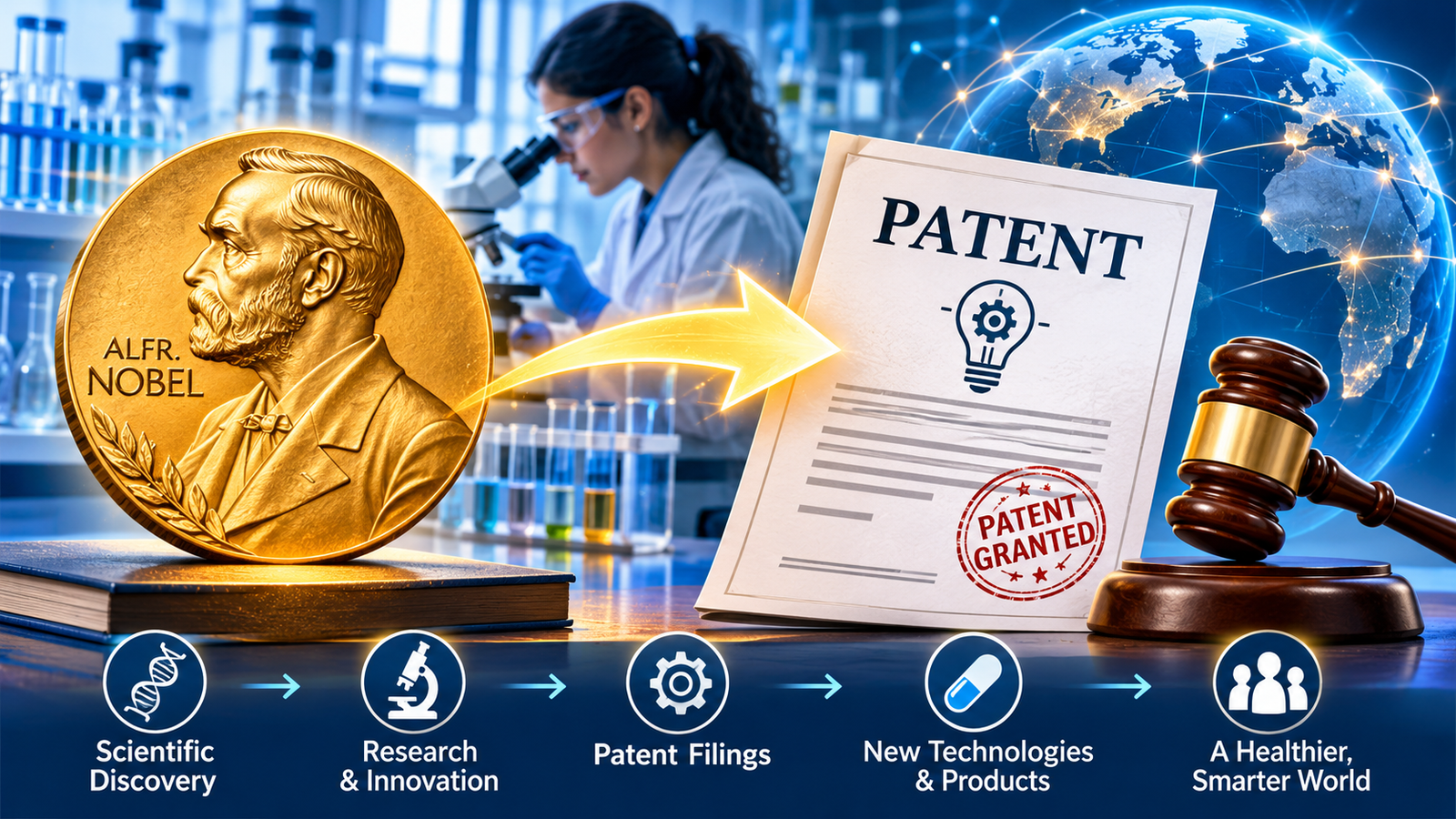
A scientific discovery may begin with a simple question in a laboratory. But what happens when that discovery changes the way the world understands science?
Thank you for reading this post, don’t forget to subscribe!Sometimes, it leads to a Nobel Prize. Sometimes, it triggers something equally significant: a global race to develop new technologies, products and commercial applications.
The relationship between Nobel Prize-winning discoveries and patent filings offers an interesting insight into how scientific knowledge moves from laboratories to industries.
A Nobel Prize recognizes exceptional scientific contributions. A patent, on the other hand, protects a qualifying invention and provides its owner with certain exclusive rights. Although these two forms of recognition serve different purposes, they are increasingly interconnected.
1. Does Winning a Nobel Prize Increase Patent Filings?
Not necessarily directly.
In many cases, researchers file patent applications years before receiving a Nobel Prize. This is because the commercial potential of a discovery may become apparent long before the scientific community recognizes its full significance.
However, Nobel recognition can increase public awareness, attract investment and encourage companies and research institutions to explore additional applications.
This can result in:
- Increased research and development investments.
- New patent applications based on the original discovery.
- Licensing and technology-transfer agreements.
- Collaborations between universities and industries.
- Competition among companies to develop commercial products.
In other words, the Nobel Prize may act as a catalyst for innovation around an already established scientific breakthrough.
2. Three Nobel-Winning Discoveries That Influenced Patent Activity
A. CRISPR: The Genetic Scissors Revolution
The 2020 Nobel Prize in Chemistry was awarded to Emmanuelle Charpentier and Jennifer Doudna for developing a method of genome editing.
Their work on CRISPR-Cas9 transformed genetic engineering by providing researchers with a powerful tool to modify DNA with remarkable precision.
But the discovery also initiated an intense intellectual property battle.
Universities and research institutions began seeking patent protection for different aspects and applications of CRISPR technology. Patent disputes emerged over inventorship, priority and the scope of protection.
The technology now has potential applications in:
- Treatment of genetic disorders.
- Cancer research.
- Agricultural crop improvement.
- Development of disease-resistant plants.
- Biotechnology and pharmaceutical research.
CRISPR demonstrates how one scientific breakthrough can generate an entire ecosystem of patentable inventions.
B. mRNA Technology: From Laboratory Research to Medical Applications
The 2023 Nobel Prize in Physiology or Medicine was awarded to Katalin Karikó and Drew Weissman for discoveries that enabled the development of effective mRNA vaccines.
Their research laid important foundations for the rapid development of COVID-19 vaccines.
The scientific breakthrough also encouraged extensive commercial and patent-related activity in areas such as:
- mRNA vaccine formulations.
- Lipid nanoparticle delivery systems.
- RNA stabilisation technologies.
- Manufacturing processes.
- Therapeutic applications beyond infectious diseases.
This example highlights an important distinction: the original scientific discovery and the subsequent technological developments may involve different patent claims and different inventors.
A Nobel-winning discovery can therefore become the foundation for numerous independent innovations.
C. Optogenetics: Controlling Brain Cells with Light
An especially interesting example comes from the 2026 Nobel Prize in Physiology or Medicine.
Karl Deisseroth, Peter Hegemann and Georg Nagel received the award for their contributions to optogenetics, a technique that uses light-sensitive proteins to control the activity of nerve cells.
The technology has opened new possibilities for studying brain circuits and investigating neurological disorders.
According to the World Intellectual Property Organization (WIPO), a search for optogenetics in its PATENTSCOPE database returned more than 7,000 results by mid-October 2026, including over 2,000 international PCT applications.
This is a striking example of how fundamental biological research can develop into a technology with applications across medicine, neuroscience and biotechnology.
3. The 2025 Nobel Prize: How One Discovery Can Create Thousands of Patent Opportunities
The 2025 Nobel Prize in Chemistry recognised the development of metal-organic frameworks (MOFs).
These are highly porous materials made by combining metal ions with organic molecules.
Their unique structures offer opportunities for:
- Carbon dioxide capture.
- Gas storage and separation.
- Water harvesting from air.
- Drug delivery.
- Environmental remediation.
WIPO reported that its PATENTSCOPE database contained more than 14,000 patent applications related to MOFs.
This illustrates an important phenomenon: a foundational scientific discovery can stimulate research into thousands of possible technological applications.
Not every application will result in a patent, but the discovery creates new opportunities for inventive activity.
4. Why Do Nobel-Winning Discoveries Generate New Patent Opportunities?
The answer lies in the difference between discovering a scientific principle and developing a practical invention.
For example, discovering a new biological mechanism does not automatically provide a commercially usable treatment.
Researchers and companies may subsequently develop:
- New formulations based on the discovery.
- Improved manufacturing processes.
- Novel delivery systems.
- Diagnostic tools.
- Medical devices.
- Industrial and environmental applications.
Each development may potentially qualify for patent protection if it satisfies the applicable legal requirements.
Thus, a single scientific breakthrough may become the starting point for an extensive patent landscape.
5. Does Every Nobel Prize Discovery Become a Patent?
Absolutely not.
A fundamental scientific discovery is not automatically patentable.
Patentability generally requires novelty, an inventive step and industrial applicability, subject to the exclusions under the relevant national patent law.
For example, a naturally occurring scientific phenomenon or a scientific theory cannot generally be patented merely because someone discovers it.
In India, Section 3 of the Patents Act, 1970, specifies categories of subject matter that are not inventions within the meaning of the Act.
This distinction is particularly important in biotechnology, pharmaceuticals and life sciences.
The discovery of a biological mechanism may be groundbreaking, but a novel and inventive technical application arising from that knowledge may offer a separate opportunity for patent protection.
6. What Does This Mean for Universities and Research Institutions?
Nobel-winning research also highlights the importance of intellectual property management within academic institutions.
Universities and research organizations increasingly need to identify potentially patentable inventions before publishing research findings or presenting them publicly.
An effective technology-transfer ecosystem can help researchers:
- Identify commercially promising discoveries.
- Conduct patentability and prior-art searches.
- Protect intellectual property.
- Identify industry partners.
- Negotiate licensing agreements.
- Translate laboratory research into market-ready technologies.
The objective is not to patent every research finding. It is to identify those innovations that can benefit society while ensuring that the intellectual contributions of researchers are appropriately recognised and protected.
The Bigger Picture: Science Creates Knowledge, Patents Enable Its Application
The relationship between Nobel Prizes and patent filings is much more complex than a simple increase in application numbers.
Nobel Prizes celebrate discoveries that expand human knowledge. Patents protect qualifying inventions that emerge from scientific and technological development.
Sometimes, the discovery itself is not patented. Sometimes, it generates hundreds of subsequent inventions. In other cases, the researchers have already built substantial patent portfolios long before receiving international recognition.
Ultimately, the real achievement is not merely receiving a Nobel Prize or securing a patent. It is transforming scientific knowledge into innovations that improve human life.
The next revolutionary discovery may already be taking place in a laboratory somewhere in the world. Its journey from a research paper to a patent, and eventually to a product that changes lives, could be the next great story of innovation.
References and Further Reading
- World Intellectual Property Organization (WIPO), Nobel Prize 2025: The 200+ PCT applications behind the breakthroughs.
- WIPO, Nobel-winning discovery has opened up a new area of innovation and patenting – Optogenetics.
- WIPO, Genetic Scissors: At the Cutting Edge of Life.
- WIPO, Frequently Asked Questions: Patents.
- Nobel Prize, Official Nobel Prize Website.
- Sanberg et al. (2026), How Patents May Lead to Nobel Prizes: From Discoveries to Commercialization, Technology and Innovation, Volume 25.
Leave a Reply