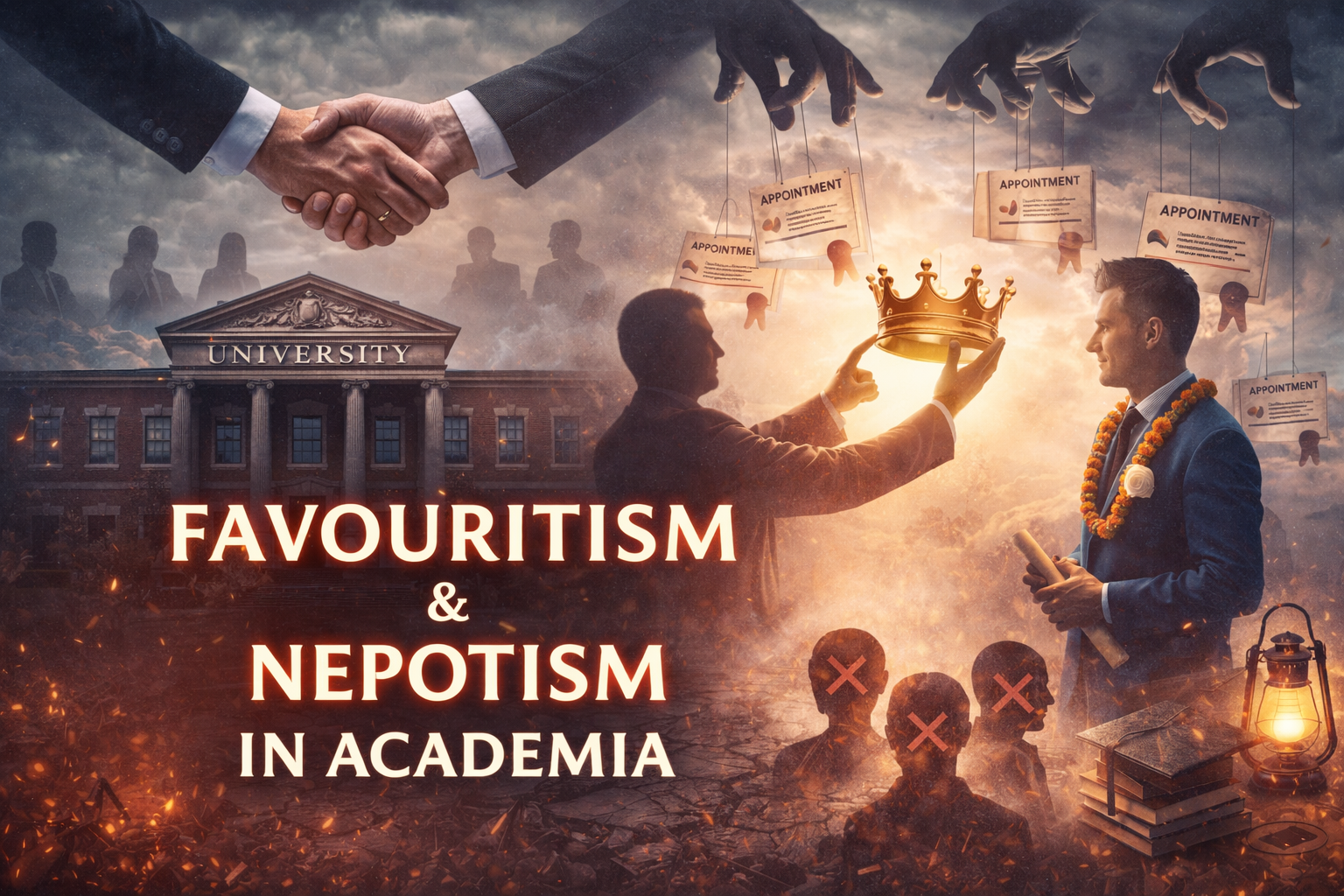
Introduction: A Silent Crisis in the Temple of Knowledge
Thank you for reading this post, don’t forget to subscribe!Universities are meant to be the custodians of knowledge, merit, and intellectual integrity. In India, they also carry the weight of a civilizational legacy—Nalanda, Takshashila, Vikramashila—institutions that once attracted scholars from across the world. Yet, in contemporary times, Indian higher education faces a profound and uncomfortable reality: systemic favouritism, nepotism, politicisation, and erosion of merit have deeply compromised academic excellence.
This crisis does not merely affect institutions; it directly impacts the quality of education, research, skill development, and global credibility of India’s knowledge system. The absence of even a single Indian university among the world’s top 100 is not accidental—it is symptomatic.
Understanding the Evils: Favouritism and Nepotism in Academia
What Do We Mean by Favouritism and Nepotism?
- Favouritism refers to preferential treatment based on loyalty, ideological alignment, institutional proximity, or personal networks rather than merit.
- Nepotism involves appointments or advantages granted on the basis of family, caste, political affiliation, or mentor–disciple nexus.
In academia, these manifest through:
- Biased faculty recruitment
- Manipulated selection committees
- Tailor-made eligibility criteria
- Promotion without rigorous performance evaluation
- Suppression of dissenting or independent voices
These practices erode the foundational principle of scholarship: intellectual honesty.
How It Degrades the Quality of Education and Skill Development
1. Decline in Teaching Standards
When faculty recruitment prioritises connections over competence, classrooms suffer. Poor pedagogical skills, outdated knowledge, and lack of intellectual curiosity become normalized. Students are trained to memorise, not think.
2. Weak Research Culture
High-quality research demands:
- Academic freedom
- Critical inquiry
- Global exposure
- Rigorous peer evaluation
Favouritism discourages originality and rewards conformity. As a result:
- Research output becomes repetitive
- Quantity overtakes quality
- International collaboration declines
- Indian journals struggle for credibility
3. Skill Mismatch and Employability Crisis
Universities should be engines of skill formation. Instead, graduates often lack:
- Analytical skills
- Research aptitude
- Practical competence
- Global academic exposure
This mismatch feeds India’s paradox: degree-rich but skill-poor graduates.
The Indian Knowledge Tradition: A Distorted Continuity
India’s classical knowledge systems thrived on:
- Guru–shishya dialogue
- Intellectual debate (Shastrartha)
- Respect for dissent
- Rigorous training over patronage
Ironically, modern academia has retained the hierarchy without the rigour, the authority without accountability. The result is a hollow imitation of tradition rather than its continuation.
Why Is There Low Excellence in Academic Recruitment?
1. Structural Flaws in Recruitment Processes
- Excessive bureaucratisation
- Non-transparent selection criteria
- Internal candidates favoured over open competition
- Limited international benchmarking
Merit becomes negotiable, not measurable.
2. Inbreeding in Universities
Academic inbreeding—where institutions recruit their own graduates—creates intellectual stagnation. It limits exposure to:
- New methodologies
- Global debates
- Cross-institutional learning
Most top global universities actively discourage this practice. In India, it is widespread.
3. Political and Ideological Interference
Appointments of:
- Vice-Chancellors
- Governing bodies
- Regulatory authorities
are often influenced by political proximity rather than academic distinction. This results in:
- Fear-driven academic culture
- Self-censorship
- Erosion of institutional autonomy
Knowledge becomes subservient to power.
Why No Indian University in the World Top 100?
This is not merely a ranking problem—it is a systemic credibility issue.
Key reasons include:
- Low citation impact
- Weak international faculty presence
- Poor student-faculty ratios
- Inadequate research funding autonomy
- Limited global academic networks
- Governance deficits
Global excellence is not built by slogans but by decades of meritocratic consistency.
Long-Term Repercussions for India
1. Brain Drain Intensifies
India continues to produce brilliant minds—but they flourish abroad. Domestic institutions fail to retain or nurture excellence.
2. Loss of Soft Power
Education is a major soft power tool. India’s inability to attract large numbers of foreign students to its universities weakens its global intellectual influence.
3. Knowledge Dependency
Without strong universities, India risks becoming a consumer of global knowledge, not a producer.
The Role of Political Interference
Political influence becomes destructive when it:
- Controls academic appointments
- Shapes curriculum for ideological ends
- Discourages critical inquiry
Healthy democracies protect universities as spaces of independent thought, not ideological factories.
Remedies: The Path to Academic Renaissance
1. Transparent and Merit-Based Recruitment
- Internationally benchmarked selection processes
- External peer review
- Public disclosure of selection criteria and outcomes
2. Strengthening Institutional Autonomy
- Academic governance insulated from political cycles
- Empowered university senates
- Performance-based accountability
3. Ending Academic Inbreeding
- Mandatory inter-institutional mobility
- Encouraging global exposure
- Incentivising international recruitment
4. Research-Centric Evaluation
- Quality-based research metrics
- Ethical publication standards
- Funding linked to innovation and impact
5. Cultivating a Culture of Dissent and Debate
True universities thrive on disagreement. Academic freedom must be:
- Protected institutionally
- Encouraged culturally
- Rewarded intellectually
6. Making India a Global Education Hub
To attract foreign students:
- World-class faculty
- Global curricula
- Research-driven campuses
- Safe, inclusive, intellectually vibrant environments
India does not lack potential—it lacks systemic courage to reform.
Conclusion: Choosing Between Mediocrity and Excellence
The crisis in Indian academia is not a failure of talent but a failure of governance, ethics, and vision. Favouritism and nepotism may offer short-term comfort to institutions, but they impose long-term damage on the nation’s intellectual future.
If India aspires to be a knowledge superpower, universities must become spaces where:
- Merit is sacred
- Inquiry is fearless
- Excellence is non-negotiable
The choice is stark: protect comfort or pursue excellence. History will judge which path we take.
Leave a Reply