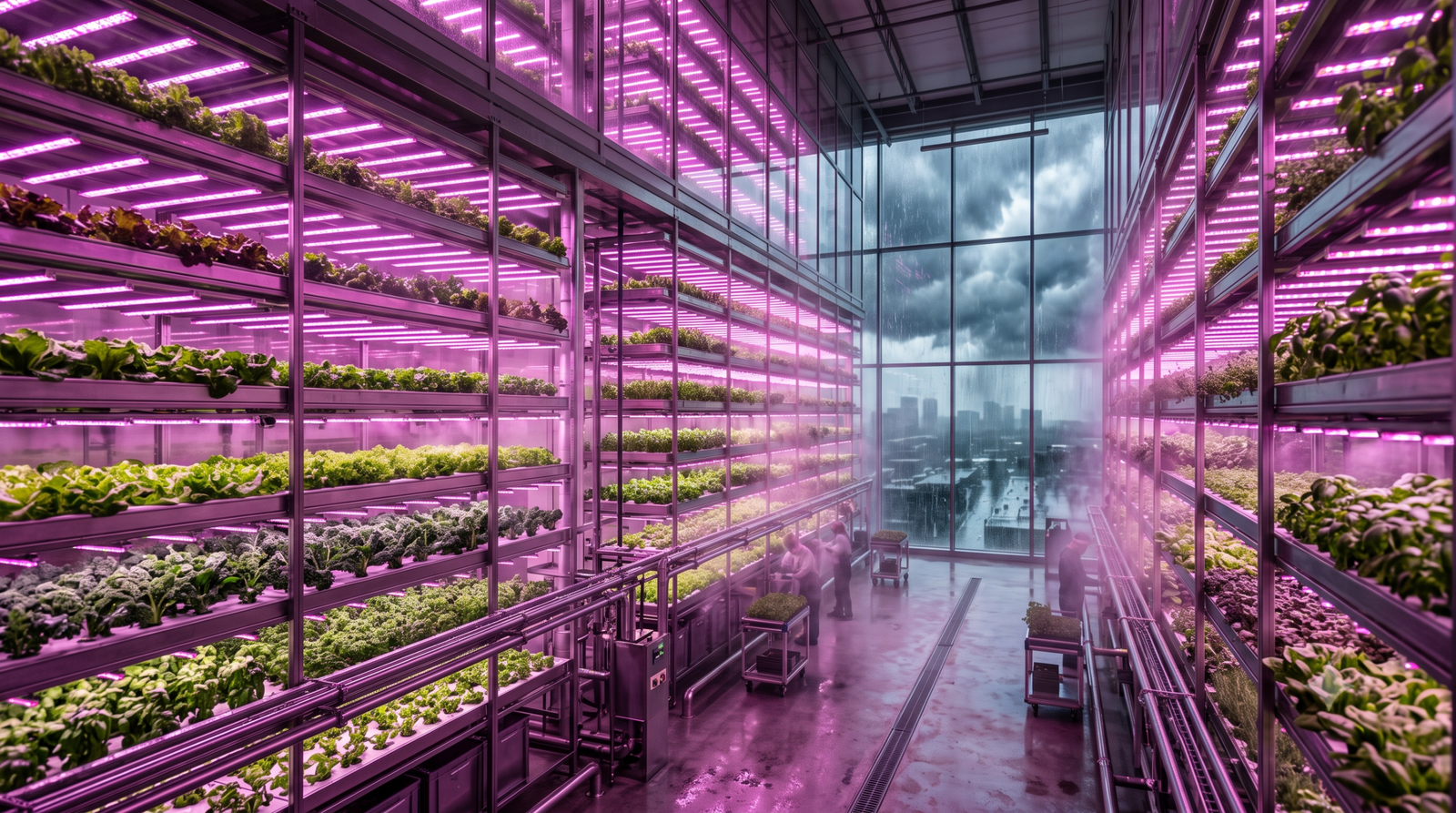
Indoor and Vertical Farming vs. a Volatile Climate
Somewhere between a warehouse and a sci-fi movie set, stacks of lettuce are growing under pink LED light, fed by nutrient-laced mist, completely indifferent to what’s happening outside. No drought. No flash flood. No unseasonal frost wiping out a harvest overnight. As climate volatility becomes the new normal for farmers worldwide, that indifference is starting to look less like a novelty and more like a necessity.
Thank you for reading this post, don’t forget to subscribe!The Problem Indoor Farming Is Trying to Solve
Traditional agriculture is fundamentally a bet on the weather. But that bet is getting riskier every year. Extreme heat, erratic rainfall and unpredictable growing seasons are already disrupting harvests globally. UK academics leading a new vertical farming research initiative argue the development of controlled environment agriculture needs to accelerate to meet the challenges of future food security helping farmers produce far more on the same land while avoiding the extreme weather events climate change keeps throwing at them.
That’s the core pitch of indoor farming: take the crop out of the climate’s hands entirely.
The Numbers That Make the Case
The efficiency gains are hard to ignore. Compare lettuce yield per square meter across growing methods: roughly 3.9 kg from an open field, 41 kg from a greenhouse and around 100 kg when farmed vertically an order-of-magnitude leap in land-use efficiency.
Water savings tell a similar story. Hydroponic systems, which grow crops without soil, can produce food using roughly 10 percent of the water required by field-grown crops a meaningful buffer as droughts intensify.
The investment community has noticed too: indoor farming raised more than $1 billion in a single year, exceeding the combined funding of the two previous years and the broader market has been projected to grow into the multibillion-dollar range by 2026.
Why “Climate-Proof” Isn’t the Same as “Solved”
Indoor and vertical farming is not a silver bullet. The core tension is cost: indoor and vertical farming results in higher unit production costs compared to land-based farming and someone has to absorb that — either taxpayers through subsidies, or consumers through higher food prices. Energy is the biggest culprit, since artificial lighting and climate control systems all run on electricity.
There’s also a scaling ceiling. Indoor farming today is overwhelmingly built around leafy greens, herbs and other high-value, fast-growing, shallow-rooted crops. Staple calorie crops like wheat, rice and corn — the crops that actually determine whether a population goes hungry — remain far harder to grow profitably indoors at scale. Some analysts describe vertical farming as somewhat overhyped on this basis, while still expecting greenhouses and controlled-environment agriculture to play a real role in climate adaptation going forward.
Where the Technology Is Actually Headed
The more credible near-term story isn’t “vertical farms replace field agriculture” — it’s controlled-environment agriculture as a strategic complement, filling specific gaps open-field farming can no longer reliably fill:
- Urban food security and supply chain resilience — growing food close to consumers shortens supply chains and reduces vulnerability to disruption.
- Land-scarce and climate-exposed regions — a way to produce food domestically rather than depending on imports vulnerable to climate shocks elsewhere.
- Year-round production of high-value crops — smoothing out the boom-bust cycle climate volatility creates in open-field harvests.
- Affordability, not capability, as the real bottleneck — researchers say the technology already works; the roadmap to make it affordable is the unsolved problem.
The Honest Takeaway
Indoor and vertical farming won’t single-handedly solve food security. But as climate volatility turns “normal” growing seasons into a thing of the past, the value of a farming method that doesn’t care what’s happening outside becomes harder to ignore — not as a replacement for the farm, but as an insurance policy sitting next to it.
The pressure pushing toward indoor agriculture — extreme weather, land scarcity, population growth — isn’t going away.
Sources: Aptean industry research; UK controlled-environment agriculture project (Aberystwyth University); Vertical Farm Daily; IREI / McAlinden Research.
Leave a Reply