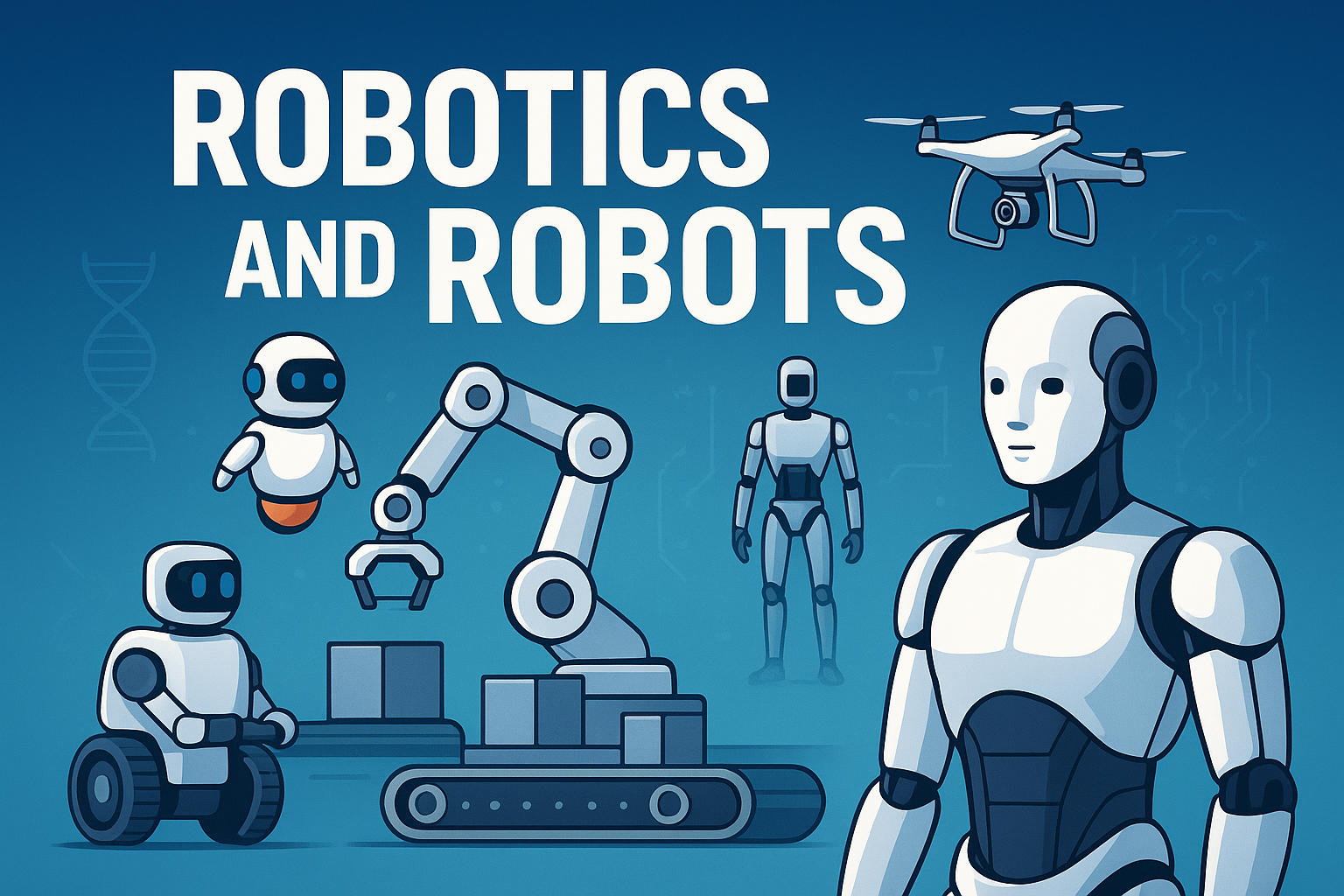
Introduction
Thank you for reading this post, don’t forget to subscribe!What are Robots and Robotics?
Robotics is an interdisciplinary branch of science and engineering focused on the design, construction, operation, and use of robots. A robot is a programmable machine capable of carrying out a series of actions autonomously or semi-autonomously.
From industrial automation to AI-driven humanoids, robotics has evolved into a transformative force across nearly every industry in 2025.
Types of Robots in 2025
- Industrial Robots – Used in manufacturing for tasks like welding, painting, assembly (e.g., ABB, FANUC).
- Service Robots – Assist in tasks like cleaning, delivery, and security (e.g., Roomba, Knightscope).
- Medical Robots – Used in surgery, rehabilitation, and diagnostics (e.g., Da Vinci Surgical System).
- Humanoid Robots – Designed to look and act like humans (e.g., Tesla Optimus, Sophia by Hanson Robotics).
- Military & Defense Robots – Used for surveillance, bomb disposal, and combat (e.g., Ghost Robotics).
- Agricultural Robots (AgriBots) – Automate planting, irrigation, and harvesting (e.g., Agrobot).
- Autonomous Vehicles & Drones – Self-driving cars and delivery drones (e.g., Waymo, Zipline).
Applications of Robotics in 2025
| Sector | Robotic Application |
| Healthcare | Surgical assistance, elderly care, rehabilitation |
| Manufacturing | Precision assembly, quality control, welding |
| Retail & Delivery | Inventory management, autonomous deliveries |
| Agriculture | Precision farming, soil analysis, crop harvesting |
| Military & Defence | Surveillance, mine clearance, weapon handling |
| Education | Robot-assisted learning, AI tutors |
| Hospitality | Automated room service, customer interaction |
| Home Automation | Cleaning robots, personal assistants |
The Future of Robotics: 2025 and Beyond
Key Trends Shaping the Future:
- AI-Powered Robots
Robots integrated with generative AI and machine learning will improve real-time decision-making and natural language communication.
- Humanoid Robots for Everyday Use
Tesla’s Optimus robot aims to become a household assistant by 2026, capable of performing tasks like cooking, cleaning, and companionship.
- Swarm Robotics
Inspired by ant colonies, swarm robots are being used in search and rescue, surveillance, and disaster response.
- Robots with Emotion and Empathy
Emotional AI will allow robots to recognize and respond to human feelings — advancing elder care and mental health applications.
- Flexible, Soft, and Bio-Inspired Robotics
Robots made of soft materials can navigate complex environments and work alongside humans more safely.
- Human-Robot Collaboration (Cobots)
Collaborative robots will dominate industries where safety and precision matter, such as healthcare and logistics.
Top Robotics Companies Leading in 2025
Here are the leading robotics companies innovating across industries:
| Company | Specialization |
| Boston Dynamics | Humanoid & quadruped robots like Atlas & Spot |
| Tesla | Optimus humanoid robot for general-purpose tasks |
| NVIDIA | AI chips & robotics simulation platforms |
| ABB Robotics | Industrial automation & robotics |
| FANUC | Factory robots and CNC systems |
| KUKA Robotics | Advanced industrial robots |
| Hanson Robotics | Social robots like Sophia |
| iRobot (by Amazon) | Home cleaning robots like Roomba |
| UBTECH Robotics | Educational and humanoid robots |
| DJI | Drones and aerial robotics |
| Agrobot | Agricultural automation robots |
| OpenAI + 1X Robotics | AI-powered robotics (neo-humanoid project) |
Robotics in India: Growing Tech Landscape
India is rapidly becoming a robotics innovation hub in 2025, with initiatives under Make in India, Startup India, and PLI schemes promoting robotics startups like:
- Asimov Robotics
- GreyOrange
- Addverb Technologies
- Gridbots
Skills & Careers in Robotics
In 2025, robotics offers lucrative careers across:
- Robotics Engineering
- AI and Machine Learning
- Mechatronics
- Embedded Systems
- Human-Robot Interaction (HRI)
- Ethical and Regulatory Tech Law
Global Market Forecast for Robotics
- By 2030, the global robotics market is projected to exceed $250 billion.
- Demand for robotics engineers and AI specialists will grow by 35–40% globally by 2030 (World Economic Forum 2024).
Ethical & Regulatory Challenges
- Job Displacement – How will robots impact employment?
- AI Control – Can we trust autonomous decision-making?
- Data Privacy – Who owns the data robots collect?
- Regulation – Global standards for safety, ethics, and liability are still evolving.
Conclusion
Robots Are the Future
From smart assistants at home to advanced machines in industries, robots are transforming the world. As AI integration, mobility, and empathy in robots increase, we’re entering a future where humans and robots will co-exist and collaborate.
Whether you’re a tech enthusiast, investor, or student — robotics is the future you can’t ignore.
FAQs on Robotics (2025)
Q1. What are the top 3 robotics companies in 2025?
Tesla, Boston Dynamics, and ABB Robotics lead the field with innovations in humanoid and industrial robots.
Q2. Are robots replacing human jobs?
They are automating repetitive tasks, but also creating new jobs in tech, programming, and robot maintenance.
Q3. What is the future of humanoid robots?
Humanoid robots like Tesla Optimus are expected to become common in homes, healthcare, and public spaces by 2030.
Q4. Is robotics a good career in 2025?
Absolutely. Robotics is among the fastest-growing fields with opportunities in AI, engineering, design, and research.
Leave a Reply