Introduction
Thank you for reading this post, don’t forget to subscribe!The geopolitical landscape of the Indo-Pacific has undergone significant transformation over the past two decades. The rise of China, growing strategic competition among major powers, maritime security concerns, disruptions in global supply chains and the changing balance of power have increased the importance of regional cooperation.
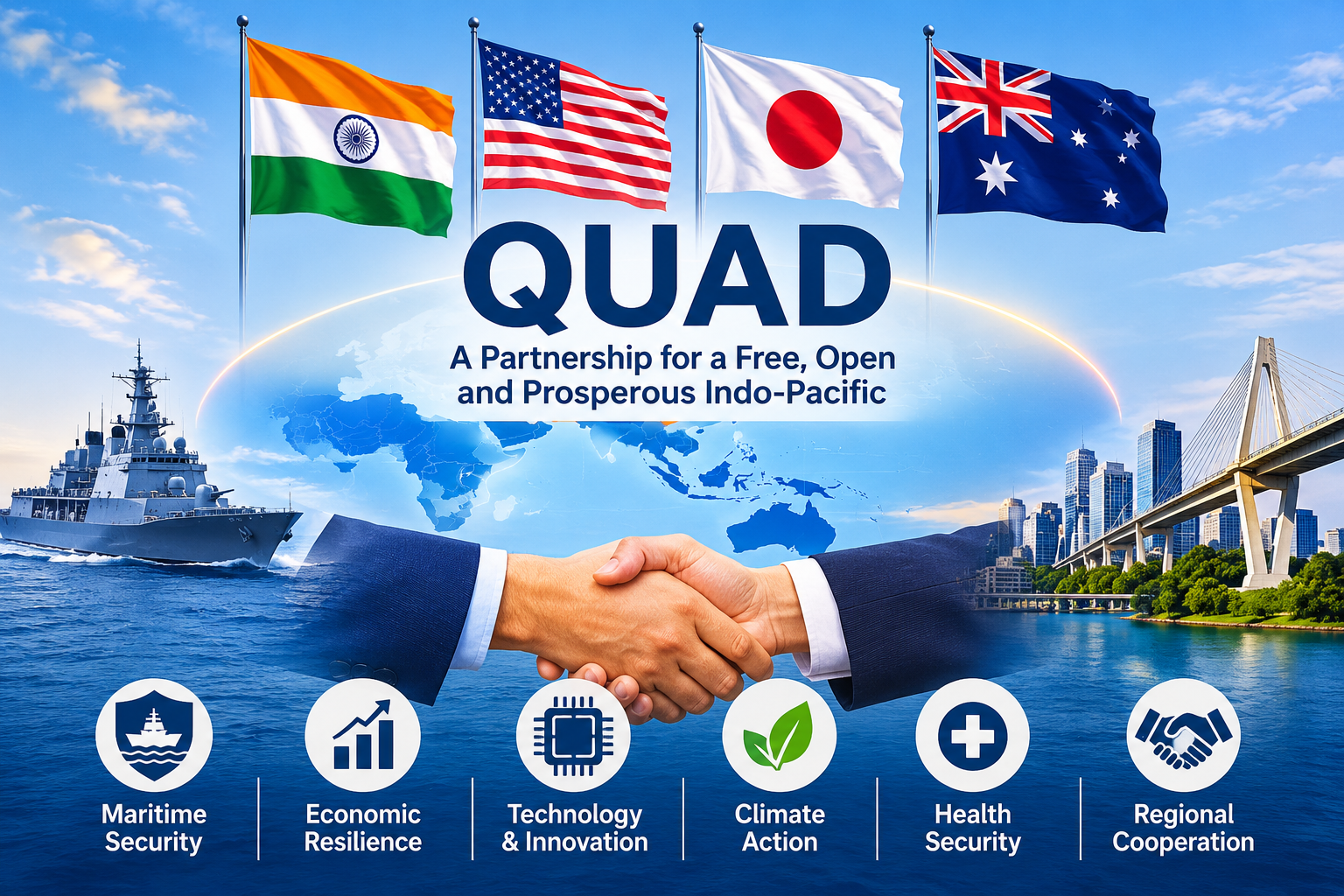
In this evolving environment, the Quadrilateral Security Dialogue (Quad) has emerged as an important strategic partnership involving four major democracies: India, the United States, Japan and Australia.
Although frequently described as a strategic grouping aimed at balancing China’s growing influence, the Quad officially presents itself as a partnership committed to maintaining a free, open, inclusive and prosperous Indo-Pacific.
But what exactly is the Quad? Why was it established? Has it achieved its original objectives? Does it have a permanent headquarters? And, most importantly, how relevant is it in contemporary international politics?
1. What is the Quad?
The Quadrilateral Security Dialogue, commonly known as the Quad, is an informal strategic and diplomatic partnership among four countries:
- India
- United States of America
- Japan
- Australia
It provides a platform for these countries to discuss and coordinate responses to common regional and global challenges.
The Quad is not a military alliance like NATO, nor is it a formal international organisation established through a binding treaty. Instead, it operates through diplomatic consultations, ministerial meetings, leaders’ summits, working groups and practical cooperation initiatives.
Its principal vision is to promote a Free and Open Indo-Pacific (FOIP), ensuring freedom of navigation, respect for international law, regional stability, economic resilience and cooperation.
2. Why was the Quad formed?
The origins of the Quad can be traced to the devastating Indian Ocean tsunami of December 2004.
Following the disaster, India, the United States, Japan and Australia coordinated their humanitarian assistance and disaster relief efforts. Their cooperation demonstrated the potential of four countries working together to address major regional challenges.
This experience provided the foundation for subsequent strategic consultations.
However, the Quad’s emergence was also influenced by broader geopolitical developments:
- China’s growing economic, military and maritime influence in the Indo-Pacific.
- Increasing concerns about freedom of navigation and maritime security.
- The strategic importance of the Indian Ocean and Western Pacific.
- The need to strengthen regional cooperation among like-minded countries.
- The growing importance of secure supply chains, technological cooperation and regional connectivity.
Thus, the Quad gradually evolved from an informal disaster-response collaboration into a wider strategic partnership.
Importantly, although China’s rise is an important geopolitical factor behind the grouping’s strategic relevance, the four members officially maintain that the Quad is not directed against any particular country.
3. When and where was the Quad established?
The Quad did not emerge as a fully established organisation at a single conference. Its development took place in several stages.
2004 – Initial cooperation: India, Australia, Japan and the United States coordinated humanitarian assistance following the Indian Ocean tsunami.
May 2007 – First official consultations: The first meeting of Quad officials took place on the sidelines of the ASEAN Regional Forum in the Philippines.
2017 – Revival of the Quad: Following a decade-long interruption, officials from the four countries met again in Manila in November 2017, on the sidelines of the East Asia Summit.
2019 – Foreign Ministers’ participation: The foreign ministers of the four countries met for the first time in September 2019 on the sidelines of the United Nations General Assembly in New York.
2021 – Leaders-level partnership: The Quad was elevated to the leaders’ level. Its first Leaders’ Summit was held virtually on 12 March 2021.
2021 onwards – Institutional expansion: Regular leaders’ summits, foreign ministers’ meetings and thematic working groups strengthened cooperation across multiple sectors.
Therefore, while the Quad’s origins date back to 2004, its first official diplomatic consultations took place in 2007, and its present strategic framework developed substantially after its revival in 2017 and elevation in 2021.
4. How many members does the Quad have?
The Quad has exactly four members:
- India
- United States
- Japan
- Australia
Membership remains restricted to these four countries. It does not have a provision for automatic membership expansion.
Nevertheless, the Quad increasingly works with other Indo-Pacific countries, regional institutions and international partners through various cooperation initiatives.
Its engagement with ASEAN, Pacific Island countries and other regional stakeholders is particularly important for promoting an inclusive Indo-Pacific.
5. What is the administrative structure and headquarters of the Quad?
One of the most interesting aspects of the Quad is that it does not follow the conventional administrative structure of an international organisation.
Unlike the United Nations, World Bank or NATO, the Quad does not have:
- A permanent international secretariat.
- A centralised headquarters.
- A permanent Secretary-General.
- A binding founding treaty.
- A standing military command.
Instead, it follows a flexible, decentralised and consultative administrative arrangement.
Its major coordination mechanisms include:
1. Leaders’ Summits: Heads of government or state provide overall political direction and establish strategic priorities.
2. Foreign Ministers’ Meetings: Foreign ministers coordinate diplomatic positions and review cooperation across major areas.
3. Quad Sherpas: Senior government representatives coordinate policy discussions, prepare meetings and facilitate implementation of agreed initiatives.
4. Senior Officials’ Meetings: Officials from relevant ministries and departments coordinate sector-specific activities.
5. Working Groups and Expert-Level Cooperation: The four countries collaborate on areas such as health security, climate change, critical and emerging technologies, infrastructure, cybersecurity and maritime security.
Does the Quad have a headquarters?
No. The Quad does not have a permanent headquarters in any of its four member countries. Meetings are hosted by member countries at different locations.
This flexible arrangement allows members to cooperate without creating a large permanent international bureaucracy.
6. What are the major objectives of the Quad?
The Quad’s objectives have expanded considerably since its initial formation.
Its major areas of cooperation include:
Maritime security: Strengthening maritime domain awareness, freedom of navigation and regional maritime cooperation.
Economic and supply-chain resilience: Diversifying supply chains and reducing vulnerabilities in strategically important sectors.
Critical and emerging technologies: Promoting cooperation in artificial intelligence, telecommunications, semiconductors, cybersecurity and other advanced technologies.
Health security: Improving regional preparedness for public health emergencies and strengthening healthcare systems.
Climate change: Supporting clean energy, climate resilience and sustainable development.
Infrastructure development: Encouraging transparent, sustainable and high-quality infrastructure investments in the Indo-Pacific.
Humanitarian assistance and disaster relief: Coordinating responses to natural disasters and other humanitarian emergencies.
These objectives demonstrate that the Quad is not exclusively a security arrangement. It has gradually developed into a multidimensional strategic and economic partnership.
7. Has the Quad achieved its formation objectives?
The answer is partly yes.
The Quad has made meaningful progress in institutionalising cooperation and translating its strategic vision into practical initiatives. However, it would be premature to describe all its objectives as fully achieved.
Some notable achievements include:
- Regular leaders’ summits and foreign ministers’ meetings have strengthened diplomatic coordination.
- The Quad Vaccine Partnership expanded cooperation on COVID-19 vaccine production and distribution.
- The Malabar naval exercises have strengthened interoperability among participating naval forces.
- The Indo-Pacific Partnership for Maritime Domain Awareness has improved regional maritime information-sharing capabilities.
- The Quad Infrastructure Fellowship initiative has supported capacity-building among infrastructure professionals.
- The Quad Partnership for Cable Connectivity and Resilience has promoted secure regional communications infrastructure.
- The Quad Cancer Moonshot, announced in 2024, strengthened cooperation against cervical cancer in the Indo-Pacific.
Nevertheless, challenges remain.
The four countries have different strategic priorities, economic interests and relationships with China. Their approaches to trade, defence cooperation and regional conflicts are not always identical.
Furthermore, the Quad has not established a collective defence mechanism or binding security guarantees.
Therefore, its achievements should be evaluated as those of a flexible strategic partnership rather than a conventional military alliance.
8. What is the relevance of the Quad in contemporary geopolitics?
The Quad has become increasingly relevant because the Indo-Pacific is now one of the most strategically important regions in the world.
Its importance can be understood through five major developments.
First, China’s growing regional influence.
China’s expanding military capabilities, maritime activities and economic influence have changed the regional balance of power. The Quad provides an important platform for its members to coordinate their responses while supporting a rules-based regional order.
Second, maritime security and global trade.
The Indo-Pacific contains some of the world’s busiest maritime trade routes. The security of the Indian Ocean, South China Sea and wider Pacific is essential for international commerce, energy transportation and economic stability.
Third, strategic supply chains.
Recent geopolitical tensions have demonstrated the vulnerability of global supply chains. Cooperation among the Quad countries can help diversify access to critical minerals, semiconductors, energy resources and essential technologies.
Fourth, technological competition.
Artificial intelligence, cybersecurity, digital infrastructure and advanced technologies are becoming central to international power. The Quad provides opportunities for cooperation in these emerging areas.
Fifth, disaster management and sustainable development.
The Indo-Pacific is vulnerable to cyclones, earthquakes, rising sea levels and other climate-related challenges. Cooperation in disaster preparedness, healthcare and climate resilience can deliver tangible benefits to regional populations.
Thus, the Quad’s relevance extends beyond traditional security concerns to economic development, technological advancement and regional stability.
9. What happened at the latest Quad Leaders’ Summit?
The latest Quad Leaders’ Summit was held on 17 November 2026 in Manila, Philippines, alongside the ASEAN-related summit meetings.
The meeting brought together:
- Donald Trump, President of the United States.
- Narendra Modi, Prime Minister of India.
- Anthony Albanese, Prime Minister of Australia.
- Sanae Takaichi, Prime Minister of Japan.
The summit was particularly significant because it was the first Quad leaders’ meeting in two years, following the September 2024 summit in Delaware, United States.
The leaders reaffirmed their commitment to a free, open and stable Indo-Pacific and announced several important areas of cooperation.
Major outcomes of the Manila Summit (2026):
1. Indo-Pacific Maritime Surveillance Collaboration: The leaders welcomed a new initiative to improve maritime information-sharing and maritime domain awareness. They also announced plans for Quad countries’ P-8 and P-3C maritime patrol aircraft to participate in a joint maritime exercise in 2027.
2. Quad Business Leaders’ Forum: The first Quad Business Leaders’ Forum is scheduled for early 2027. It aims to strengthen private-sector cooperation, promote commercial partnerships and encourage investment among the four countries.
3. Critical minerals and energy security: The leaders reaffirmed cooperation on resilient critical-mineral supply chains, energy security and the protection of important maritime transit corridors.
4. Cybersecurity cooperation: Enhanced Quad Cybersecurity Cooperation was announced to address increasing cyber threats and strengthen an open and secure cyberspace.
5. Undersea cable connectivity: The leaders welcomed progress under the Quad Partnership for Cable Connectivity and Resilience. Australia’s expanded contribution will also cover electricity cables, while upcoming undersea cable projects in the Indian Ocean are expected to strengthen regional connectivity.
6. Artificial intelligence and emerging technologies: The leaders reaffirmed cooperation on trusted artificial intelligence technologies and supported the Super Intelligence Accelerator to facilitate technological access, deployment and technical assistance across the Indo-Pacific.
7. Counterterrorism: The four countries unequivocally condemned terrorism and violent extremism, including cross-border terrorism, and committed to strengthening cooperation in this area.
The leaders also reaffirmed their support for ASEAN centrality and unity, recognising the importance of regional institutions in maintaining peace and stability.
Overall, the Manila summit demonstrated a renewed emphasis on maritime security, economic resilience, technology, connectivity and counterterrorism.
10. Why is the Quad important for India?
For India, the Quad has considerable strategic, economic and diplomatic significance.
Strategic autonomy: Participation enables India to strengthen partnerships with major powers without entering into a binding military alliance.
Indian Ocean security: India’s geographical position makes maritime security and freedom of navigation particularly important for its national interests.
Technology and innovation: Cooperation with the United States, Japan and Australia can support India’s technological capabilities, research ecosystem and digital infrastructure.
Economic opportunities: Supply-chain diversification and investment partnerships can strengthen India’s manufacturing ambitions and economic resilience.
Regional leadership: The Quad provides India with an important platform to contribute to the governance and strategic direction of the Indo-Pacific.
Importantly, India’s participation also reflects its broader foreign policy approach of engaging with multiple strategic partners while maintaining independent decision-making.
Conclusion: Is the Quad still relevant?
The Quad remains highly relevant in contemporary international relations, particularly as geopolitical competition, maritime insecurity, technological rivalry and economic interdependence reshape the Indo-Pacific.
However, its long-term success will depend less on diplomatic declarations and more on its ability to deliver measurable outcomes.
The partnership must continue to strengthen regional connectivity, maritime security, technological cooperation, economic resilience and humanitarian assistance while respecting the interests of smaller Indo-Pacific countries.
It must also avoid becoming an exclusively confrontational geopolitical instrument. An inclusive and cooperative approach will be essential for maintaining regional trust.
Ultimately, the Quad represents an evolving model of strategic cooperation in which four democracies seek to address shared challenges without establishing a conventional military alliance or supranational institution.
Its future significance will depend on how effectively it transforms its shared vision of a free, open and prosperous Indo-Pacific into tangible benefits for the region and its people.
Leave a Reply