Every winter, Delhi finds itself wrapped in a grey blanket of smog. Schools face restrictions, people wear masks, outdoor activities are reduced, and the familiar debate begins: Who is responsible for the pollution? Vehicles? Farmers? Industries? Construction?
Thank you for reading this post, don’t forget to subscribe!But here is a more interesting question: Are we fighting the right enemy, or are we looking at only one part of a much bigger problem?
Delhi’s air pollution is not caused by a single source. It is the result of multiple pollution sources, regional emissions, atmospheric chemistry and weather conditions working together. Understanding this combination is the first step towards finding lasting solutions.
Let’s explore what is actually happening in the air we breathe.
1. What is happening to Delhi’s air?
Delhi’s air quality changes throughout the year, but the situation often becomes particularly concerning during October, November and the winter months.
On 16 November 2026, Delhi’s average Air Quality Index (AQI) was reported at 216 in the morning, placing it in the Poor category. Although this was an improvement from the previous day’s reading, several monitoring stations continued to record much higher pollution levels.
This tells us something important: a better AQI reading on one day does not mean that the pollution problem has disappeared.
But what exactly does AQI mean?
Understanding the AQI
The Air Quality Index is a numerical indicator that communicates how polluted the air is and what its potential health implications may be.
| AQI value | Category | What it means |
| 0–50 | Good | Minimal health impact |
| 51–100 | Satisfactory | Minor breathing discomfort to sensitive people |
| 101–200 | Moderate | Discomfort to people with lung, asthma or heart conditions |
| 201–300 | Poor | Breathing discomfort to many people on prolonged exposure |
| 301–400 | Very Poor | Respiratory illness risk on prolonged exposure |
| 401–500 | Severe | Health effects even on healthy people; serious impacts on vulnerable groups |
These are India’s CPCB AQI categories.
2. What are we actually breathing? Meet PM2.5 and PM10
One of the biggest concerns during Delhi’s pollution episodes is particulate matter.
Particulate matter (PM) refers to tiny solid particles and liquid droplets suspended in the air. These may include dust, soot, smoke, metals and chemical compounds.
Two major categories are:
PM10: Particles with a diameter of 10 micrometers or less. They can enter the respiratory system and reach the lungs.
PM2.5: Fine particles with a diameter of 2.5 micrometers or less. These are particularly concerning because they can travel deep into the lungs, and some components may enter the bloodstream.
To understand their size, imagine this: a human hair is approximately 50–70 micrometers thick. A PM2.5 particle is roughly 20–28 times smaller!
That is why these particles are difficult to see individually and why ordinary cloth coverings cannot reliably protect us from them.
Think about it: You may not see pollution entering your lungs, but that does not mean it isn’t happening.
3. Who is responsible for Delhi’s pollution?
Here is where the debate becomes complicated.
Let’s examine the major contributors.
A. Vehicle emissions – The everyday contributor
Cars, buses, trucks, motorcycles and other vehicles release pollutants through fuel combustion.
These include:
- Nitrogen oxides (NOx)
- Carbon monoxide (CO)
- Particulate matter
- Volatile organic compounds (VOCs)
Diesel vehicles, especially poorly maintained ones, can be significant sources of particulate and nitrogen oxide emissions.
Traffic congestion makes matters worse because vehicles spend more time operating at inefficient speeds, idling and accelerating.
But vehicles are not the only culprit.
B. Stubble burning – A seasonal contributor
After harvesting paddy, some farmers in Punjab, Haryana and neighbouring regions burn leftover crop residue to prepare their fields for the next crop.
This releases smoke, fine particles, carbon monoxide and other pollutants.
Depending on wind direction and atmospheric conditions, some of this pollution can travel hundreds of kilometers.
However, blaming farmers alone would be scientifically misleading. Crop-residue burning is one contributor among several, and its relative contribution changes from day to day.
Farmers also need affordable alternatives, suitable machinery, timely access to equipment and economic incentives to manage agricultural residue without burning it.
C. Construction and road dust – The visible problem
Have you noticed dust rising whenever a vehicle passes a construction site or an uncovered road?
Construction activities, demolition, uncovered soil, poorly maintained roads and dust resuspension contribute to PM10 and, in some cases, finer particles.
Unlike some other sources, road dust can be a persistent local problem throughout the year.
Covering construction materials, controlling dust at sites, mechanised road sweeping and proper waste management can help reduce these emissions.
D. Industries, power plants and waste burning
Industrial combustion, brick kilns, diesel generators and other fuel-burning activities release particulate matter, sulphur dioxide (SO2), nitrogen oxides and other pollutants.
Open burning of garbage, leaves and other waste adds further pollution.
These sources may be located within Delhi or in the surrounding National Capital Region (NCR).
E. Firecrackers and household fuel burning
Firecrackers release smoke, fine particles and various chemical compounds.
Similarly, burning wood, coal, dung cakes and other solid fuels for cooking or heating can contribute to particulate pollution.
These emissions may be particularly important during certain seasons and weather conditions.
The important lesson: Delhi’s pollution is not a competition between vehicles, farmers and industries. It is a combined emissions problem that requires action across all these sectors.
4. The invisible enemy: Why does pollution become worse in winter?
This is perhaps the most interesting part of Delhi’s pollution story.
If pollutants are released throughout the year, why does the air become so much worse during winter?
The answer lies partly in atmospheric physics.
Understanding temperature inversion
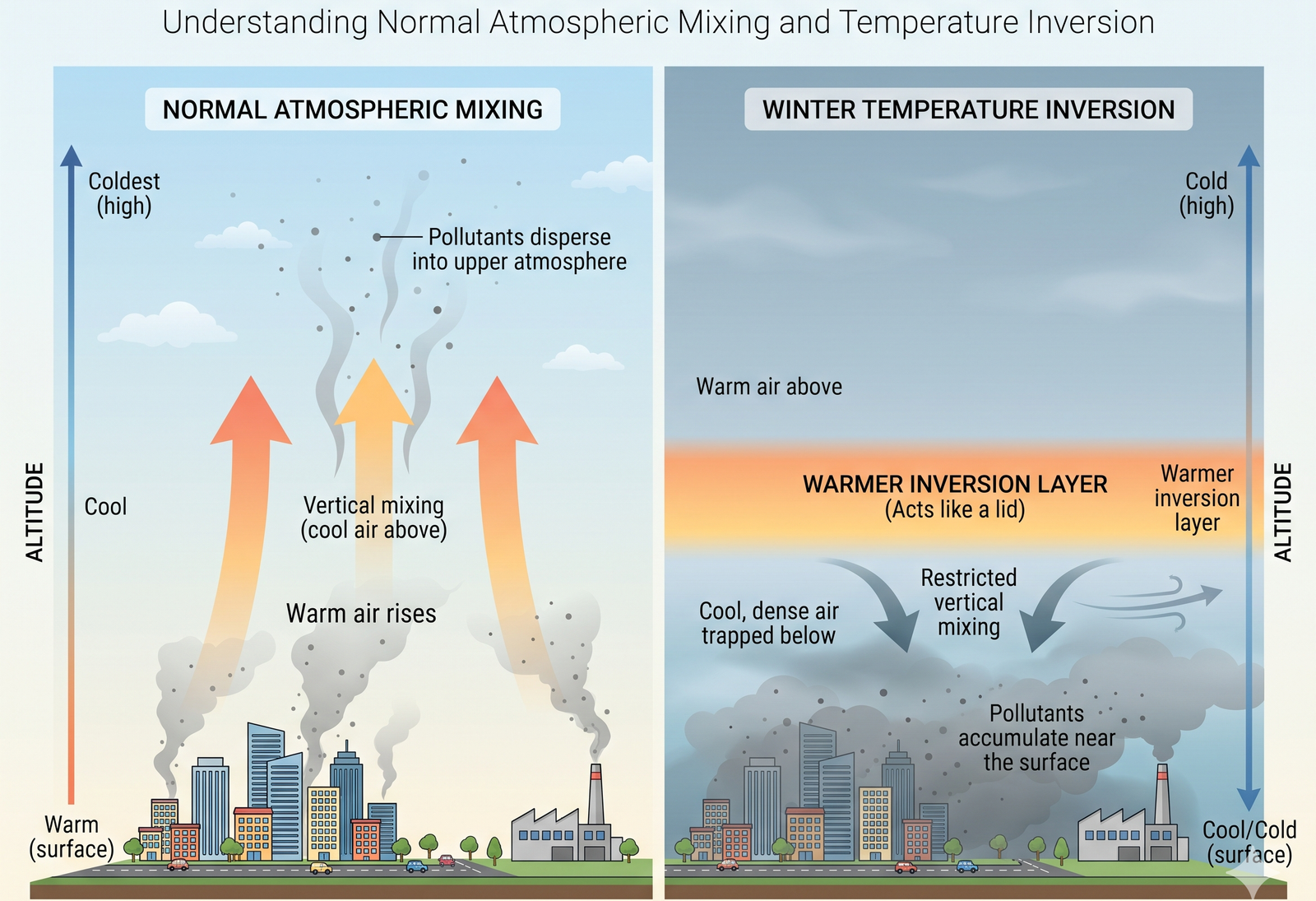
Normally, air temperature decreases as we move higher in the atmosphere. Warm air near the surface can rise, allowing vertical mixing and helping disperse pollutants.
During winter, a phenomenon called temperature inversion can occur.
Under normal conditions:
- Air near the ground is relatively warmer.
- It rises and mixes with the surrounding atmosphere.
- Pollutants can disperse vertically.
During a temperature inversion:
- A layer of warmer air sits above cooler air near the ground.
- The cooler air becomes relatively stable.
- Vertical movement and mixing are restricted.
- Pollutants accumulate closer to the surface.
Think of it like putting a lid on a cooking pot. Smoke and heat cannot escape as easily when the lid restricts their movement.
That is roughly what happens when atmospheric conditions prevent pollutants from dispersing.
The role of wind, fog and sunlight
Winter conditions often make the problem worse:
- Slow winds: Pollutants are not dispersed efficiently.
- Low mixing height: The volume of air available to dilute pollutants becomes smaller.
- Fog and high humidity: Water droplets and moisture interact with particles and can contribute to haze.
- Reduced sunlight: Atmospheric mixing may weaken, while certain chemical reactions continue to produce secondary pollutants.
An important point: fog and smog are not the same thing. Fog consists mainly of tiny water droplets, whereas smog contains air pollutants. They can occur together, making visibility and air quality particularly poor.
5. The chemistry behind the smog: Pollution can create more pollution!
Here is something many people don’t realize.
Not all the particles in the air are emitted directly from vehicles, industries or fires.
Some are formed through chemical reactions in the atmosphere. These are called secondary pollutants or secondary aerosols.
For example:
- Sulphur dioxide can undergo atmospheric oxidation to form sulphate particles.
- Nitrogen oxides can be transformed into nitric acid.
- These compounds can react with ammonia to form fine particulate matter such as ammonium sulphate and ammonium nitrate.
- Volatile organic compounds can undergo chemical reactions to produce secondary organic aerosols.
In simple words, pollutants released into the atmosphere can react with one another and create additional particles.
This makes air pollution much more complicated than simply counting the number of vehicles on the road.
It also explains why controlling only one source may not be enough.
6. Is Delhi’s pollution really only a Delhi problem?
Absolutely not.
Delhi is part of a much larger geographical region known as the Indo-Gangetic Plain.
Pollutants do not recognize state boundaries. Smoke and other airborne pollutants can travel from neighboring states depending on wind patterns and atmospheric conditions.
This is why scientists often study the entire Delhi-NCR airshed rather than treating Delhi as an isolated city.
An airshed is a geographical region in which air pollutants move and mix through atmospheric processes.
A solution limited to Delhi’s municipal boundaries cannot fully address a problem that extends across several states.
7. Are our current solutions enough?
Measures such as the Graded Response Action Plan (GRAP) are used to respond to deteriorating air quality.
Depending on the pollution level and forecast, restrictions may include:
- Limits on certain construction activities.
- Restrictions on polluting vehicles.
- Controls on industrial operations.
- Dust-control measures.
- Restrictions on diesel generator use.
- Additional public transport and pollution-control measures.
These actions are important because they can help reduce emissions during severe pollution episodes.
But there is a fundamental limitation.
Emergency measures control the symptoms; long-term emission reduction addresses the cause.
Delhi needs year-round action, including:
- Better and more reliable public transport.
- Cleaner fuels and stricter vehicle-emission enforcement.
- Scientific management of agricultural residue.
- Dust control at construction sites and on roads.
- Cleaner industrial technologies.
- Prevention of open waste burning.
- Regional coordination between Delhi and neighboring states.
- Continuous air-quality monitoring and transparent pollution-source data.
8. What can we do as ordinary citizens?
We cannot individually control the weather or industrial emissions, but our everyday choices can contribute to cleaner air.
Here are some practical steps:
- Prefer public transport, carpooling, walking or cycling when air quality and personal safety permit.
- Avoid unnecessary vehicle idling.
- Maintain vehicles and follow emission standards.
- Never burn household waste, leaves or plastic.
- Avoid firecrackers.
- Support proper segregation and disposal of waste.
- Check the AQI before planning outdoor exercise.
- During high-pollution episodes, reduce strenuous outdoor activities, especially for children, older adults and people with heart or lung conditions.
- If outdoor exposure is unavoidable during high pollution, a well-fitting N95 or equivalent respirator can help reduce exposure to particulate matter.
Remember, an air purifier or mask can reduce personal exposure, but neither can replace the need for clean air policies.
9. Quick Myth vs Fact: How much do you know about air pollution?
Myth 1: Delhi’s pollution is caused only by stubble burning.
Fact: Crop-residue burning can contribute significantly during certain periods, but vehicles, industries, road dust, construction, waste burning and other sources also matter.
Myth 2: If the sky looks clear, the air must be clean.
Fact: PM2.5 particles are too small to be seen individually. Air can look clear and still contain harmful levels of fine particles.
Myth 3: Rain permanently solves air pollution.
Fact: Rain can temporarily remove some airborne particles through wet deposition, but pollution returns if emissions continue.
Myth 4: Planting more trees alone will solve Delhi’s pollution.
Fact: Urban greenery has important environmental benefits, but trees cannot compensate for uncontrolled emissions. Source reduction must come first.
Myth 5: Pollution is only a winter problem.
Fact: Pollution exists throughout the year. Winter meteorological conditions often make it more concentrated and visible.
10. The real question: Are we fighting the right enemy?
Perhaps we have been asking the wrong question all along.
Instead of asking whether farmers, vehicles, industries or construction activities are responsible, we should ask:
How can we reduce pollution from every major source, across the entire region, throughout the year?
Delhi does not need another temporary debate about who is to blame. It needs scientific planning, consistent enforcement, cleaner technology, regional cooperation and public participation.
Clean air is not a luxury. It is a basic requirement for a healthy life.
And the fight for it cannot begin and end with the arrival of winter.
Because the air we breathe today shapes the health of generations tomorrow.
A small question for you: If you could introduce just one major change to reduce Delhi’s air pollution, what would it be — cleaner public transport, strict industrial controls, a complete solution to stubble burning, or better dust management?
Share your thoughts in the comments. Let’s make clean air a public conversation, not just a winter headline.
Sources and further reading
- Central Pollution Control Board (CPCB) – National Air Quality Index.
- Commission for Air Quality Management (CAQM) – Official website and policy documents.
- Air Quality Early Warning System for Delhi – Indian Institute of Tropical Meteorology.
- World Health Organization – Air pollution and health.
- CAQM – Why does Air Pollution Intensify During Winter in Delhi-NCR?
Leave a Reply