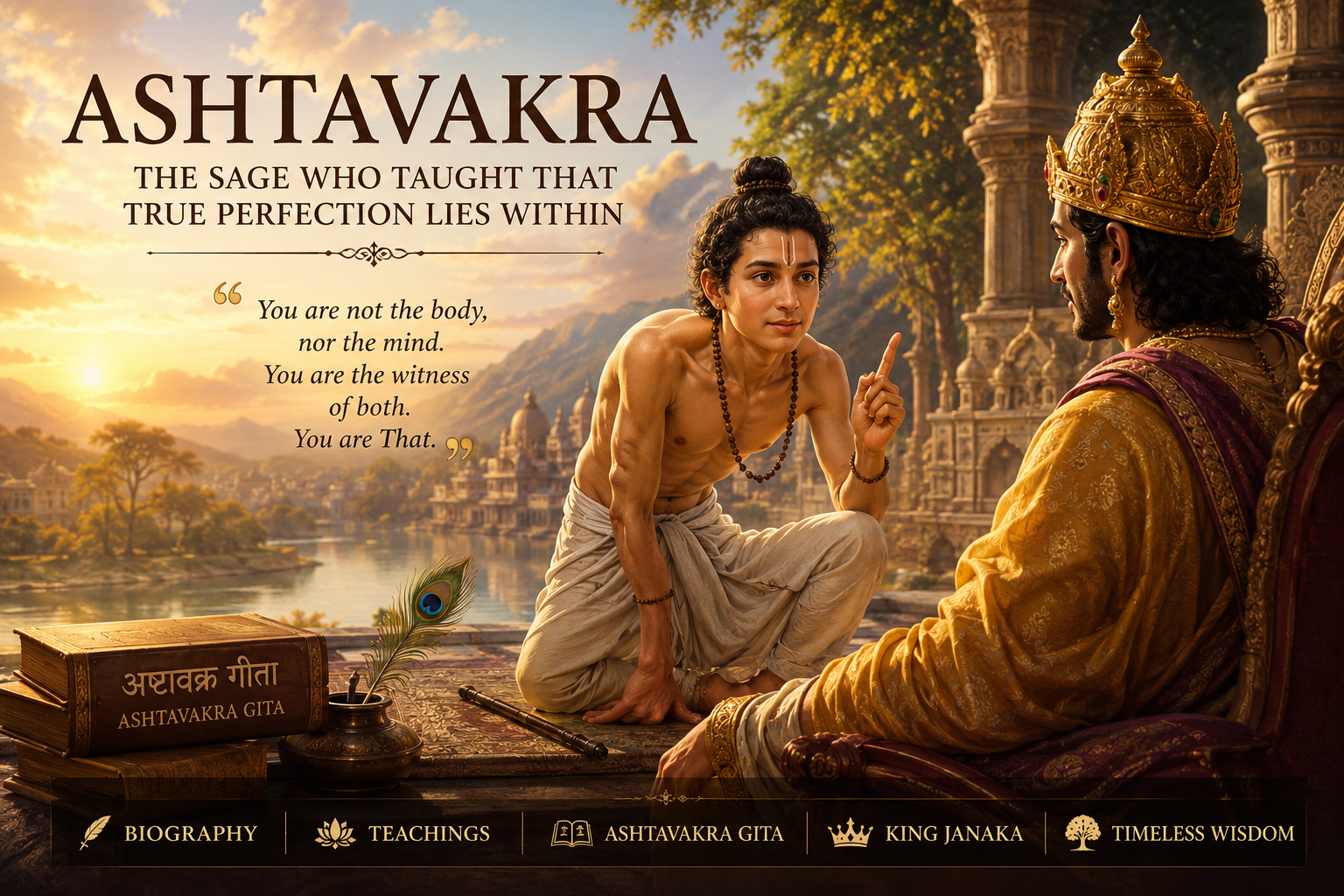
Ashtavakra: The Sage Beyond Physical Perfection
Thank you for reading this post, don’t forget to subscribe!Among the countless sages who illuminated the spiritual traditions of India, few stand as uniquely as Ashtavakra. He was not remembered for royal power, military victories, or material achievements. Instead, he became immortal because of his extraordinary wisdom, fearless intellect, and profound realization of the Self.
Born with eight physical deformities, Ashtavakra transformed what many considered a disability into a symbol of spiritual greatness. His life reminds humanity that the worth of a person is determined not by appearance but by consciousness, wisdom, and character.
Today, his teachings continue to inspire philosophers, monks, psychologists, entrepreneurs, and spiritual seekers across the world.
Who Was Ashtavakra?
Ashtavakra was an ancient Indian sage and philosopher best known as the principal teacher of the Ashtavakra Gita, one of the purest texts of Advaita (non-dual) philosophy.
According to Hindu tradition, he lived during the period associated with King Janaka of Mithila, who is also mentioned in the Upanishads and the Mahabharata. The exact historical period cannot be established with certainty, but most scholars consider Ashtavakra a figure preserved primarily through India’s spiritual literature rather than historical records.
Unlike many sages, Ashtavakra never founded a religion, sect, or institution. His influence spread entirely through his teachings.
Meaning of the Name Ashtavakra
The Sanskrit word Ashtavakra consists of two words:
- Ashta = Eight
- Vakra = Bent or Curved
Thus, Ashtavakra literally means “the one bent in eight places.”
According to tradition, his body was deformed at:
- Neck
- Chest
- Arms
- Knees
- Feet
- Back
- Waist
- Head
These physical deformities became symbolic. They demonstrated that wisdom has nothing to do with bodily perfection.
Birth and Family
Traditional accounts describe Ashtavakra as the son of Kahoda, a learned sage, and Sujata, daughter of the great sage Uddalaka Aruni, one of the most respected Vedic teachers.
Even while in his mother’s womb, Ashtavakra displayed extraordinary intelligence.
One day, Kahoda was reciting the Vedas incorrectly.
The unborn child corrected his father.
Instead of appreciating the correction, Kahoda became angry and cursed the unborn child.
The curse caused the child’s body to become crooked in eight places.
Though symbolic in many interpretations, this story conveys an important lesson:
Knowledge does not depend on age, status, or physical appearance.
The Defeat of Kahoda
Kahoda later visited the court of King Janaka to participate in scholarly debates.
There he encountered a brilliant scholar named Bandi.
The condition of debate was severe.
Whoever lost would be drowned in the river.
Kahoda was defeated and disappeared into the waters.
Ashtavakra grew up believing his father had died.
Journey to King Janaka’s Court
When Ashtavakra was still a young boy, he decided to rescue his father.
Together with his cousin Shvetaketu, he travelled to Mithila.
At the entrance to King Janaka’s court, guards laughed at the deformed child.
They believed wisdom belonged only to elderly scholars.
Ashtavakra replied with confidence:
“One does not become great merely by age. Wisdom alone makes a person truly learned.”
His words impressed everyone.
He was allowed into the royal assembly.
The Famous Debate with Bandi
Inside the court, Ashtavakra challenged Bandi.
The debate covered:
- Vedas
- Dharma
- Philosophy
- Logic
- Spirituality
Despite his young age, Ashtavakra defeated the renowned scholar.
After the debate, Bandi revealed that he was actually the son of Varuna, the god of the oceans.
Those scholars who had disappeared were not dead but had been sent to participate in a sacred ritual.
Kahoda returned safely.
According to tradition, when Ashtavakra later bathed in a sacred river, his body became straight.
Whether understood literally or symbolically, the story signifies the triumph of knowledge over ignorance.
King Janaka and Ashtavakra
King Janaka occupies a unique position in Indian philosophy.
Although a king, he sought liberation rather than worldly success.
Recognizing Ashtavakra’s extraordinary wisdom, Janaka accepted him as his spiritual teacher.
Their dialogue eventually became known as the Ashtavakra Gita.
Unlike many scriptures that describe rituals or duties, this work focuses entirely on self-realization.
The Ashtavakra Gita
The Ashtavakra Gita is among the most profound texts of Advaita Vedanta.
Unlike the Bhagavad Gita, which addresses moral dilemmas and righteous action, the Ashtavakra Gita speaks directly about the nature of consciousness.
Its central message is remarkably simple:
You are already free.
Liberation is not something to be achieved.
It is something to be recognized.
Core Teachings of Ashtavakra
1. You Are Not the Body
The body changes.
The mind changes.
Thoughts change.
But the witnessing consciousness remains unchanged.
According to Ashtavakra, our real identity is that eternal awareness.
2. The Self Is Pure Consciousness
Everything experienced belongs to the world.
The experiencer remains untouched.
This witnessing awareness is called the Atman.
3. Attachment Creates Suffering
Desire binds people.
Possessions bind people.
Even identity binds people.
Freedom comes from inner detachment, not external renunciation.
4. Liberation Is Immediate
Most spiritual traditions describe gradual progress.
Ashtavakra says realization can happen instantly.
The moment ignorance disappears; liberation is attained.
5. Happiness Comes From Within
External pleasures are temporary.
Real happiness is independent of circumstances.
The enlightened person remains peaceful in success and failure alike.
Why Is Ashtavakra Unique?
Many sages emphasized:
- rituals,
- meditation,
- austerity,
- sacrifice,
- discipline.
Ashtavakra emphasized only knowledge of one’s true Self.
His philosophy is radical because it rejects the idea that liberation requires years of external effort.
Instead, realization depends upon direct understanding.
Comparison with the Bhagavad Gita
| Bhagavad Gita | Ashtavakra Gita |
| Dialogue between Krishna and Arjuna | Dialogue between Ashtavakra and Janaka |
| Action with detachment | Pure Self-realization |
| Combines Karma, Bhakti and Jnana | Focuses almost entirely on Jnana |
| Addresses social duty | Addresses absolute freedom |
| Practical spirituality | Absolute non-dual philosophy |
Both texts complement each other rather than contradict each other.
Historical Evidence
Unlike emperors or political rulers, Ashtavakra left no inscriptions or monuments.
Knowledge about him primarily comes from:
- Mahabharata
- Ashtavakra Gita
- Traditional Hindu literature
- Later commentaries on Advaita Vedanta
Modern historians generally regard him as a revered figure preserved in India’s philosophical tradition. While the precise dates of his life remain uncertain, his influence on Indian thought is undeniable.
Influence on Indian Philosophy
Ashtavakra’s teachings significantly shaped later Advaita traditions.
His philosophy inspired:
- Advaita Vedanta scholars
- Monastic traditions
- Modern spiritual teachers
- Meditation practitioners
- Non-dual philosophy movements
Although the Ashtavakra Gita is distinct from the works of Adi Shankaracharya, its emphasis on the identity of the individual Self (Atman) and the Absolute (Brahman) aligns closely with the Advaita Vedanta tradition that Shankaracharya later systematized.
Modern Relevance
Many people today experience:
- anxiety,
- stress,
- depression,
- comparison,
- insecurity.
Ashtavakra would argue that these arise because people identify too strongly with the body, mind, social status, and possessions.
His solution is simple:
Know who you truly are.
This insight resonates with contemporary discussions in mindfulness, self-awareness, and contemplative psychology, even though Ashtavakra’s teaching is rooted in a distinct philosophical and spiritual framework.
Lessons We Can Learn from Ashtavakra
- Never judge people by appearance.
- Intelligence is greater than physical beauty.
- Truth deserves respect regardless of age.
- Self-knowledge is the highest knowledge.
- Peace begins within.
- Detachment is freedom.
- Real success is inner contentment.
- Wisdom defeats ego.
- Every human being possesses inner divinity.
Interesting Facts About Ashtavakra
- He corrected Vedic recitation before birth.
- He defeated celebrated scholars while still a child.
- He became the spiritual teacher of King Janaka.
- His body was bent in eight places according to tradition.
- His teachings remain among the purest expressions of non-dual philosophy.
- The Ashtavakra Gita contains some of the most uncompromising statements on liberation in Indian spiritual literature.
Frequently Asked Questions (FAQs)
Was Ashtavakra a real historical person?
He is a revered figure in Hindu tradition. While ancient texts describe his life in detail, historians cannot establish his exact dates or biography with certainty because contemporary historical records are unavailable.
Why was Ashtavakra’s body bent?
According to tradition, his father cursed him after the unborn child corrected his Vedic recitation. Many readers also interpret the story symbolically, emphasizing wisdom over physical form.
What is the main teaching of Ashtavakra?
That one’s true nature is pure consciousness and that liberation comes through realizing this truth.
Who was King Janaka?
Janaka was the philosopher-king of Mithila and the principal student in the Ashtavakra Gita.
Is the Ashtavakra Gita different from the Bhagavad Gita?
Yes. The Bhagavad Gita addresses duty, devotion, and knowledge, whereas the Ashtavakra Gita focuses almost exclusively on direct realization of the Self through non-dual wisdom.
Conclusion
The story of Ashtavakra is far more than the biography of an ancient sage. It is a timeless reminder that the highest truths are not determined by physical appearance, social status, or worldly success. A child born with eight bodily deformities became one of India’s greatest teachers because he saw beyond the body and recognized the eternal Self.
Whether one approaches Ashtavakra as a historical sage, a revered figure of sacred tradition, or a philosopher of non-dualism, his message remains profoundly relevant: freedom is not something to be acquired from the outside—it is discovered within. In a world often obsessed with external achievements and appearances, Ashtavakra’s life and teachings continue to inspire seekers toward inner wisdom, self-realization, and lasting peace.
Leave a Reply