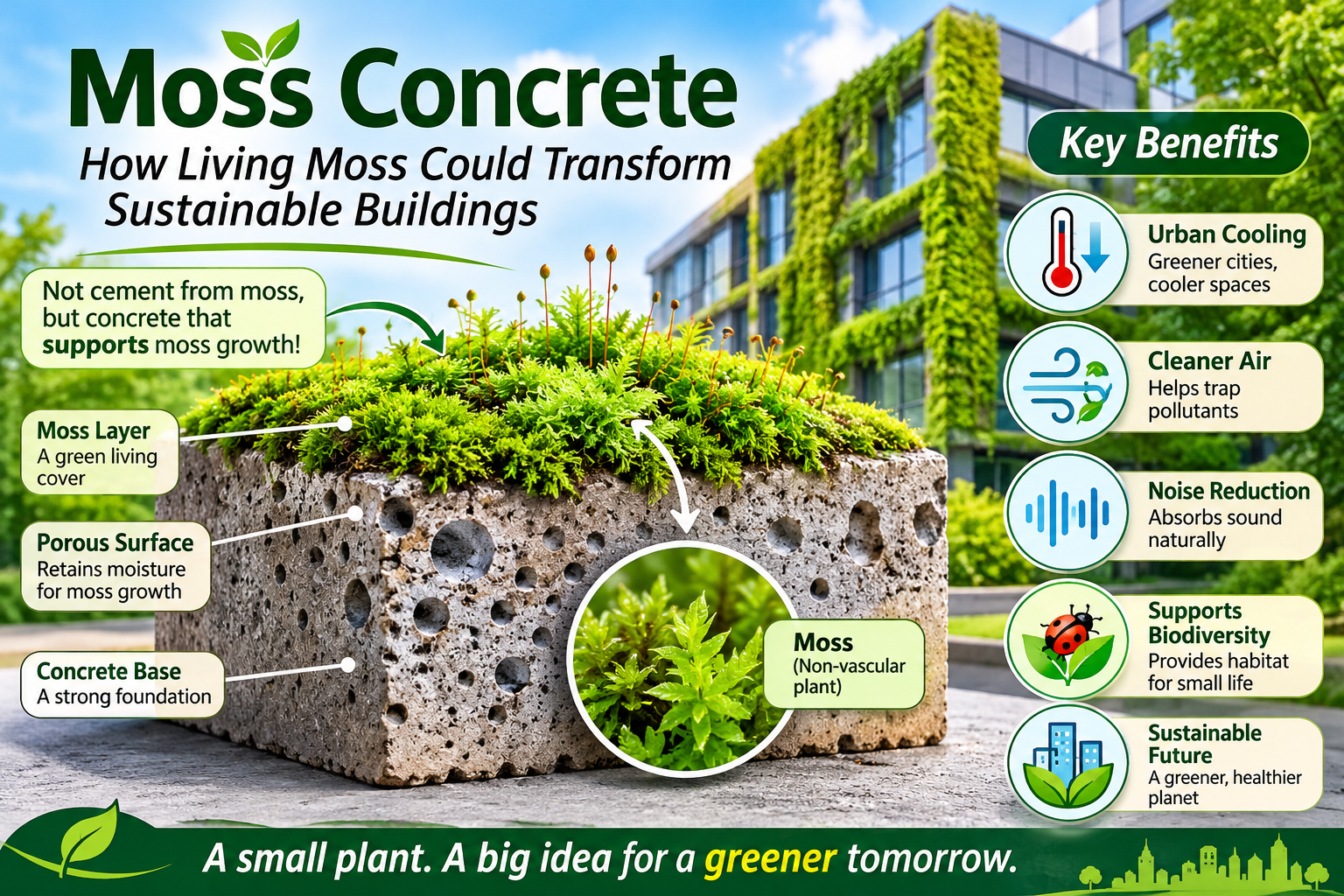
Imagine walking through a city where concrete walls are covered not with paint, tiles or artificial green panels, but with a soft, natural layer of living moss. What if our buildings could become a little greener without needing traditional gardens or large spaces for planting?
Thank you for reading this post, don’t forget to subscribe!This may sound like something from a science-fiction movie, but researchers are exploring exactly this possibility through an innovative material called Moss Concrete or Bio receptive Concrete.
It brings together two seemingly opposite things: the hard, grey world of concrete and the soft, green world of plants.
And the science behind it is fascinating!
1. What Exactly Is Moss Cement?
First, let’s clear up a common misconception.
Moss cement does not mean cement manufactured from moss. Instead, it refers to specially designed cement-based materials that provide suitable conditions for moss to grow on their surfaces.
The scientific term is bio receptive concrete.
The word bio receptive simply means capable of supporting biological growth.
Unlike conventional concrete, which is generally designed to resist biological colonization, bio receptive concrete is engineered to encourage organisms such as mosses to establish themselves on its surface.
The result? A building material that can develop a living green layer.
Research in this field has demonstrated that mosses can grow on specially designed cementitious surfaces when their physical and environmental requirements are met.
2. How Does Moss Grow on Concrete?
You might wonder: mosses normally grow on rocks, tree trunks and damp soil. How can they survive on concrete?
The answer lies in the unique biology of mosses.
Mosses are small, non-vascular plants. Unlike flowering plants, they do not have true roots, stems and leaves with the same complex transport systems.
They absorb water and nutrients largely through their surfaces and depend on environmental moisture for active growth.
This makes them interesting candidates for green building materials.
Scientists modify concrete properties to make the surface more suitable for moss colonization.
Some important factors include:
- Porosity: Small pores help retain moisture.
- Surface texture: A rough surface can provide attachment points.
- Water retention: Moss needs sufficient moisture to remain active.
- Surface chemistry: Concrete’s alkalinity and chemical composition influence biological growth.
- Light and humidity: Environmental conditions determine whether moss can establish and survive.
In simple terms, researchers are trying to turn an ordinary concrete surface into a suitable habitat for moss.
A 2026 study published in Ecological Engineering demonstrated a two-stage approach: growing moss on bio receptive concrete indoors and then gradually adapting it to outdoor conditions.
3. Why Are Scientists Interested in Moss Concrete?
This technology is not just about making buildings look attractive. It could offer several environmental benefits.
A. Greener cities and urban cooling
Urban areas contain large amounts of concrete, asphalt and other heat-absorbing surfaces. This contributes to the Urban Heat Island effect, making cities warmer than surrounding rural areas.
Vegetation can help cool urban environments through shading and evapotranspiration.
Moss-covered surfaces could contribute to greener building envelopes, although their actual cooling benefits under different climatic conditions still need more field testing.
B. Potential air-quality benefits
Mosses have a high surface-area-to-volume ratio and can interact with airborne particles and pollutants.
This makes them interesting for environmental monitoring and research into urban pollution.
However, moss-covered concrete should not be considered a proven solution for removing city-wide air pollution. Its actual pollutant-removal capacity at building scale remains an important research question.
C. Noise reduction
Here is something particularly interesting!
A 2025 study published in Building and Environment investigated the sound-absorption properties of moss growing on bio receptive concrete.
Researchers found that moss-covered concrete absorbed more sound than bare concrete in nearly all tested conditions. Certain moss species performed particularly well at frequencies above 1,000 Hz.
This opens up interesting possibilities for green acoustic barriers along roads and urban infrastructure.
D. Supporting urban biodiversity
Moss-covered surfaces may provide small habitats for microorganisms and other tiny organisms.
They could contribute to more nature-inclusive urban environments, particularly where conventional green spaces are limited.
However, the ecological benefits will depend on the moss species, surrounding environment and long-term survival of the vegetation.
4. Is Moss Concrete a Perfect Sustainable Building Material?
Not quite. Like every emerging technology, moss concrete has challenges that researchers are still trying to solve.
Some of the major limitations include:
- Survival in harsh climates: Extreme heat, prolonged dryness and intense sunlight can affect moss growth.
- Water availability: Although mosses can tolerate periods of drying, they need moisture to grow actively.
- Slow establishment: Natural moss colonization can take years.
- Maintenance: Moss colonies may require suitable moisture, light and surface conditions to survive.
- Long-term durability: Researchers still need to understand how biological growth affects concrete surfaces over many years.
An interesting finding from the 2026 research is that different moss species behave differently. Some grow quickly indoors but struggle outdoors, while others establish more slowly but adapt better to outdoor conditions.
This means selecting the right moss species is just as important as designing the right concrete.
5. Could Moss Concrete Work in India?
India could be an interesting setting for exploring this technology.
Our cities face several interconnected environmental challenges:
- Rising urban temperatures.
- Increasing demand for energy-intensive air conditioning.
- Limited space for conventional urban greenery.
- Growing concerns about urban noise and environmental quality.
Moss-based building surfaces could offer an additional approach to urban greening, particularly on selected building facades, shaded walls, boundary structures and noise barriers.
However, India has diverse climatic conditions. A moss species suitable for a humid region may not survive equally well in the dry and hot conditions of Delhi, Rajasthan or central India.
Therefore, Indian research should focus on:
- Identifying locally adapted moss species.
- Developing concrete mixtures with suitable porosity and moisture retention.
- Testing moss survival under Indian temperature and rainfall conditions.
- Evaluating water requirements and maintenance costs.
- Measuring actual cooling, sound absorption and environmental benefits.
This is where collaboration between botanists, material scientists, civil engineers and environmental researchers could make a real difference.
6. What Does the Future Hold?
Moss concrete represents an interesting shift in how we think about construction materials.
Traditionally, buildings have been designed to keep nature outside. Green roofs, living walls and bio receptive materials are challenging that approach by exploring ways to integrate biological systems into the built environment.
Imagine roadside noise barriers that support moss growth, building facades that provide small ecological habitats, or concrete structures that become part of urban greening strategies.
These possibilities are worth exploring.
But let’s remember one important thing: moss concrete will not replace trees, parks or conventional green infrastructure. Nor will it eliminate the carbon footprint associated with cement production.
Its real value may lie in adding another tool to the growing collection of sustainable construction technologies.
Final Thoughts
Perhaps the future of sustainable architecture will not be about making buildings completely separate from nature. Instead, it may be about designing buildings that allow nature to become a part of them.
Moss concrete is still an emerging technology, but it offers an exciting scientific idea: what if the walls of our cities could become living surfaces rather than just lifeless structures?
Sometimes, the smallest plants can inspire some of the biggest innovations!
References and further reading
- Veeger, M., Ottelé, M. & Jonkers, H.M. (2026). Growing moss on bioreceptive concrete using a novel two-step approach: The effects of light, water, and species selection. Ecological Engineering, 223, 107839.
- Veeger, M., Ottelé, M. & Jonkers, H.M. (2025). Evaluating mosses on bioreceptive concrete: Effective sound absorbers? Building and Environment, 281, 113194.
- Bioreceptive concrete: State of the art and potential benefits (2023).
Leave a Reply