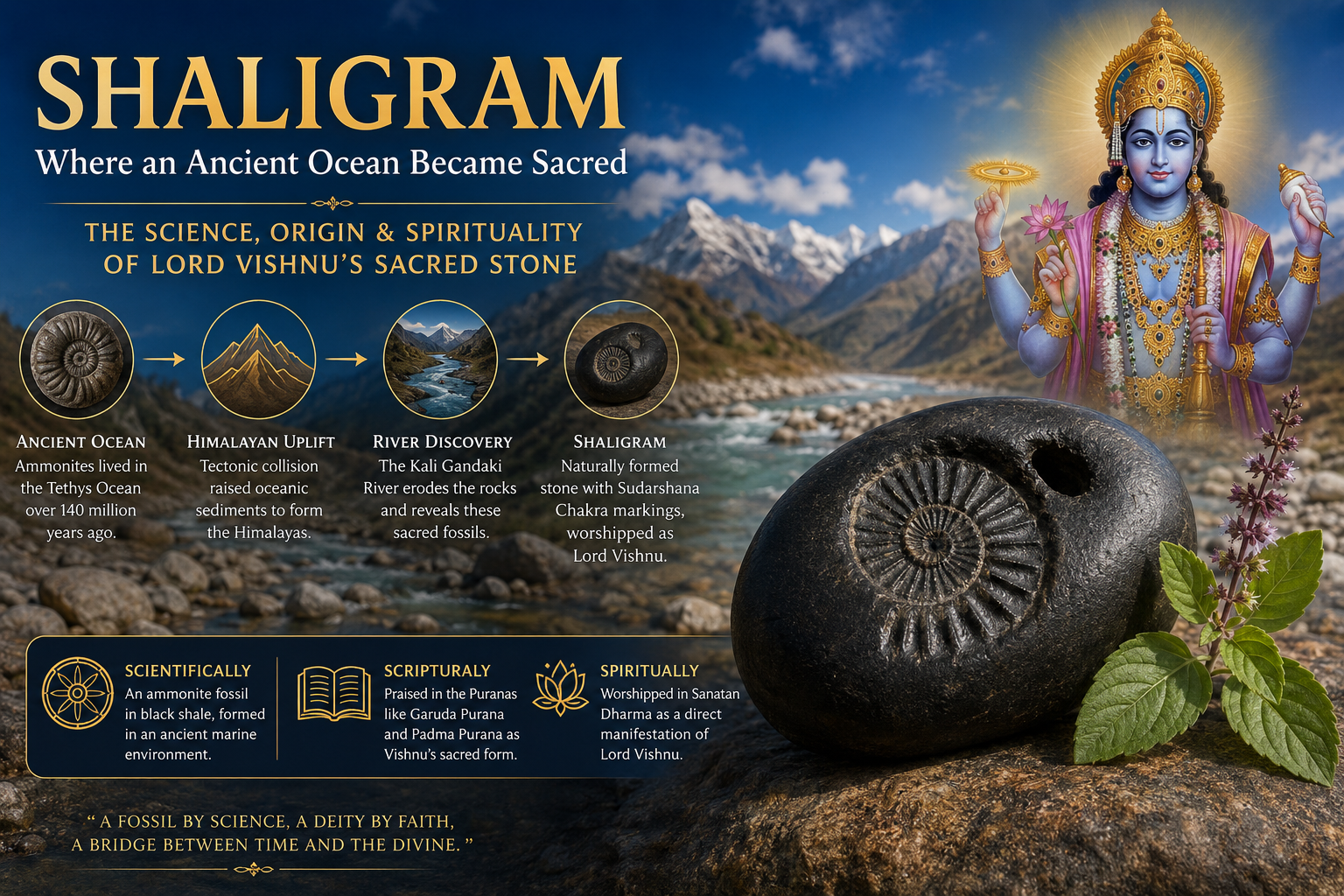
Shaligram: A Stone That Connects an Ancient Ocean, the Himalayas and Lord Vishnu
Thank you for reading this post, don’t forget to subscribe!Few objects in the religious traditions of India present such a fascinating meeting point between science, geology, palaeontology, mythology and spirituality as the Shaligram Shila.
To a geologist, a Shaligram is associated with an extraordinarily old marine world—a fossil-bearing rock containing the remains or impressions of ammonites, extinct marine cephalopods that lived in ancient seas.
To a devotee of Sanatan Dharma, however, the same naturally occurring stone is not merely a fossil. It is Shalagrama Shila, a sacred and naturally manifest form of Bhagwan Vishnu.
And geographically, there is another extraordinary dimension: these fossils originated in sediments deposited in an ancient ocean and are today found in the Himalayas, thousands of metres above sea level.
This raises a remarkable question:
How did the fossil of a marine creature become embedded in the world’s highest mountains—and eventually become one of the most sacred objects of Vaishnava worship?
The answer takes us back more than a hundred million years, to an ocean that existed before the Himalayas were born.
1. What Exactly Is a Shaligram?
A Shaligram, also written Shaligrama or Shalagrama Shila, is a naturally occurring sacred stone associated particularly with the Gandaki/Kali Gandaki River system of Nepal.
Many Shaligrams contain the fossilised remains or impressions of ammonites—extinct marine animals belonging to the cephalopod group.
Ammonites were relatives of modern squid, cuttlefish and nautiluses. They possessed coiled shells, often displaying beautiful spiral structures.
These fossil structures are especially important because the characteristic spiral ribs and internal structures visible on some Shaligrams are traditionally interpreted as manifestations of Vishnu’s Sudarshana Chakra.
Modern palaeontological research confirms the presence of Jurassic ammonite faunas in the Himalayan region, including Nepal.
Thus, the Shaligram represents an extraordinary intersection:
Ancient marine life → fossilisation → Himalayan uplift → river erosion → sacred geography → religious worship.
2. The Scientific Origin: When the Himalayas Were an Ocean
Perhaps the most fascinating fact about Shaligrams is that their story begins long before the Himalayas existed.
The region that is now the Himalayas was once part of the Tethys Ocean, an ancient ocean that existed between major continental landmasses.
During the Jurassic and Early Cretaceous periods, roughly 166–140 million years ago, marine sediments accumulated in parts of the region that would eventually become the Himalayas. The rocks known as the Spiti Shales are among the geological formations associated with this ancient marine environment.
Ammonites inhabited these ancient seas.
When they died, their shells settled on the sea floor. Over enormous periods of geological time:
- Ammonites lived in the ancient ocean.
- Their shells sank after death.
- They became buried beneath sediments.
- Pressure and chemical processes transformed the sediments into rock.
- Their shells and impressions became preserved as fossils.
- The Indian Plate moved northward.
- India collided with Eurasia.
- Marine sediments were folded, compressed and uplifted.
- The Himalayas emerged.
- Rivers subsequently eroded the rocks and exposed fossil-bearing material.
So, in a very literal geological sense:
A Shaligram is a fragment of an ancient ocean preserved within the mountains created by continental collision.
3. But Why Are Marine Fossils Found in the Himalayas?
This is perhaps the most spectacular scientific aspect of the Shaligram story.
If ammonites lived in the sea, why are their fossils now found in the Himalayas?
The answer lies in plate tectonics.
The Indian subcontinent was once connected to the southern supercontinent Gondwana. Over geological time, the Indian Plate separated and began moving northwards.
Between India and Eurasia lay the Tethys Ocean.
As the Indian Plate moved north, the ocean gradually narrowed. Eventually, India collided with the Eurasian Plate.
This collision caused enormous deformation of the Earth’s crust.
Marine sediments deposited on the ancient seabed were:
- compressed,
- folded,
- faulted,
- uplifted,
- and incorporated into the growing Himalayan mountain system.
The Himalayas are therefore not simply a collection of rocks formed on land. They contain a geological record of an ancient marine environment.
Scientific studies of Himalayan ammonites have documented Jurassic marine faunas in Nepal and the broader Himalayan belt.
This makes the Shaligram almost like a geological time capsule.
4. Why Are Shaligrams Found Particularly in the Kali Gandaki?
The Kali Gandaki River cuts through Himalayan terrain containing fossil-bearing geological formations.
As the river flows through the mountains, it continuously erodes rocks.
Some fossil-bearing rocks are broken away from the surrounding formations and carried downstream.
The continuous action of:
- water,
- sediment,
- abrasion,
- weathering,
- and transportation
gradually produces smooth, rounded stones.
This is why Shaligrams are traditionally collected from the river environment rather than manufactured by humans.
The Kali Gandaki valley of Mustang has consequently become the central geographical source of Shaligrams and an important pilgrimage landscape. Academic research describes Shaligrams as originating from this particular Himalayan region and notes their long-standing religious importance.
5. Why Is Shaligram Black?
The characteristic black or dark colour of many Shaligrams has an interesting geological explanation.
The fossil-bearing rocks associated with Shaligrams include dark, organic-rich sedimentary rocks, particularly black shale.
Black shale can form in marine environments where oxygen levels are very low. Under such conditions, organic material can be preserved rather than completely decomposed.
The accumulation of organic carbon contributes to the dark colour of the rock.
The Bristol Dinosaur Project explains that the black shale associated with the Shaligram-bearing geological sequence formed under very low-oxygen underwater conditions, allowing organic carbon to accumulate and produce the characteristic dark colour.
Therefore, the black colour does not require a supernatural explanation from a geological perspective.
At the same time, its blackness acquired profound symbolic meaning within Hindu thought.
Black and dark forms of Vishnu and Krishna have deep associations within Vaishnava traditions, and the dark, naturally occurring stone became especially compatible with the theological understanding of Vishnu’s presence.
6. What Is an Ammonite?
To understand Shaligram scientifically, we need to understand the animal preserved within it.
Ammonites were marine molluscs belonging to the subclass Ammonoidea.
They lived in Earth’s oceans for hundreds of millions of years before becoming extinct at the end of the Cretaceous Period, approximately 66 million years ago.
Their most recognisable feature was their spirally coiled shell.
When their shells became fossilised, their internal structures could leave distinctive patterns.
These patterns are particularly important in Shaligrams because they can resemble a circular wheel.
And that leads directly into the religious interpretation.
7. The Scientific Spiral and the Sudarshana Chakra
One of the most beautiful connections between science and tradition is the interpretation of fossil markings.
The internal ribs and structures of ammonite fossils can create radial patterns.
To a palaeontologist, these are anatomical and fossil structures.
To a Vaishnava devotee, a circular radial marking may resemble Sudarshana Chakra, the divine discus of Vishnu.
The Natural History Museum notes that the radial markings in saligrams are associated with ammonite ribs and that these are traditionally understood as representations of Vishnu’s chakra.
This provides an extraordinary example of how humans interpret natural forms through cultural and religious symbolism.
The fossil did not have to be carved into a wheel.
Nature itself appeared to have created the symbol.
For the devotee, this is precisely part of the sacredness of the Shaligram.
8. Why Is Shaligram Considered a Form of Vishnu?
This is where science ends and theology begins.
Science can explain:
- what the stone is,
- what fossils it contains,
- how the rock formed,
- why it is black,
- how the Himalayas uplifted,
- and how the river exposed it.
Science cannot experimentally establish the theological proposition that the stone is Bhagwan Vishnu.
That is a matter of religious belief and sacred tradition.
Within Vaishnavism, however, the Shaligram is not merely considered a symbol of Vishnu.
It is traditionally regarded as a naturally manifest form of Vishnu himself.
This distinction is extremely important.
A conventional idol is normally shaped by human hands and ritually consecrated.
A Shaligram, by contrast, is revered because it is naturally formed.
Academic research on Shaligram worship observes that practitioners can simultaneously understand the stone as a fossil, a sacred object and a divine presence.
This makes Shaligram worship particularly distinctive in Hindu religious practice.
9. The Pauranic Story: Vishnu, Tulasi and the Gandaki
The scientific story is fascinating, but the Pauranic story is equally compelling.
There are several versions of the Shaligram origin story across Hindu traditions, and they should not be treated as one single universally identical narrative.
One prominent tradition connects Shaligram with Tulasi/Vrinda and the Gandaki River.
According to versions of the story, Vrinda was an extraordinarily devoted and chaste woman whose spiritual power became central to the conflict involving her husband, Jalandhara.
Through a divine episode involving Vishnu, Vrinda’s chastity was broken. When she discovered what had happened, she became deeply distressed and cursed Vishnu to become stone.
Vishnu accepted the curse.
He manifested in the region of the Gandaki River as the sacred Shaligram.
In some versions, Tulasi herself became the sacred Tulasi plant, thereby establishing an eternal relationship between:
Tulasi → Vishnu → Shaligram → Gandaki.
The details vary considerably among textual and regional traditions. Scholars of Shaligram mythology specifically note that there are multiple origin narratives, including stories involving Tulasi and the Vajra-kita, the legendary “thunderbolt worm.”
10. The Vajra-kita: The Mythological “Worm” That Carves the Stone
Here the Puranic imagination becomes particularly interesting from a modern scientific perspective.
Traditional stories describe a creature called Vajra-kita—literally associated with a powerful or diamond-like worm—that creates the distinctive marks or holes in Shaligrams.
The traditional imagery is striking because ammonite fossils really do contain complex structures and openings that can appear as though something has carved them.
Older descriptions of Shaligram traditions even describe them as stones perforated by insects or worms.
Modern palaeontology, of course, explains the markings through:
- fossilised ammonite anatomy,
- shell structure,
- mineral replacement,
- weathering,
- erosion,
- and geological processes.
But the Vajra-kita story remains religiously meaningful because it provides a mythological explanation for why the stones bear seemingly deliberate marks.
It is a fascinating example of how an ancient culture interpreted a natural geological phenomenon through sacred narrative.
11. The Garuda Purana and the Sacred Status of Shalagrama
The importance of Shalagram is not merely a modern Vaishnava practice.
Traditional Hindu literature gives the stone a very high sacred status.
A passage cited from the Garuda Purana states that among places in which the Lord may be worshipped, the Shalagrama is considered especially significant. This tradition is discussed in contemporary scholarship on Shaligram pilgrimage and religion.
The Padma Purana likewise contains extensive discussions of Gandaki and Shalagrama worship.
One passage describes the sacredness of the Gandaki region and associates Shalagrama stones with Vishnu.
The importance assigned to Shalagrama therefore developed within a much larger sacred geography involving:
- Gandaki,
- Himalaya,
- Vishnu,
- Tulasi,
- pilgrimage,
- sacred rivers,
- and moksha.
12. Why Is Shaligram Worship So Important in Sanatan Dharma?
The answer lies partly in the Hindu understanding of divine presence in nature.
Sanatan Dharma does not always require the divine to be represented through a human-shaped statue.
The sacred may be encountered through:
- rivers,
- mountains,
- trees,
- plants,
- animals,
- stones,
- natural formations,
- and sacred landscapes.
Shaligram represents this idea in an exceptionally concentrated form.
It is:
nature + time + fossil + mountain + river + mythology + devotion.
A devotee therefore does not necessarily see a contradiction between:
“This is an ammonite fossil.”
and
“This is Vishnu.”
They belong to different levels of understanding.
The first is a scientific description.
The second is a religious and theological relationship.
Modern anthropological scholarship on Shaligram specifically notes that practitioners can understand Shaligrams simultaneously as ammonites, stones and deities rather than treating these categories as mutually exclusive.
13. Why Is It Worshipped Without Being Carved?
This is perhaps the most remarkable aspect of Shaligram worship.
The stone is not manufactured into the image of Vishnu.
There is no sculptor.
No chisel creates the chakra.
No artist paints the markings.
No human hand creates its basic form.
It emerges from geological processes.
This makes the Shaligram an example of an aniconic or non-anthropomorphic representation of divinity.
In many Vaishnava traditions, the natural form itself is considered sufficient for worship.
The sacredness is therefore not dependent upon artistic perfection.
The mountain is the sculptor.
The river is the polisher.
Geological time is the craftsman.
That is perhaps one of the most poetic ways to understand Shaligram.
14. Why Is Tulasi Offered to Shaligram?
The relationship between Tulasi and Vishnu is deeply embedded in Vaishnava practice.
Tulasi is regarded as especially dear to Vishnu.
The Padma Purana contains extensive passages celebrating the sacred status of Tulasi and her association with Vishnu.
Consequently, in many households where Shalagram is worshipped, Tulasi leaves are offered to the Shalagram.
This ritual brings together the two dimensions of the Puranic story:
Tulasi → devotion and sacred plant
Shaligram → Vishnu
The ritual therefore becomes more than an offering of a leaf.
It symbolically reunites two sacred manifestations.
15. Why Are There Different Types of Shaligrams?
Traditional Shalagram classification is remarkably elaborate.
Different stones may have different:
- shapes,
- sizes,
- colours,
- openings,
- spiral markings,
- fossil structures,
- and surface patterns.
Traditional texts and later manuals classify these characteristics and associate particular forms with different manifestations of Vishnu.
Some markings are interpreted as:
- Chakra — discus
- Shankha — conch
- Gada — mace
- Padma — lotus
The classification is religious rather than a modern geological taxonomy.
Scientifically, differences can arise from different ammonite species, fossil preservation, orientation, mineralisation and erosion.
Research on Himalayan ammonites has documented multiple ammonite genera and assemblages in the region, helping explain why fossil forms can vary substantially.
16. Shaligram and the Passage of Geological Time
Think about the timescale involved.
A human life may last approximately 70–100 years.
Recorded human civilisation extends over several thousand years.
But the ammonite fossils associated with Shaligrams can be more than 140 million years old.
The Himalayas themselves began their major uplift tens of millions of years ago.
The river continues to erode the mountains today.
Thus, when a person holds a Shaligram, they may literally be holding a piece of Earth’s deep geological history.
It has passed through:
Ancient ocean → burial → fossilisation → continental collision → Himalayan uplift → erosion → river → human hands → sacred altar.
That is an extraordinary journey.
17. Is Every Black Stone from the Himalayas a Shaligram?
No.
This distinction is important.
The religious term Shaligram has a specific geographical and traditional meaning.
Not every black stone is a Shaligram.
Nor is every fossil-bearing stone necessarily regarded as an authentic Shaligram according to traditional criteria.
Similarly, commercially marketed stones may sometimes be labelled “Shaligram” without reliable provenance.
From a scientific perspective, identification should ideally consider:
- geological context,
- fossil morphology,
- rock type,
- provenance,
- and palaeontological characteristics.
From a religious perspective, devotees may additionally rely upon traditional characteristics and lineage-based knowledge.
18. Science Does Not “Disprove” Shaligram Worship
An important point is often missed in discussions about science and religion.
If palaeontology demonstrates that a Shaligram contains an ammonite fossil, it does not scientifically demonstrate that Vishnu is absent from it.
Science answers questions such as:
What is this object physically?
Religion asks questions such as:
What does this object mean?
How should human beings relate to it?
What does it represent spiritually?
Can nature itself be a manifestation of the divine?
These are not necessarily identical questions.
A person can accept the geological explanation of a Shaligram and still worship it as Vishnu.
Indeed, contemporary scholarship on Shaligrams explicitly observes that the categories of fossil, stone and deity can coexist within devotees’ understanding.
19. The Shaligram as a Symbol of the Hindu Idea of Nature
Perhaps the deeper philosophical significance of Shaligram lies here.
Modern civilisation often divides the world into:
nature vs. culture
matter vs. spirit
science vs. religion
object vs. subject
Shaligram challenges these divisions.
It is a natural object.
Yet it is worshipped as a divine presence.
It is a fossil.
Yet it participates in living religious practice.
It belongs to geological time.
Yet it exists within human ritual time.
It comes from a river.
Yet it becomes part of a household shrine.
It is scientifically explainable.
Yet its religious meaning cannot be exhausted by scientific description.
This is why the Shaligram is much more than an interesting fossil.
It is a profound example of sacred nature.
20. The Journey of a Shaligram in One Diagram
The entire story can be understood as a remarkable geological and cultural sequence:
Ancient Tethys Ocean
↓
Ammonites live and die
↓
Shells buried in marine sediments
↓
Fossilisation over millions of years
↓
Indian Plate moves north
↓
India–Eurasia collision
↓
Marine sediments uplifted into Himalayas
↓
Rivers erode fossil-bearing rocks
↓
Kali Gandaki exposes and transports fossils
↓
Naturally shaped black fossil stones emerge
↓
Traditional identification as Shalagrama
↓
Associated with Sudarshana Chakra and Vishnu
↓
Worship in Vaishnava households and temples
It is difficult to imagine a better example of how Earth history can become cultural history.
21. Why Shaligram Remains Relevant in the Modern Scientific Age
The Shaligram does not belong only to the past.
Its relevance may actually be increasing.
In an age of climate change, biodiversity loss and ecological degradation, the Shaligram offers an ancient reminder:
Human beings are not separate from the natural world.
A stone worshipped as Vishnu can be interpreted as a cultural expression of the idea that the natural world possesses sacred value.
The mountain is sacred.
The river is sacred.
The fossil is sacred.
The landscape is sacred.
This worldview can potentially encourage a deeper ecological ethic.
The Kali Gandaki landscape itself has become an important pilgrimage and cultural environment, and contemporary scholarship has examined the relationship between Shaligram worship, pilgrimage, landscape and environmental pressures.
22. Shaligram: Where Science and Spirituality Meet
The most fascinating thing about Shaligram is not that science and religion give the same explanation.
They do not.
Science tells us that Shaligrams are associated with ancient marine fossils preserved in Himalayan rocks.
Geology tells us that the Himalayas contain rocks formed from sediments deposited in ancient seas.
Palaeontology tells us that ammonites once inhabited those seas.
Plate tectonics explains how those marine rocks reached the mountains.
River erosion explains how fossils became exposed.
But Sanatan Dharma gives the object another dimension.
It says:
This naturally formed stone is a manifestation of Vishnu.
The spiral becomes Sudarshana Chakra.
The Gandaki becomes a sacred river.
The Himalayas become a sacred landscape.
The fossil becomes Shalagrama Shila.
And the act of holding a piece of ancient Earth becomes an act of darshana and devotion.
23. The Deeper Meaning: An Ocean Preserved in a Mountain
Perhaps the most beautiful way to understand Shaligram is to see it as a story of transformation.
An animal once lived in an ocean that no longer exists.
Its shell became buried.
The ocean disappeared.
The land moved.
Continents collided.
Mountains rose.
The fossil remained.
A river exposed it.
Human beings discovered it.
And a civilisation gave it sacred meaning.
So the Shaligram carries several histories simultaneously:
The history of an animal.
The history of an ocean.
The history of the Indian Plate.
The history of the Himalayas.
The history of the Gandaki River.
The history of Hindu pilgrimage.
The history of Vaishnava devotion.
That is what makes it so extraordinary.
Conclusion: The Fossil That Became a Deity
The Shaligram is one of those rare objects where deep time and human faith meet in a single stone.
Scientifically, it opens a window into an ancient marine ecosystem and the geological processes that transformed the floor of an ocean into the Himalayas.
Religiously, it is revered as Shalagrama Shila—the naturally manifest presence of Lord Vishnu.
Puranic traditions connect it with Vishnu, Tulasi, the Gandaki River and the mysterious Vajra-kita. The characteristic markings of ammonite fossils became associated with Vishnu’s Sudarshana Chakra, creating a remarkable convergence between natural form and sacred symbolism.
And perhaps that is the greatest lesson of the Shaligram.
It reminds us that the Earth has a memory.
A mountain can contain an ocean.
A stone can contain the memory of an extinct creature.
A river can uncover geological history.
And a civilisation can look at that same stone and see the Divine.
Whether one approaches Shaligram as a fossil, a geological specimen, a sacred object, or a manifestation of Vishnu, its story is undeniably extraordinary.
The Shaligram is, in one sense, an ammonite fossil.
In another, it is a geological time capsule.
In the Hindu spiritual imagination, it is Vishnu himself.
And perhaps its deepest beauty lies precisely in the fact that all three ways of seeing it can exist together.
Leave a Reply